MMBF5485 vs FDMA905P: Component Comparison for Power Electronics Engineers
Quick verdict
For low-current, high-frequency RF switching or small-signal amplification up to 400 MHz, the MMBF5485 JFET is the clear choice due to its RF-optimized design and low noise figure. For power switching applications requiring high continuous current (up to 10 A) at voltages up to 12 V, the FDMA905P P-channel MOSFET offers much higher current capability, low R_DS(on), and better thermal dissipation, making it suitable for DC/DC converters and load switching.
Spec comparison table
| Spec | MMBF5485 | FDMA905P | Notes |
|---|---|---|---|
| Configuration | N-Channel JFET | P-Channel MOSFET | Different transistor types; FDMA905P suitable for high current switching, MMBF5485 for RF. |
| Current rating (continuous) | 10 mA | 10 A | FDMA905P supports 1000× higher current, critical for power applications. |
| Frequency (max) | 400 MHz | Not specified (power MOSFET) | MMBF5485 is RF-capable; FDMA905P is not designed for RF switching. |
| Gain | Not specified | Not specified | Gain not provided; MMBF5485 likely has small-signal gain, FDMA905P is a power switch. |
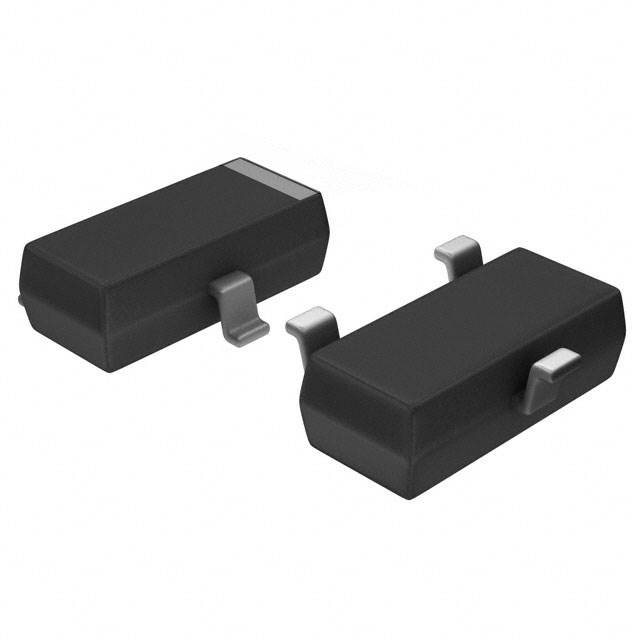
| Mounting type | Surface Mount (SOT-23-3) | Surface Mount (6-WDFN 2x2) | FDMA905P’s exposed pad improves thermal dissipation. |
| Noise figure | 4 dB | Not specified | 4 dB noise figure in MMBF5485 useful in low noise RF front ends. |
| Output power (max) | Not specified | Not specified | No direct output power rating; inferred from current and voltage ratings. |
| Package case | TO-236-3, SC-59, SOT-23-3 | 6-WDFN Exposed Pad | FDMA905P’s package is optimized for low thermal resistance and power dissipation. |
| Voltage rated | 25 V (max) | 12 V (max) | MMBF5485 has higher voltage rating, but low current capability limits power use. |
| Voltage test | 15 V (test voltage) | N/A | Test voltage is a characterization detail. |
| Gate charge (Q_g max) | N/A | 29 nC @ 6 V | Gate charge affects switching speed and gate drive power; FDMA905P requires moderate gate drive. |
| Gate-source voltage max | N/A | ±8 V | FDMA905P’s gate voltage rating limits drive voltage range. |
| Input capacitance (C_iss) | N/A | 3405 pF @ 6 V | FDMA905P input capacitance affects switching losses and gate drive requirements. |
| R_DS(on) max @ 10A, 4.5V | N/A | 16 mΩ | Low R_DS(on) means lower conduction losses; not comparable for MMBF5485. |
| Threshold voltage (V_GS_th) | N/A | 1 V @ 250 µA | FDMA905P’s threshold voltage is typical for logic-level MOSFETs. |
| Power dissipation max (Ta) | N/A | 2.4 W | FDMA905P can dissipate significant power; MMBF5485 not specified, likely very low. |
| Operating temperature range | Not specified | -55°C to 150°C (TJ) | FDMA905P rated for wide temperature range, suitable for harsh environments. |
| Technology | JFET | MOSFET (Metal Oxide) | Different device physics and application domains. |
Design trade-offs
The MMBF5485 is a JFET optimized for RF applications up to 400 MHz, with a low noise figure of 4 dB and a modest voltage rating of 25 V. Its current capability is extremely limited at 10 mA, reflecting its small-signal nature. This device is intended for front-end amplification or RF switching, where low noise and high-frequency operation matter more than power handling.
In contrast, the FDMA905P is a power P-channel MOSFET designed for DC applications with continuous drain current up to 10 A and a max drain-source voltage of 12 V. Its 16 mΩ R_DS(on) at 10 A and 4.5 V gate drive voltage indicates it can handle significant conduction currents with moderate losses. The 6-WDFN package with exposed pad improves thermal management, allowing up to 2.4 W dissipation in typical ambient conditions.
From a gate drive perspective, the FDMA905P requires a drive voltage up to ±8 V maximum, with a typical V_GS(th) of 1 V, making it compatible with common logic-level signals but requiring careful gate drive design to minimize switching losses caused by its 29 nC gate charge. The MMBF5485, being a JFET, has inherently different gate drive requirements (usually zero gate current), simplifying drive circuitry at high frequencies but not suitable for power switching.
Thermal considerations heavily favor the FDMA905P for power applications. The MMBF5485’s SOT-23 package and low current rating limit it to signal-level power dissipation, while the FDMA905P’s exposed pad and 2.4 W rating allow it to be used in power regulation or load switching with appropriate PCB thermal design.
Cost-wise, the MMBF5485 is likely cheaper per unit due to its simpler construction and smaller die size, but this is offset by its narrow application scope. The FDMA905P’s advanced 6-MicroFET technology and larger die area for low R_DS(on) increases cost but is justified by its power handling.
Layout sensitivity is different: MMBF5485 requires careful RF layout to maintain performance at 400 MHz, including controlled impedance and minimal parasitic capacitance/inductance. FDMA905P layout focuses on minimizing thermal resistance, ensuring good copper area under the exposed pad, and minimizing parasitic inductance in the power path.
Use-case fit
Choose MMBF5485 when…
- Designing low-noise RF front-end amplifiers or switches operating near 400 MHz.
- Implementing small-signal analog switches or buffers requiring minimal noise figure.
- Operating in voltage ranges up to 25 V but with current limited to tens of milliamps.
- Requiring a compact SOT-23 package for space-constrained high-frequency designs.
- Needing a JFET device for linear or analog applications where MOSFET gate capacitance is problematic.
Choose FDMA905P when…
- Designing DC/DC converters, load switches, or power regulators handling currents up to 10 A.
- Implementing P-channel MOSFET high-side switches with 12 V rails.
- Needing low conduction losses with R_DS(on) as low as 16 mΩ at 10 A.
- Requiring robust thermal management with a package optimized for heat dissipation.
- Working within automotive or industrial temperature ranges (-55°C to 150°C junction).
Drop-in compatibility
These devices are not pin- or footprint-compatible. The MMBF5485 is a 3-pin SOT-23 (TO-236-3) package JFET, while the FDMA905P is a 6-pin 2x2 mm 6-WDFN with an exposed pad. Besides physical footprint, their electrical characteristics and pin functions differ completely due to device type and application domain. Substituting one for the other would require a redesign of the PCB footprint, gate drive circuitry, and likely the entire application block.
Alternatives to consider
- BSS138 (N-Channel MOSFET SOT-23): For low-voltage, low-current switching where a MOSFET is preferred over a JFET.
- FDMS86100 (P-Channel MOSFET 30 V, 6 mΩ): For higher voltage and lower R_DS(on) power switching applications than FDMA905P.
- J310 (N-Channel JFET, RF applications): An alternative JFET for RF circuits with similar frequency and low noise requirements as MMBF5485.