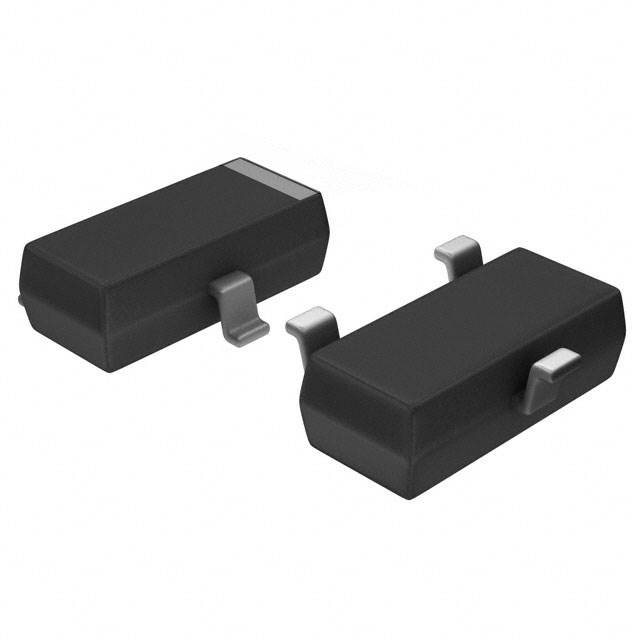
MMBF5485 vs FDC6321C: Component Comparison for Power Electronics Design
Quick verdict
For RF and low-current analog switching or signal amplification up to 400 MHz, the MMBF5485 is the clear choice due to its JFET architecture and low noise figure. For general-purpose DC load switching or logic-level MOSFET switching at currents up to several hundred milliamps, the FDC6321C is a better fit thanks to its higher current rating, integrated dual N- and P-channel MOSFETs, and logic-level gate drive.
Spec comparison table
| Spec | MMBF5485 | FDC6321C | Notes |
|---|---|---|---|
| Configuration | N-Channel JFET | N- and P-Channel MOSFET Array | FDC6321C offers complementary MOSFET pairs, enabling half-bridge or push-pull stages. |
| Current rating (continuous) | 10 mA | 680 mA (N), 460 mA (P) | FDC6321C supports ~50x higher current, suitable for load switching; MMBF5485 is signal-level only. |
| Frequency (fT) | 400 MHz | Not specified | MMBF5485 is designed for RF applications; FDC6321C is not intended for RF use. |
| Noise figure | 4 dB | Not specified | MMBF5485’s noise figure suits low-noise RF front-ends; FDC6321C lacks noise specs. |
| Output power max | Not specified | 700 mW | FDC6321C can handle modest power dissipation; MMBF5485 not rated for power handling. |
| Voltage rating (Vds max) | 25 V | 25 V | Both support typical low-voltage applications; no advantage either way. |
| Voltage test | 15 V | Not specified | MMBF5485 tested at 15 V; FDC6321C does not specify test voltage explicitly. |
| Mounting type | SOT-23-3 | SuperSOT-6 (TSOT-23-6) | FDC6321C’s 6-pin package offers more functionality but larger footprint than SOT-23-3. |
| Package case | TO-236-3 / SC-59 / SOT-23-3 | TSOT-23-6 | MMBF5485 has smaller 3-pin package; FDC6321C’s 6-pin package integrates two devices. |
| Technology | JFET | MOSFET (Metal Oxide) | JFET for analog/RF; MOSFET for digital/ power switching. |
| Gate charge (Qg max) @ Vgs | Not specified | 2.3 nC @ 5 V | FDC6321C’s low gate charge supports fast switching; MMBF5485 not characterized here. |
| Input capacitance (Ciss max) @ Vds | Not specified | 50 pF @ 10 V | FDC6321C input capacitance is low for MOSFETs, enabling faster switching. |
| Rds(on) max @ Id, Vgs | Not specified | 450 mΩ @ 500 mA, 4.5 V | FDC6321C’s on-resistance defines conduction losses; MMBF5485 not specified for on-resistance. |
| Threshold voltage (Vgs_th max) | Not specified | 1.5 V @ 250 µA | FDC6321C supports logic-level gate drive; MMBF5485 JFET gate bias differs fundamentally. |
| Operating temperature range (TJ) | Not specified | -55°C to 150°C | FDC6321C specifies extended temp range; MMBF5485 datasheet does not specify. |
Design trade-offs
The MMBF5485 is a discrete N-channel JFET optimized for RF signal amplification and switching at frequencies up to 400 MHz. Its low noise figure (4 dB) and low current capability (10 mA max) make it suitable for low-level analog signals rather than power switching. The JFET input gate structure implies very high input impedance and no gate drive current, but it requires biasing circuits different from MOSFETs, complicating gate drive and limiting digital interfacing.
In contrast, the FDC6321C is a dual MOSFET array integrating both N- and P-channel devices in a single SuperSOT-6 package. With continuous drain currents of 680 mA and 460 mA respectively, it targets low-voltage DC load switching and small power conversion tasks. Its logic-level gate drive threshold (1.5 V max) and low gate charge (2.3 nC at 5 V) enable efficient switching with low gate driver losses. The specified on-resistance (450 mΩ at 500 mA, 4.5 V gate drive) indicates modest conduction losses, suitable for low to moderate currents.
Thermal considerations differ: MMBF5485’s low current rating and lack of power dissipation data suggest it cannot handle significant thermal stress, limiting use to signal-level applications. FDC6321C’s 700 mW power dissipation rating and higher current capacity mean it can handle more thermal load, but PCB layout must ensure adequate thermal vias and copper area, especially when operating near max current or switching at high frequency.
From a layout perspective, MMBF5485’s 3-pin SOT-23 package is compact and simpler to route but requires careful biasing and RF layout techniques to minimize parasitic capacitances and noise pickup. FDC6321C’s 6-pin SuperSOT package requires more board space but integrates complementary MOSFETs, enabling half-bridge or push-pull circuits in compact form. The MOSFET technology also allows for more straightforward gate drive with standard microcontroller or driver IC signals.
Cost at volume is generally lower for MOSFET arrays like FDC6321C due to integration and widespread usage in switching applications; however, specialized JFETs such as MMBF5485 may carry a premium due to niche RF use and lower production volumes.
Use-case fit
Choose MMBF5485 when…
- Designing low-noise RF front-ends or mixers requiring low gate noise and high input impedance.
- Implementing analog switches or amplifiers at frequencies up to 400 MHz with very low signal currents (up to 10 mA).
- Requiring JFET technology for linearity or specific analog characteristics that MOSFETs cannot provide.
- Working in circuits where the low gate drive current and noise figure are critical, such as sensor interfaces or instrumentation.
- Space is tight and a 3-pin SOT-23 package with minimal pin count is preferred over functionality.
Choose FDC6321C when…
- Building low-voltage, low-current DC load switches or drivers requiring up to several hundred milliamps continuous current.
- Implementing complementary push-pull stages or half-bridge drivers in small-signal power conversion or motor control.
- Needing logic-level gate drive compatibility with microcontrollers or FPGAs without additional gate drivers.
- Optimizing switching efficiency with low gate charge and acceptable on-resistance at moderate currents.
- Operating in wide temperature ranges (-55°C to 150°C junction) with integrated dual devices in a single package to save board space.
Drop-in compatibility
The MMBF5485 and FDC6321C are not pin-compatible or footprint-compatible. The MMBF5485 is a 3-pin JFET in SOT-23-3, whereas the FDC6321C is a 6-pin dual MOSFET array in a SuperSOT-6 (TSOT-23-6) package. Substituting one for the other requires a redesign of the PCB footprint and likely the surrounding circuit, especially gate drive and biasing networks. The differing device technologies (JFET vs MOSFET) also mean driver circuits and expected behavior will not be interchangeable.
Alternatives to consider
- BSS138 (N-Channel MOSFET, SOT-23): Widely used logic-level MOSFET with higher current rating (~200 mA) than MMBF5485, suitable for low-voltage switching.
- 2N7002 (N-Channel MOSFET, SOT-23): Similar to BSS138 but typically with better Rds(on) and current handling for general-purpose switching.
- BSS84 (P-Channel MOSFET, SOT-23): Complementary to N-channel MOSFETs like 2N7002, useful for push-pull or level shifting in small-signal circuits.