MMBF5485 vs EPC2001C: Component Comparison for Power Electronics Engineers
Quick verdict
For low-power RF or signal-level switching up to a few milliamps at high frequency, the MMBF5485 is the better choice due to its JFET technology optimized for 400 MHz operation and low noise figure. For high-current power conversion, where high voltage, low R_DS(on), and fast switching matter, the EPC2001C GaN FET dominates, handling continuous currents up to 36 A and blocking 100 V with extremely low conduction losses.
Spec comparison table
| Spec | MMBF5485 | EPC2001C | Notes |
|---|---|---|---|
| Configuration | N-Channel JFET | N-Channel GaN FET | Both N-channel; EPC2001C uses GaN, enabling higher voltage and current capability. |
| Current rating (continuous) | 10 mA | 36 A (Ta) | EPC2001C supports 3600x higher current; MMBF5485 limited to signal-level currents. |
| Frequency | 400 MHz | Not specified | MMBF5485 is optimized for RF; EPC2001C not specified for RF but designed for power. |
| Gain | Not specified | Not specified | No direct gain data; MMBF5485 is a JFET, often used for low-noise gain stages. |
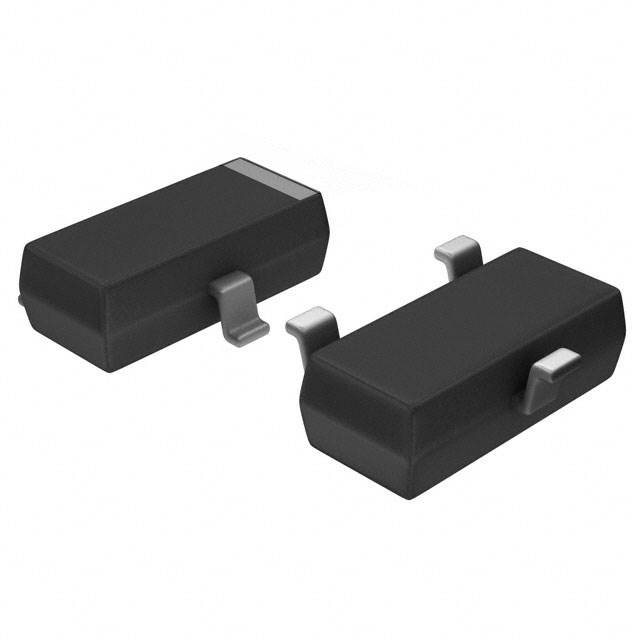
| Mounting type | Surface Mount (SOT-23-3) | Surface Mount (Die) | MMBF5485 comes in standard SOT-23-3; EPC2001C is bare die, affecting assembly. |
| Noise figure | 4 dB | Not specified | MMBF5485’s 4 dB noise figure suits low-noise RF front ends; EPC2001C not marketed for noise. |
| Output power max | Not specified | Not specified | No data for comparison. |
| Package case | TO-236-3, SC-59, SOT-23-3 | Die | SOT-23-3 is easy for standard PCB assembly; die requires specialized packaging. |
| Voltage rating (V_DS max) | 25 V | 100 V | EPC2001C supports 4x higher voltage, enabling use in higher voltage power systems. |
| Voltage test | 15 V | Not specified | Test voltage less relevant than rating. |
| Gate charge (Q_G) | Not specified | 9 nC @ 5 V | EPC2001C’s gate charge is low for a power MOSFET, enabling fast switching. |
| Gate-source voltage max | Not specified | +6 V / -4 V | EPC2001C has defined V_GS limits; MMBF5485 datasheet does not specify. |
| Input capacitance (C_iss) | Not specified | 900 pF @ 50 V | EPC2001C’s input capacitance is moderate for a power device, impacting gate drive. |
| R_DS(on) max | Not specified | 7 mΩ @ 25 A, 5 V | EPC2001C has extremely low R_DS(on), critical for efficiency in power applications. |
| Threshold voltage (V_GS_th) | Not specified | 2.5 V @ 5 mA | EPC2001C requires typical gate drive above 2.5 V to fully enhance. |
| Operating temperature range | Not specified | -40°C to 150°C (TJ) | EPC2001C supports wide temp range; MMBF5485 data not provided. |
Design trade-offs
The MMBF5485 is a low-current JFET optimized for RF front-end applications with a 400 MHz frequency rating and a typical noise figure of 4 dB. Its JFET structure offers inherently low noise and good linearity for small-signal amplification or switching, but it is limited to currents around 10 mA and voltages up to 25 V. The SOT-23-3 package simplifies PCB layout and assembly for low-power circuits.
In contrast, the EPC2001C is a GaN FET die designed for high-efficiency power conversion. Its 100 V voltage rating and continuous current rating of 36 A reflect a power device intended for high-current DC-DC converters or motor drives. Its extremely low R_DS(on) of 7 mΩ at 25 A and 5 V gate drive dramatically reduces conduction losses, improving efficiency in high-current applications. The gate charge of 9 nC at 5 V is low relative to silicon MOSFETs in similar power classes, enabling fast switching and reduced gate drive losses.
Thermally, the EPC2001C die requires careful PCB layout with low-inductance and low-thermal-resistance paths to dissipate power effectively. The lack of a packaged case means assembly complexity and reliability concerns rise without proper handling and packaging infrastructure. By contrast, the MMBF5485’s packaged SOT-23-3 form factor simplifies thermal management as the device dissipates minimal power at milliamps.
Gate drive requirements also differ substantially: the EPC2001C demands a dedicated, stable 5 V gate drive with tight voltage limits (+6 V max, -4 V min) to avoid damage and ensure optimal switching. The MMBF5485’s JFET gate structure typically requires biasing rather than a drive voltage swing, and its gate threshold is not specified, reflecting its small-signal nature.
Cost and availability considerations also diverge. The EPC2001C is a specialized GaN die, likely higher cost and lower availability in standard SMT formats, suitable for high-performance designs where efficiency gains justify complexity. The MMBF5485 is a legacy, widely available, low-cost JFET for RF signal paths and low-power switching.
Use-case fit
Choose MMBF5485 when…
- Designing low-noise RF front-end amplifiers or switches operating near 400 MHz.
- Implementing small-signal analog switching or buffering with currents under 10 mA.
- Requiring a fully packaged, easy-to-assemble SOT-23-3 device.
- Working within low-voltage (<25 V) systems where noise figure and linearity matter.
- Prototyping or maintaining legacy RF designs where JFET characteristics are specified.
Choose EPC2001C when…
- Building high-current (tens of amps) power converters or motor controllers operating up to 100 V.
- Targeting high-efficiency synchronous rectification or low-loss switching at gate drive voltages around 5 V.
- Designing for operation across a wide temperature range (-40°C to 150°C junction).
- Prioritizing fast switching and low conduction loss in compact power stages.
- Integrating GaN FETs for next-generation power electronics despite die-level assembly complexity.
Drop-in compatibility
The MMBF5485 comes in a standard SOT-23-3 package, while the EPC2001C is a bare die with no package. This means they are not footprint-compatible or pin-to-pin drop-in substitutes. The MMBF5485’s pinout corresponds to a JFET transistor in a three-lead package, while the EPC2001C requires custom PCB layout and specialized assembly processes for die attach and wire bonding or flip-chip mounting.
Substituting one for the other would require redesign of the PCB footprint, gate drive circuitry, thermal management strategy, and potentially the entire power stage topology. Gate voltage drive requirements differ, as do maximum voltage and current ratings. No direct pin compatibility or footprint compatibility exists based on the available data.
Alternatives to consider
- BSS138 (NXP, Infineon, others): A low-voltage N-channel MOSFET in SOT-23 with higher current (up to 200 mA) than MMBF5485, suitable for small-signal switching but not RF.
- CSD18540Q5A (Texas Instruments): A 40 V, low R_DS(on) MOSFET in a small package for power applications, easier to handle than a die and suitable for mid-level power.
- GS61008P (GaN Systems): Another GaN FET die with similar voltage and current ratings, worth evaluating for high-efficiency power stages requiring low gate charge.