MMBF5485 vs DMN63D8L-7: Component Comparison for Power Electronics Design
Quick verdict
For low-current RF switching and amplification up to 400 MHz where noise figure and high-frequency performance are critical, the JFET-based MMBF5485 is the clear choice. For general-purpose low-voltage MOSFET switching applications requiring higher current capability (up to 350mA) and better power handling, DMN63D8L-7 offers a more practical solution with easier gate drive and better thermal margin.
Spec comparison table
| Spec | MMBF5485 | DMN63D8L-7 | Notes |
|---|---|---|---|
| Configuration | N-Channel JFET | N-Channel MOSFET | JFET for MMBF5485, MOSFET for DMN63D8L-7 impacts drive and switching characteristics |
| Current rating (continuous) | 10 mA | 350 mA (Ta) | DMN63D8L-7 supports 35x higher continuous current |
| Frequency | 400 MHz | Not specified (MOSFET, slower) | MMBF5485 designed for RF operation, DMN63D8L-7 not optimized for RF |
| Voltage rating (Drain-Source) | 25 V (rated), 15 V test | 30 V (max & typ) | DMN63D8L-7 has slightly higher voltage rating |
| Noise figure | 4 dB | Not specified | MMBF5485 better suited for low-noise RF applications |
| Output power max | Not specified | Not specified | Neither datasheet states output power max explicitly |
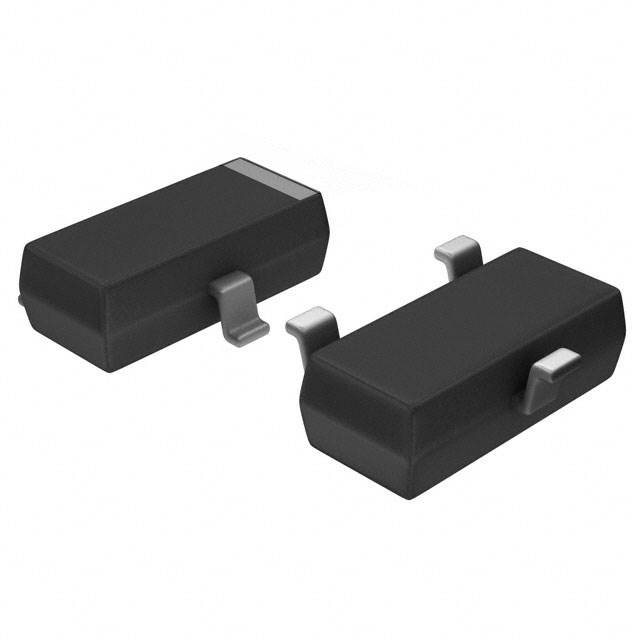
| Package | TO-236-3 / SC-59 / SOT-23-3 | TO-236-3 / SC-59 / SOT-23-3 | Same package, footprint compatible |
| Technology | JFET | MOSFET | Different device physics affects drive, switching, and linearity |
| Maximum power dissipation (Ta) | Not specified | 350 mW (Ta) | DMN63D8L-7 datasheet specifies max dissipation, useful for thermal design |
| Forward diode voltage (typ) | N/A | 1.2 V (typ), 0.8–1.2 V range | Only DMN63D8L-7 has body diode; forward voltage important for synchronous rectification |
| Gate threshold voltage | Not specified | 0.8–1.5 V (max 1.5 V @ 250µA) | DMN63D8L-7 has well-defined Vth, easier to drive reliably |
| Gate charge (Qg) | Not specified | 0.9 nC @ 10 V | DMN63D8L-7 gate charge is low, enabling fast switching |
| Gate-source voltage rating | Not specified | ±20 V max | DMN63D8L-7 gate can tolerate ±20 V, typical for MOSFETs |
| On resistance (Rds(on)) | Not specified | 2.8 Ω @ 250 mA, 10 V gate | DMN63D8L-7 on-resistance is high compared to power MOSFETs but acceptable for low currents |
| Input capacitance (Ciss) | Not specified | 23.2 pF @ 25 V | DMN63D8L-7 input capacitance impacts switching speed and gate driver requirements |
| Output capacitance (Coss) | Not specified | 3.0 pF | Low output capacitance helps switching performance |
| Reverse transfer capacitance (Crss) | Not specified | 2.2 pF | Affects Miller effect and switching behavior |
| Forward transconductance (gfs) | Not specified | 80 mS max | DMN63D8L-7 transconductance relevant for gain and switching |
| Thermal resistance (junction to ambient) | Not specified | 243–359 °C/W | DMN63D8L-7 thermal resistance quite high, limits power dissipation |
| Switching times | Not specified | Turn-on delay 2.3 ns, fall 16.7 ns | DMN63D8L-7 switching times suitable for low-power switching |
| Operating temperature range | Not specified | -55 to +150 °C | DMN63D8L-7 supports wide temperature range |
| Zero gate voltage drain current | Not specified | 1.0 µA max | Low leakage current for DMN63D8L-7 |
| Mounting type | Surface mount | Surface mount | Both SOT-23-3, suitable for compact PCB footprints |
Design trade-offs
The MMBF5485 is a JFET optimized for RF applications up to 400 MHz with a low noise figure of 4 dB. This makes it suitable for small-signal RF switching and amplification where linearity and low noise are critical. The maximum continuous current is only 10 mA, limiting its use to signal-level applications rather than power switching. Additionally, the JFET structure means gate drive requirements are different: it is voltage-controlled with very high input impedance but no true gate oxide, so static gate current may be higher, and gate voltage range is limited to about 15 V test voltage.
In contrast, the DMN63D8L-7 is a low-voltage (30 V) MOSFET designed for general-purpose switching with a continuous current rating of 350 mA and power dissipation up to 350 mW at ambient. Its Rds(on) of 2.8 Ω at 250 mA and 10 V gate drive is relatively high, indicating this device is intended for low current, low power applications, not for load switching at several amps. The MOSFET structure offers well-defined gate threshold voltages (0.8 to 1.5 V typical), low gate charge (0.9 nC total), and fast switching times (turn-on delay ~2.3 ns), making it easier to drive and suitable for moderately fast switching circuits.
Thermal design is challenging for DMN63D8L-7 due to its high thermal resistance junction-to-ambient (~243–359 °C/W), so power dissipation must be strictly limited. At 350 mW max dissipation, continuous operation at full current requires careful PCB layout with adequate copper area for heat sinking.
From a layout perspective, both devices share the SOT-23-3 package and footprint, simplifying board design and potential substitution. However, the MMBF5485’s RF-centric design may be more sensitive to parasitic capacitances and PCB layout quality at high frequencies, necessitating careful grounding and shielding practices.
Cost-wise, the DMN63D8L-7 is likely cheaper and more readily available for general switching tasks, while the MMBF5485, being a specialized RF JFET, might carry a premium and be less commonly stocked.
Use-case fit
Choose MMBF5485 when…
- Designing a low-noise RF front-end switch or amplifier operating up to 400 MHz.
- Working on small-signal analog circuits requiring low noise figure and high linearity.
- Implementing a gate-controlled impedance element in RF tuning or matching networks.
- Operating at very low currents (≤10 mA) where device leakage and noise dominate system performance.
- Your design calls for a JFET with high input impedance and minimal gate drive current.
Choose DMN63D8L-7 when…
- Switching low-voltage DC loads up to 350 mA with modest power dissipation (≤350 mW).
- Requiring a MOSFET with low gate charge for efficient gate driving at moderate switching frequencies.
- Implementing general-purpose level shifting or load switching in battery-powered or portable devices.
- Needing a device with a well-defined threshold voltage for predictable on/off control.
- Designing circuits with ambient temperatures up to 150 °C and requiring a robust MOSFET.
Drop-in compatibility
Both devices come in the SOT-23-3 (TO-236-3, SC-59) package, which suggests footprint compatibility. However, the MMBF5485 is a JFET with different pinout conventions and internal structure compared to the MOSFET DMN63D8L-7.
Datasheets do not explicitly confirm pin-to-pin compatibility. The MMBF5485’s gate, drain, and source terminals may not map directly to the MOSFET’s gate, drain, and source in the same pin order. Substituting one for the other without verifying pin assignments could damage the device or cause circuit malfunction.
Therefore, do not assume drop-in compatibility without verifying pinouts and functional equivalence.
Alternatives to consider
- 2N5457 (N-Channel JFET): A common low-noise JFET alternative to MMBF5485 for RF and analog applications with higher current capability.
- BSS138 (N-Channel MOSFET): A small-signal MOSFET with similar voltage rating but lower Rds(on) and widely used in low-current switching.
- 2N7002 (N-Channel MOSFET): A logic-level MOSFET with lower Rds(on) and higher