MMBF5485 vs DMN3042L-7: Detailed Component Comparison for Hardware Engineers
Quick verdict
For RF switching and low-current, high-frequency analog front-end applications, the MMBF5485 is the superior choice due to its JFET technology, 400MHz frequency rating, and low noise figure. Conversely, for power switching, load driving, and general-purpose low-voltage MOSFET switching, the DMN3042L-7 wins with its much higher current rating (5.8A), lower R_DS(on), and robust thermal handling.
Spec comparison table
| Spec | MMBF5485 | DMN3042L-7 | Notes |
|---|---|---|---|
| Configuration | N-Channel JFET | N-Channel MOSFET | Both N-Channel, but different transistor types—JFET vs MOSFET affects drive and frequency. |
| Current rating (continuous) | 10mA | 5.8A (Ta) | DMN3042L-7 supports ~580x higher current, critical for power applications. |
| Frequency | 400MHz | Not specified | MMBF5485 is specified for RF use; DMN3042L-7 not intended for RF switching. |
| Gain | Not specified | Not specified | N/A for direct comparison; gain relevant mostly for JFET in low noise applications. |
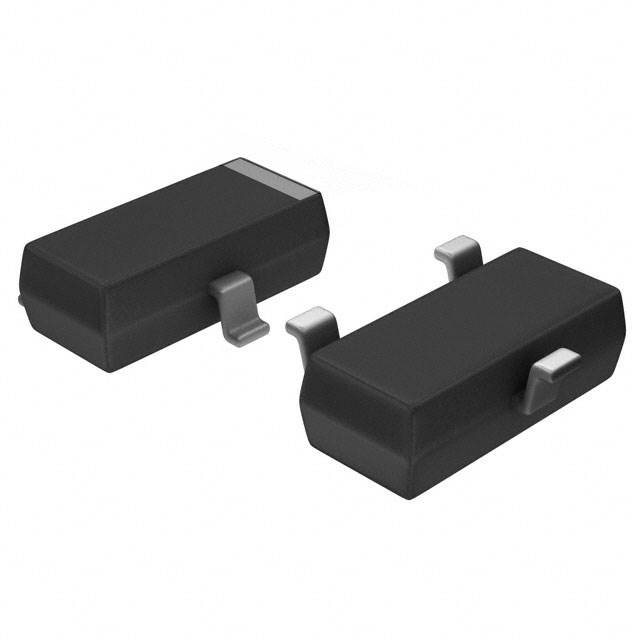
| Mounting type | Surface Mount | Surface Mount | Both SOT-23-3 package, typical for small-signal and low-power MOSFETs. |
| Noise figure | 4dB | Not specified | MMBF5485 offers low noise figure, useful for RF front ends; DMN3042L-7 not characterized for noise. |
| Output power max | Not specified | 720mW (Ta) | DMN3042L-7 can dissipate 720mW, allowing higher power switching. |
| Package case | TO-236-3, SC-59, SOT-23-3 | TO-236-3, SC-59, SOT-23-3 | Identical physical packaging. |
| Supplier device package | SOT-23-3 | SOT-23-3 | Identical, footprint-compatible. |
| Technology | JFET | MOSFET (Metal Oxide) | Different device physics; JFET for low noise and RF, MOSFET for power and switching. |
| Voltage rated | 25 V | 30 V | DMN3042L-7 supports 20% higher maximum drain-source voltage. |
| Voltage test | 15 V | Not specified | MMBF5485 rated/tested at 15V; DMN3042L-7 max V_DS is 30V, more robust. |
| Drive voltage max R_DS(on) min | Not specified | 2.5V (min R_DS(on)), 10V | DMN3042L-7 has specified R_DS(on) at 2.5V and 10V; low gate drive voltage improves efficiency. |
| Gate charge Qg max @ Vgs | Not specified | 20 nC @10V | DMN3042L-7’s 20nC gate charge will impact gate driver sizing and switching speed. |
| Gate-source voltage max | Not specified | ±12V | DMN3042L-7 can tolerate ±12V gate-source, enabling robust gate drive design. |
| Input capacitance C_iss max @ Vds | Not specified | 860pF @ 15V | DMN3042L-7 input capacitance affects switching losses and speed; unknown for MMBF5485. |
| Operating temperature range | Not specified | -55°C to 150°C (TJ) | DMN3042L-7 rated for wide temp range, enhancing reliability in harsh environments. |
| Power dissipation max (Ta) | Not specified | 720mW | DMN3042L-7 can handle significant power dissipation, MMBF5485 not specified. |
| R_DS(on) max @ Id, Vgs | Not specified | 26.5mΩ @ 5.8A, 10V | DMN3042L-7 offers low conduction losses at rated current and gate voltage. |
| Vgs threshold max @ Id | Not specified | 1.4V @ 250µA | DMN3042L-7 has low threshold voltage, allowing logic-level drive. |
Design trade-offs
The fundamental difference between these devices stems from their transistor technology and intended application spaces. The MMBF5485 is a JFET optimized for RF and low-current analog switching up to 400MHz. Its low noise figure (4dB) and high-frequency capability make it suitable for sensitive front-end circuits where signal integrity and low distortion are critical. However, the JFET’s current rating is extremely low (10mA), severely limiting power handling and load-driving capability.
In contrast, the DMN3042L-7 is a power MOSFET designed for load switching and power management at voltages up to 30V and currents up to 5.8A. Its low R_DS(on) of 26.5mΩ at 10V gate drive implies low conduction losses in high-current switching applications. The 720mW power dissipation rating allows this device to handle substantial thermal loads, but the relatively high input capacitance (860pF) and 20nC gate charge require careful gate driver design to maintain efficient switching at high frequencies.
From a layout perspective, the MMBF5485’s small-signal JFET characteristics require minimal gate drive current and are more sensitive to PCB parasitics at high frequency. The DMN3042L-7 needs a low-impedance gate driver that can source/sink tens of milliamps rapidly to switch the MOSFET efficiently and avoid excessive switching losses or device heating. The MOSFET’s higher gate threshold (1.4V max) and ±12V gate tolerance provide flexibility but also require attention to gate voltage limits to prevent damage.
Thermally, the DMN3042L-7 can dissipate 720mW at ambient temperature, which mandates adequate PCB copper area and thermal vias in designs handling near-maximum current. The MMBF5485’s thermal limits are not specified but are expected to be minimal due to its low current rating.
Cost-wise, the DMN3042L-7 is likely more expensive due to its power device nature, but it also replaces larger discrete MOSFETs in space-constrained designs. The MMBF5485 is a specialized RF component, potentially commanding a price premium in small quantities but justified by its RF performance.
Use-case fit
Choose MMBF5485 when…
- Designing RF front-end switches or low-noise RF amplifiers operating near 400MHz.
- Implementing low-current analog signal switching or multiplexing with tight noise figure requirements.
- Building circuits where gate drive current must be minimal, and device parasitics at high frequency are critical.
- The load current stays below 10mA, and voltage requirements do not exceed 15V.
- Space is limited to SOT-23-3 but RF performance is paramount.
Choose DMN3042L-7 when…
- Switching loads up to 5.8A at voltages up to 30V, such as in DC-DC converters or power switches.
- Implementing logic-level MOSFET switching with gate drive voltages of 5V to 10V.
- Thermal dissipation near 720mW is expected, requiring a device with robust power handling.
- The switching frequency is moderate and gate charge (20nC) can be driven efficiently by the selected gate driver.
- Operating over a wide temperature range (-55°C to 150°C junction temperature).
Drop-in compatibility
Both devices share the same SOT-23-3 package and pinout style typical for small-signal transistors, but the MMBF5485 is a JFET and the DMN3042L-7 is a MOSFET. Without the exact pin configuration datasheets side-by-side, it cannot be confirmed if the pin assignments are identical. Assuming standard SOT-23-3 pinouts, the pin functions (Gate, Drain, Source) may differ in order or internal structure, so do not assume pin or footprint drop-in compatibility without verifying pinout.
Substituting one for the other is not straightforward due to different device physics, drive requirements, and maximum current/voltage ratings. The MMBF5485 cannot replace the DMN3042L-7 in power switching applications, and vice versa, the DMN3042L-7 will not meet RF gain/noise requirements of the MMBF5485.
Alternatives to consider
- BSS138: Popular N-channel MOSFET in SOT-23 with logic-level drive, suitable for low-current switching; consider if DMN3042L-7’s current is overkill.
- 2N5457: JFET with similar low-noise, high-frequency properties for analog/RF switching, alternative to MMBF5485.
- Si2302: Low-voltage MOSFET with low R_DS(on) and low gate charge