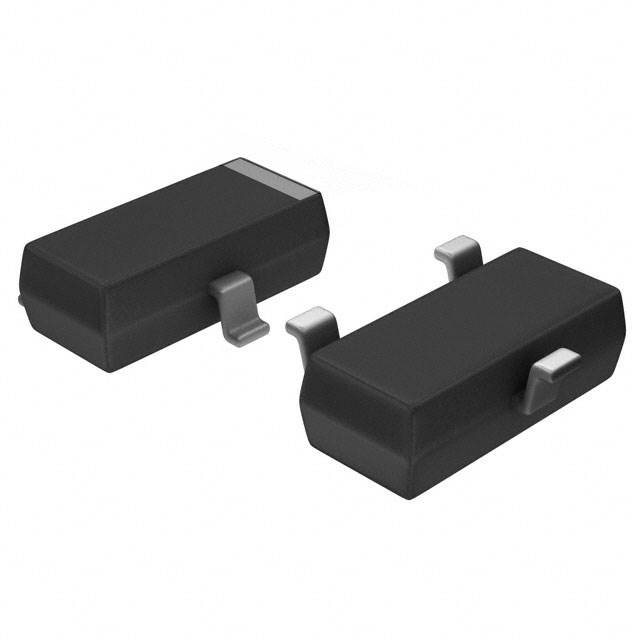
MMBF5485 vs DMN3023L-7: Component Comparison for Power Electronics Engineers
Quick verdict
For low-current, high-frequency RF switching or amplification, the MMBF5485 excels due to its JFET technology and 400 MHz frequency rating, making it suitable for sensitive analog front ends and low-noise applications. Conversely, the DMN3023L-7 is the clear winner for power switching and load driving up to several amps, thanks to its much higher current capacity (6.2 A) and low R_DS(on), making it suitable for DC-DC converters and power management in compact surface mount packages.
Spec comparison table
| Spec | MMBF5485 | DMN3023L-7 | Notes |
|---|---|---|---|
| Configuration | N-Channel JFET | N-Channel MOSFET | Both N-channel, but JFET vs MOSFET implies different drive and switching characteristics. |
| Current rating (continuous) | 10 mA | 6.2 A (Ta) | DMN3023L-7 supports ~620x higher current, critical for power applications. |
| Frequency rating | 400 MHz | Not specified | MMBF5485 is designed for RF frequency operation, DMN3023L-7 not suitable for high-frequency RF. |
| Gain | Not specified | Not specified | Gain is typically a parameter for RF devices; MMBF5485 may have intrinsic gain, DMN3023L-7 is a switch. |
| Mounting type | Surface Mount (SOT-23-3) | Surface Mount (SOT-23-3) | Both use the same industry-standard package. |
| Noise figure | 4 dB | Not specified | MMBF5485 offers a low noise figure, useful in RF and low-noise analog circuits. |
| Output power max | Not specified | Not specified | No data; MMBF5485 designed for low power, DMN3023L-7 power limited by dissipation and R_DS(on). |
| Package case | TO-236-3, SC-59, SOT-23-3 | TO-236-3, SC-59, SOT-23-3 | Identical mechanical package supports potential footprint interchange. |
| Technology | JFET | MOSFET (Metal Oxide) | Different transistor types affect drive requirements and switching behavior. |
| Voltage rated | 25 V | 30 V | DMN3023L-7 has a higher voltage rating, providing more headroom for power switching. |
| Voltage test | 15 V | Not specified | MMBF5485 tested at 15 V; DMN3023L-7 max V_DS is 30 V, indicating greater ruggedness. |
| Drive voltage max / R_DS(on) min R_DS(on) | Not specified | 2.5 V drive voltage, R_DS(on) at 10V | DMN3023L-7’s R_DS(on) of 25 mΩ at 10V drive is critical for conduction loss and efficiency. |
| Gate charge Qg max (V_GS) | Not specified | 18.4 nC @ 10 V | DMN3023L-7 requires moderate gate charge; impacts gate driver sizing and switching speed. |
| Gate-source voltage max | Not specified | ±20 V | DMN3023L-7 can tolerate ±20 V on gate, giving some robustness to drive transients. |
| Input capacitance C_iss max (V_DS) | Not specified | 873 pF @ 15 V | DMN3023L-7 input capacitance affects switching speed and EMI considerations. |
| Operating temperature range | Not specified | -55°C to 150°C (TJ) | DMN3023L-7 supports wide temperature range, beneficial for automotive/industrial environments. |
| Power dissipation max (Ta) | Not specified | 900 mW (Ta) | DMN3023L-7’s power dissipation rating guides thermal design; MMBF5485 likely lower due to low current rating. |
| Threshold voltage V_GS_th max (I_D) | Not specified | 1.8 V @ 250 µA | DMN3023L-7’s threshold voltage guides gate drive voltage selection and logic interface compatibility. |
Design trade-offs
The fundamental difference between the MMBF5485 and DMN3023L-7 lies in their transistor technology and intended application domains. The MMBF5485 is a JFET optimized for RF frequencies up to 400 MHz and very low current levels (~10 mA). Its low noise figure (4 dB) and JFET characteristics make it suitable for analog front-end circuits requiring low distortion and stable gain at high frequencies. However, its current handling capability and voltage rating (25 V) are limited, making it unsuitable for power switching or load driving.
In contrast, the DMN3023L-7 is a power MOSFET designed for switching applications up to 30 V and continuous currents up to 6.2 A. Its low R_DS(on) of 25 mΩ at 10 V gate drive reduces conduction losses significantly, which is critical in DC-DC converters and power management circuits. The device’s gate charge (18.4 nC at 10 V) is moderate, meaning gate driver design must accommodate this charge for efficient switching, especially at high frequencies. Its relatively high input capacitance (873 pF) can slow switching transitions and increase switching losses, so layout and gate driver impedance must be optimized.
Thermally, the DMN3023L-7’s 900 mW power dissipation rating at ambient temperature requires careful PCB layout with thermal vias and copper area to maintain junction temperature within limits. The MMBF5485’s low current operation means thermal management is usually less critical, but its JFET structure requires a stable biasing network to ensure linearity and minimize distortion.
From a firmware or control perspective, the DMN3023L-7’s threshold voltage of 1.8 V and maximum gate-source voltage of ±20 V make it compatible with standard 3.3 V or 5 V logic levels (with some margin), but gate drive voltage of 10 V is recommended for low R_DS(on). The MMBF5485, as a JFET, has different biasing needs and is not driven like a MOSFET switch; it requires continuous gate bias and careful handling of input impedance to preserve RF characteristics.
Cost-wise, MOSFETs like the DMN3023L-7 are generally more common and available at high volumes with competitive pricing. The specialized JFET MMBF5485 may be more expensive per unit and less commonly stocked, reflecting its niche application.
Use-case fit
Choose MMBF5485 when…
- You need a low-noise, low-distortion RF switch or amplifier stage operating up to 400 MHz.
- Your circuit involves very low currents (≤10 mA) and requires a JFET’s linearity and input impedance characteristics.
- You are designing analog front-ends for RF receivers or instrumentation amplifiers where noise figure and frequency response are critical.
- The application requires a compact SOT-23 package with low parasitic capacitances for high-frequency operation.
- Your design voltage is below 25 V and current is minimal, prioritizing signal integrity over power handling.
Choose DMN3023L-7 when…
- You need a power MOSFET capable of switching or driving loads up to 6.2 A continuously at voltages up to 30 V.
- Your design requires low conduction losses with R_DS(on) of 25 mΩ at 10 V gate drive for improved efficiency in DC-DC converters or power switches.
- You can provide a 10 V gate drive voltage to fully enhance the MOSFET and minimize switching losses.
- Thermal management is possible with PCB copper area or heat sinking to handle up to 900 mW dissipation.
- Your application demands wide temperature operation (-55°C to 150°C junction) for automotive or industrial environments.
Drop-in compatibility
Both devices share the SOT-23-3 package and appear mechanically footprint-compatible. However, they are fundamentally different transistor types (JFET vs MOSFET) with distinct pin functions and biasing requirements. The MMBF5485 is a JFET with a different internal structure and biasing scheme, whereas the DMN3023L-7 is a power MOSFET switch.
Datasheets should be consulted to confirm pinouts; substituting one for the other is not recommended without circuit redesign because:
- Drive signals differ: MMBF5485 requires continuous bias voltage; DMN3023L-7 requires gate voltage swings for switching.
- Electrical characteristics differ dramatically (current, voltage, gate drive).
- Application function (RF amplifier vs power switch) differs.
Therefore, they are not drop-in replacements despite sharing the package.
Alternatives to consider
- BSS138 (N-channel MOSFET, 50 V, 200 mA, SOT-23): A low-voltage MOSFET for signal switching and low-power loads, suitable as a general-purpose alternative to DMN3023L-7 at lower current.
- 2N5457 (N-channel JFET, 25 V, low noise): A classic JF