MMBF5485 vs DMG3402L-7: Component Comparison for Hardware Engineers
Quick verdict
For RF switching and low-noise amplification up to 400 MHz, the MMBF5485 is the clear choice due to its JFET technology and low noise figure. Conversely, for power switching and load driving applications requiring up to 4 A continuous current and robust thermal performance, the DMG3402L-7 is superior, offering a much higher current rating and lower R_DS(on).
Spec comparison table
| Spec | MMBF5485 | DMG3402L-7 | Notes |
|---|---|---|---|
| Configuration | N-Channel JFET | N-Channel MOSFET | JFET (MMBF5485) better for low-noise RF; MOSFET (DMG3402L-7) better for power switching. |
| Current rating (continuous) | 10 mA | 4 A (Ta) | DMG3402L-7 supports 400× higher current, critical for switching/load applications. |
| Frequency | 400 MHz | Not specified | MMBF5485 optimized for RF frequencies up to 400 MHz; DMG3402L-7 not intended for RF. |
| Gain | Not specified | Not specified | No direct comparison; MMBF5485 used in RF amplification contexts. |
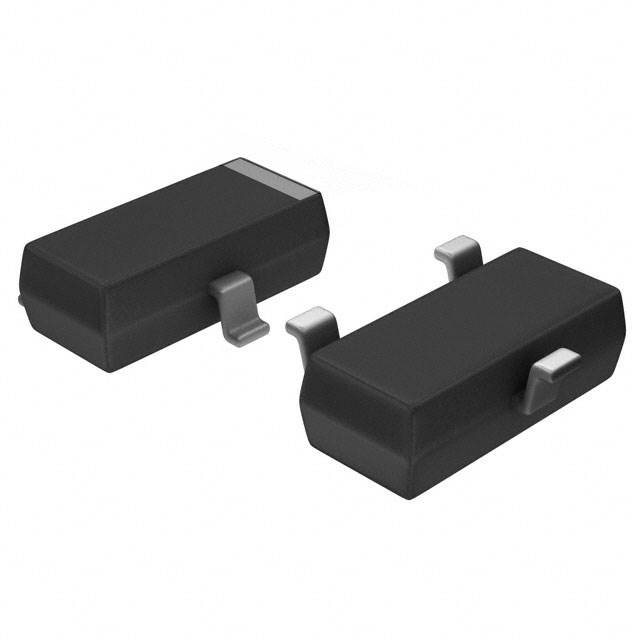
| Mounting type | Surface Mount (SOT-23-3) | Surface Mount (SOT-23-3) | Both use the same package for PCB footprint compatibility. |
| Noise figure | 4 dB | Not specified | MMBF5485’s 4 dB noise figure suits low-noise RF front-ends; DMG3402L-7 not optimized here. |
| Output power max | Not specified | 1.4 W (Ta) | DMG3402L-7 can dissipate more power, crucial for high current switching. |
| Package case | TO-236-3, SC-59, SOT-23-3 | TO-236-3, SC-59, SOT-23-3 | Identical packages, easing layout swaps if pinouts match. |
| Technology | JFET | MOSFET | JFET for high-frequency low-noise; MOSFET for power and switching efficiency. |
| Voltage rated | 25 V | 30 V | DMG3402L-7 has higher voltage rating, provides more headroom in power applications. |
| Voltage test | 15 V | Not specified | MMBF5485 voltage test at 15 V is lower than DMG3402L-7’s max voltage rating. |
| Drive voltage max R_DS(on) | Not specified | 2.5 V (min), 10 V | DMG3402L-7 can be driven fully on at low gate voltage (2.5 V), important for logic-level drive. |
| Gate charge (Q_g) max | Not specified | 11.7 nC @ 10 V | DMG3402L-7 requires moderate gate charge, impacting switching speed and driver design. |
| Gate-source voltage max | Not specified | ±12 V | DMG3402L-7 supports ±12 V gate drive; MMBF5485 not specified. |
| Input capacitance (C_iss) | Not specified | 464 pF @ 15 V | DMG3402L-7’s input capacitance affects switching losses and speed; MMBF5485 data missing. |
| Operating temperature range | Not specified | -55°C to 150°C (TJ) | DMG3402L-7 rated for extended temperature range, important for reliability in harsh environments. |
| R_DS(on) max | Not specified | 52 mΩ @ 4 A, 10 V | DMG3402L-7 offers low on-resistance at typical drive voltages, reducing conduction losses. |
| Threshold voltage (V_GS_th) | Not specified | 1.4 V @ 250 µA | DMG3402L-7 has low threshold voltage, enabling easier drive from low-voltage logic. |
Design trade-offs
The MMBF5485 and DMG3402L-7 address fundamentally different design challenges despite sharing a package and N-channel polarity. The MMBF5485 is a JFET optimized for RF applications, specifically where low noise figure and operation up to 400 MHz are critical. Its extremely low current rating (10 mA) and lack of power dissipation specs indicate it is unsuitable for load switching or power stages. In contrast, the DMG3402L-7 is a logic-level MOSFET designed for power switching, with a continuous drain current rating of 4 A and a maximum power dissipation of 1.4 W.
From a layout perspective, the MMBF5485’s JFET structure typically offers lower input capacitance and better linearity at RF frequencies, but requires careful impedance matching and often a dedicated biasing network. The DMG3402L-7 demands attention to gate drive and switching losses; its 11.7 nC gate charge at 10 V is moderate, so gate driver selection and PCB trace inductance become relevant for efficient hard switching at high frequencies. The DMG3402L-7’s low R_DS(on) of 52 mΩ at 4 A and 10 V gate drive translates to tangible efficiency gains in DC-DC converters or load switches compared to older or higher R_DS(on) MOSFETs.
Thermally, the DMG3402L-7 can handle significantly higher power dissipation (up to 1.4 W at ambient), requiring appropriate thermal management in high-current applications. The MMBF5485, with no specified power rating, should be treated as a low-power device. Its small SOT-23 footprint aids in compact RF front-end design, whereas the DMG3402L-7’s footprint and power rating make it suitable for small to medium power switching stages.
Costwise, the DMG3402L-7 is likely more expensive per unit due to higher silicon area and more complex processing, but this is justified in power applications. The MMBF5485’s niche in RF and low noise amplification keeps it cost-effective for those specialized applications but unsuitable for general switching.
Use-case fit
Choose MMBF5485 when…
- Designing low-noise RF front-ends or switches operating up to 400 MHz.
- Implementing JFET-based gain stages where noise figure around 4 dB is critical.
- Current requirements are minimal (≤10 mA) and linearity is prioritized over power handling.
- Compact SOT-23 packages are needed for tight RF layouts.
- A low voltage rating (25 V) is sufficient and high voltage margin is not required.
Choose DMG3402L-7 when…
- Switching or driving loads up to 4 A continuous current at voltages up to 30 V.
- Low R_DS(on) at logic-level gate drive (2.5 V to 10 V) is needed to minimize conduction losses.
- Operating temperature extremes from -55°C to 150°C are expected.
- Moderate power dissipation (~1.4 W) requires a thermally robust device in SOT-23.
- Gate drive circuitry can supply ~11.7 nC gate charge for efficient switching.
Drop-in compatibility
Both devices share the SOT-23-3 package (TO-236-3, SC-59), which suggests footprint compatibility on the PCB. However, the MMBF5485 is a JFET and the DMG3402L-7 is a MOSFET with different electrical characteristics and likely different pinouts (e.g., source and gate may be swapped). Without explicit pinout confirmation from datasheets, these parts should not be considered drop-in replacements electrically or functionally. Substituting one for the other without redesign risks circuit failure or damage.
Alternatives to consider
- BSS138 (N-Channel MOSFET, SOT-23): Common small-signal MOSFET with low gate charge and moderate current rating (~200 mA), suitable for low-power switching.
- 2N3819 (N-Channel JFET): Popular RF JFET alternative with similar low noise figure, useful for RF front-ends.
- Si2302DS (N-Channel MOSFET, SOT-23): Provides low R_DS(on) (~85 mΩ at 4.5 V) and low gate charge, a compromise between small-signal and power MOSFET applications.