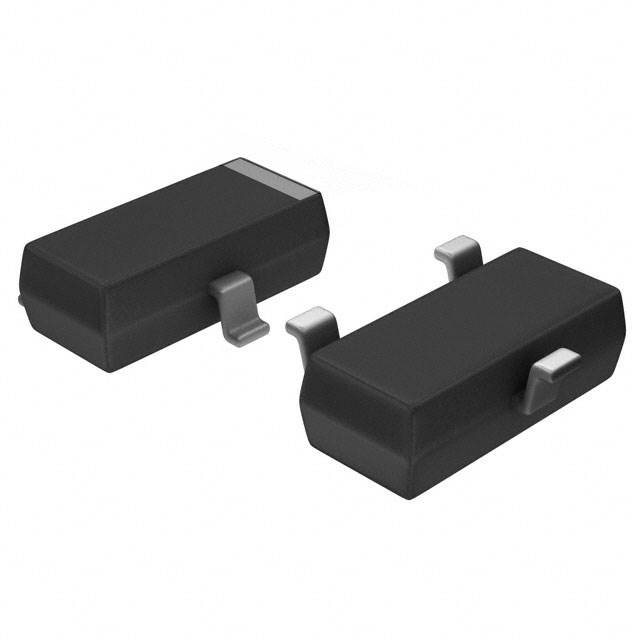
MMBF5485 vs CSD17484F4: Component Comparison for Hardware Engineers
Quick verdict
For low-current, high-frequency RF switching or small-signal amplification up to 400 MHz, the MMBF5485 JFET is the clear choice due to its low noise figure and suitability for RF applications. For power switching or load driving up to 3 A with low gate charge and moderate voltage requirements, the CSD17484F4 MOSFET outperforms with its higher current rating, lower R_DS(on), and better thermal handling.
Spec comparison table
| Spec | MMBF5485 | CSD17484F4 | Notes |
|---|---|---|---|
| Configuration | N-Channel JFET | N-Channel MOSFET | Both N-Channel, but different device types impacting behavior and drive requirements. |
| Current rating (continuous) | 10 mA | 3 A (Ta) | CSD17484F4 supports 300x higher current, suitable for power applications. |
| Frequency | 400 MHz | Not specified (low-frequency MOSFET) | MMBF5485 is designed for RF; CSD17484F4 is not optimized for RF use. |
| Gain | Not specified | N/A | Gain relevant for JFET (MMBF5485), not MOSFET. |
| Mounting type | Surface Mount | Surface Mount | Both surface mount packages; different package types. |
| Noise figure | 4 dB | Not specified | Lower noise figure important for RF front-ends; only MMBF5485 has this spec. |
| Output power max | Not specified | Not specified | No data; likely dependent on application. |
| Package case | TO-236-3, SC-59, SOT-23-3 | 3-XFDFN (3-PICOSTAR) | Different physical packages; affects layout and thermal dissipation. |
| Supplier device package | SOT-23-3 | 3-PICOSTAR | Different footprint and pinout. |
| Technology | JFET | MOSFET (Metal Oxide) | Fundamental device difference affecting drive, switching, and conduction mechanisms. |
| Voltage rated | 25 V | 30 V | CSD17484F4 has a slightly higher voltage rating. |
| Voltage test | 15 V | Not specified | MMBF5485 tested at 15 V; CSD17484F4 max gate-source voltage is 12 V. |
| Continuous drain current (Id) at 25°C | 10 mA | 3 A (Ta) | CSD17484F4 enables higher power switching. |
| Drain-source voltage max (Vds) | 25 V | 30 V | CSD17484F4 supports higher voltage stress. |
| Drive voltage max (Gate-Source) | Not specified | 12 V | CSD17484F4 gate max rating is 12 V; MMBF5485 JFET gate drive differs (JFET gate). |
| R_DS(on) | Not specified | 121 mΩ @ 500 mA, 8 V | CSD17484F4 R_DS(on) specified, useful for conduction loss estimates. |
| Gate charge Qg max | Not specified | 2.04 nC @ 8 V | CSD17484F4 gate charge relevant for switching losses and gate drive sizing. |
| Input capacitance (Ciss) | Not specified | 195 pF @ 15 V | CSD17484F4 input capacitance impacts switching speed and gate drive power. |
| Operating temperature range | Not specified | -55°C to 150°C (TJ) | CSD17484F4 rated for wider temperature range; MMBF5485 data not provided. |
| Power dissipation max | Not specified | 500 mW (Ta) | CSD17484F4 power rating supports moderate power dissipation. |
| Vgs threshold voltage | Not specified | 1.1 V @ 250 µA | CSD17484F4 has a low threshold for easy logic-level drive. |
Design trade-offs
The MMBF5485 and CSD17484F4 target fundamentally different applications despite both being N-channel devices. The MMBF5485 is a JFET optimized for RF operation up to 400 MHz, with a low 4 dB noise figure, making it suitable for low-noise RF front-ends or signal switches where linearity and noise are critical. Its continuous current rating is extremely low (10 mA), so it cannot be used as a power switch or load driver.
In contrast, the CSD17484F4 is a power MOSFET designed for load switching or power management applications up to 3 A continuous current and 30 V voltage rating. It has a low R_DS(on) of 121 mΩ at 500 mA and 8 V drive, which means conduction losses are moderate but manageable for small to medium loads. Its gate charge of 2.04 nC at 8 V is relatively low, enabling efficient switching at moderate frequencies, but it is not suitable for RF frequencies.
Thermally, the CSD17484F4’s 500 mW power dissipation rating (at ambient) and wide junction temperature range (-55°C to 150°C) allow for operation in demanding environments with proper heat sinking or PCB thermal design. The MMBF5485’s thermal data is not specified but is inherently limited by its low current and power handling.
From a gate drive perspective, the MMBF5485, being a JFET, requires a different biasing approach—its gate behaves like a reverse-biased diode, typically driven with zero or negative voltage relative to source, and does not switch like a MOSFET. The CSD17484F4 requires a positive gate voltage up to 12 V max, with logic-level threshold around 1.1 V, making it compatible with common microcontroller or driver outputs.
Layout considerations differ sharply: the MMBF5485’s SOT-23-3 package is a common, compact footprint with low parasitic inductances for RF applications. The CSD17484F4’s 3-PICOSTAR (3-XFDFN) package is optimized for thermal dissipation and low R_DS(on), but has a different footprint and pinout. The MOSFET’s input capacitance and gate charge also require careful gate resistor and driver selection to avoid switching losses and EMI.
Cost-wise, the MMBF5485 is a specialized low-power RF JFET, likely more expensive per unit in volume due to its niche use. The CSD17484F4 is a mass-market power MOSFET in a compact package, generally cheaper in large quantities.
Use-case fit
Choose MMBF5485 when…
- Designing RF front-end switches or low-noise amplifiers operating up to 400 MHz.
- Your application demands very low noise figure (4 dB) and minimal signal distortion at low currents (<10 mA).
- You need a JFET device with a SOT-23 package for compact, low-power RF switching.
- The load current is minimal, and voltage requirements are under 25 V.
- The circuit requires a device with a gate that can be reverse biased for low distortion.
Choose CSD17484F4 when…
- You need a compact power MOSFET capable of switching or driving loads up to 3 A continuous current.
- Your operating voltage is up to 30 V, with low R_DS(on) to minimize conduction losses.
- The application involves switching frequencies where a 2 nC gate charge is acceptable (e.g., DC-DC converters, load switches).
- Thermal dissipation up to 500 mW at ambient is required with a wide temperature range (-55°C to 150°C).
- You require a logic-level compatible MOSFET with a threshold voltage near 1.1 V for direct MCU or driver compatibility.
Drop-in compatibility
These two devices are not pin-compatible or footprint-compatible. The MMBF5485 uses a SOT-23-3 package (TO-236-3, SC-59) with a specific pinout optimized for RF JFET operation, while the CSD17484F4 comes in a 3-PICOSTAR (3-XFDFN) package with a different pin arrangement designed for power MOSFET switching.
Substituting one for the other would require a board redesign, including footprint changes and circuit reconfiguration due to different device physics (JFET vs MOSFET), gate drive requirements, and thermal considerations. The MMBF5485 cannot handle the current or voltage demands suitable for the CSD17484F4, and the CSD17484F4 is not suitable for RF switching or low-noise amplification.
Alternatives to consider
- BSS138 (N-Channel MOSFET, 50 V, 200 mA, SOT-23): A general-purpose logic-level MOSFET with low gate charge for low-current switching.
- 2N7002 (N-Channel MOSFET, 60 V, 200 mA, SOT-23): Widely used MOSFET for switching applications with low gate threshold.
- J310