MMBF5485 vs CSD17483F4: Component Comparison for Power Electronics Design
Quick verdict
For low-current RF switching and amplification up to hundreds of MHz, the MMBF5485 JFET is the clear choice due to its RF-optimized characteristics and low noise figure. Conversely, for general-purpose power switching and load driving up to 1.5A with moderate gate drive voltages, the CSD17483F4 MOSFET offers far superior current capability, thermal performance, and lower on-resistance, making it better suited for DC/DC converters, load switches, and low-voltage power stages.
Spec comparison table
| Spec | MMBF5485 | CSD17483F4 | Notes |
|---|---|---|---|
| Configuration | N-Channel JFET | N-Channel MOSFET | Both N-channel, but different device technologies affect drive and switching behavior. |
| Current rating (continuous) | 10 mA | 1.5 A (Ta) | CSD17483F4 supports 150× higher continuous current, critical for power applications. |
| Frequency | 400 MHz | Not specified | MMBF5485 is RF-optimized for hundreds of MHz; CSD17483F4 not intended for RF switching. |
| Gain | Not specified | Not specified | Gain not typically specified for MOSFETs; MMBF5485 likely has transconductance gain. |
| Noise figure | 4 dB | Not specified | MMBF5485 low noise figure suits RF front-ends; CSD17483F4 noise figure irrelevant. |
| Output power max | Not specified | 500 mW (Ta) | CSD17483F4 can dissipate up to 500 mW, allowing higher power operation than MMBF5485. |
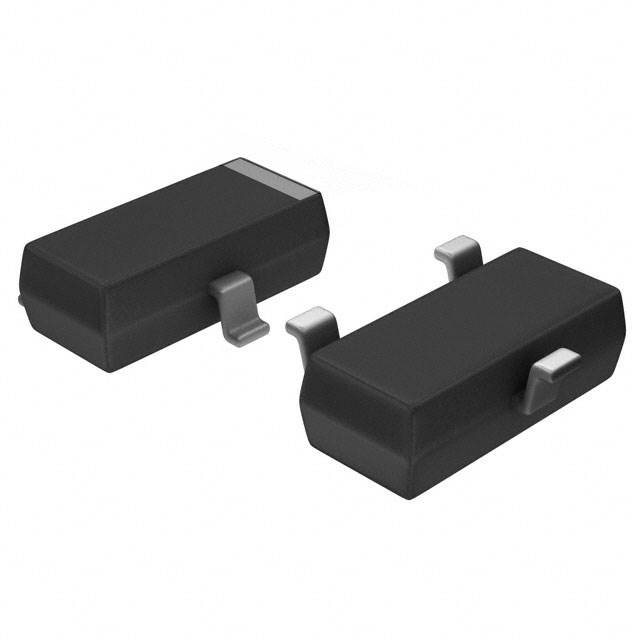
| Package type | TO-236-3 (SOT-23-3) | 3-PICOSTAR (XFDFN) | Different packages; PCB footprint and thermal paths differ significantly. |
| Voltage rating (max) | 25 V | 30 V | CSD17483F4 has a slightly higher max voltage rating, offering more margin. |
| Voltage test | 15 V | Not specified | MMBF5485 tested at 15 V; CSD17483F4 max gate voltage is 12 V, limiting gate drive voltage. |
| Technology | JFET | MOSFET (Metal Oxide) | Different switching and drive requirements; MOSFET gate is voltage-driven, JFET current-driven. |
| Gate charge (Qg) | Not specified | 1.3 nC @ 4.5 V | CSD17483F4 requires moderate gate charge, impacting switching losses and gate drive design. |
| Gate-source voltage max | Not specified | 12 V | CSD17483F4 max gate voltage is 12 V; exceeding this risks damage. |
| Drain-source voltage max | 25 V | 30 V | CSD17483F4 offers better voltage margin. |
| Continuous drain current | 10 mA | 1.5 A (Ta) | CSD17483F4 is suitable for significantly higher currents. |
| Rds(on) | Not specified | 240 mΩ @ 500mA, 8V | Rds(on) info only for CSD17483F4; 240 mΩ is moderate, suitable for low-current switching. |
| Input capacitance (Ciss) | Not specified | 190 pF @ 15 V | CSD17483F4 input capacitance affects switching speed and gate drive losses. |
| Operating temperature range | Not specified | -55°C to 150°C (TJ) | CSD17483F4 suitable for extended temperature ranges; MMBF5485 datasheet not explicit. |
| Mounting type | Surface Mount (SOT-23-3) | Surface Mount (3-PICOSTAR) | Both surface mount but different footprints and thermal characteristics. |
Design trade-offs
The MMBF5485 is a JFET with an exceptionally low current rating (10 mA max) and a high-frequency response up to 400 MHz, making it tailored for RF signal switching and low-noise amplification rather than power switching. Its 4 dB noise figure and JFET technology imply a low input capacitance and low noise contribution, critical in RF front-end designs where signal integrity at high frequency matters more than conduction losses or switching speed. The small SOT-23-3 package aids in compact layouts but offers limited thermal dissipation capability, which aligns with its low power and current rating.
On the other hand, the CSD17483F4 is a MOSFET optimized for power switching at currents up to 1.5A continuous, with a maximum drain-source voltage of 30 V and a power dissipation of 500 mW at ambient temperature. Its 240 mΩ Rds(on) at 500 mA and 8 V gate drive represents a moderate conduction loss, suitable for low-voltage DC/DC converters and load switch applications. The 1.3 nC gate charge at 4.5 V is relatively low, balancing gate drive losses and switching speed for efficient operation in switching regulators or general-purpose load drives. The 3-PICOSTAR package offers better thermal performance and a smaller footprint compared to traditional SOT-23, which is beneficial in dense layouts.
From a gate drive perspective, the MMBF5485 JFET requires biasing of the gate-source junction and typically operates at lower voltages, while the CSD17483F4 MOSFET needs a positive gate voltage up to 12 V with well-defined drive levels to minimize Rds(on). The MOSFET’s gate is capacitive; thus, gate drivers must source and sink current to switch effectively, impacting switching losses and EMI. The JFET’s lower frequency operation and lower current rating reduce the concern for switching losses but require careful biasing to operate in the desired region.
Thermally, the CSD17483F4 can dissipate significantly more power and sustain higher currents, with operating junction temperatures up to 150°C, which is important for power stages. The MMBF5485 is constrained by lower current and power dissipation limits, making it unsuitable for power handling but ideal for sensitive RF paths.
Cost-wise, MOSFETs like the CSD17483F4 tend to be more expensive per unit due to manufacturing complexity and packaging but offer much higher performance in power applications. The MMBF5485 is a specialized RF transistor, potentially more expensive per unit at low volume but necessary for RF front-end roles.
Use-case fit
Choose MMBF5485 when…
- Designing RF switches or low-noise amplifiers operating up to 400 MHz where low noise figure (4 dB) is critical.
- Implementing signal path switching at very low currents (under 10 mA) where MOSFET gate charge and switching losses are prohibitive.
- Working in designs requiring JFET input characteristics for impedance matching or low distortion at RF frequencies.
- Space is limited but the application requires a proven SOT-23-3 package RF transistor.
- The application voltage does not exceed 25 V and the current stays in the microamp to milliamp range.
Choose CSD17483F4 when…
- Switching or driving loads up to 1.5 A continuous at voltages up to 30 V in DC/DC converters, load switches, or power rails.
- Designing power stages where 500 mW dissipation and 240 mΩ Rds(on) at practical gate drive voltages (8 V) are acceptable.
- Gate drive voltage is limited to 12 V max, and you need low gate charge (1.3 nC at 4.5 V) for efficient switching.
- Operating temperature ranges from -55°C to 150°C are required for harsh or industrial environments.
- Layout density favors a 3-PICOSTAR package with improved thermal performance over SOT-23.
Drop-in compatibility
The MMBF5485 and CSD17483F4 are not pin-compatible nor footprint-compatible. The MMBF5485 is a SOT-23-3 (TO-236-3) package, while the CSD17483F4 is in a 3-PICOSTAR (XFDFN) package with different pin assignments and physical dimensions. Substituting one for the other would require PCB redesign and changes to the gate drive and biasing circuitry due to their different device technologies (JFET vs MOSFET) and electrical characteristics. Without a custom adapter or circuit redesign, these parts are not interchangeable.
Alternatives to consider
- BSS138 (NXP, N-Channel MOSFET): A widely used small-signal MOSFET with moderate current rating (~200 mA) and SOT-23 package, suitable for low-voltage switching.
- 2N3819 (N-Channel JFET): A classic JFET with higher current capability than MMBF5485, useful for low-noise RF switching or amplification.
- SI2302 (Vishay, N-Channel MOSFET): Low-voltage MOSFET with low gate charge and Rds(on), good for general-purpose power switching in SOT-23.