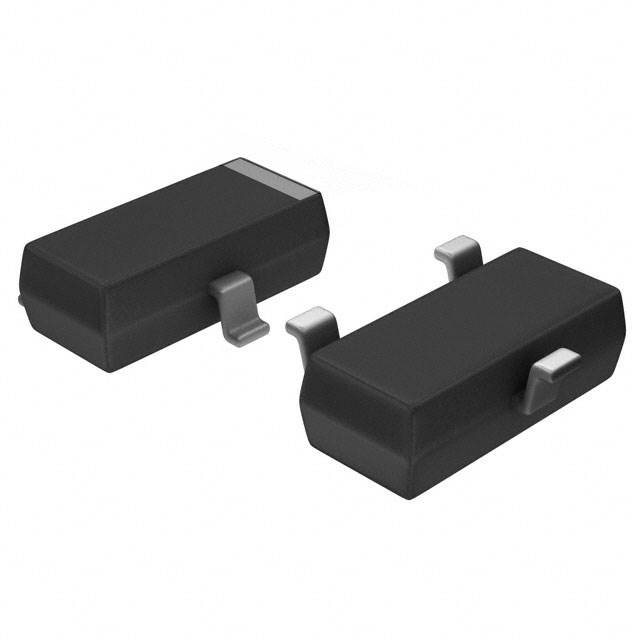
MMBF5485 vs C3M0350120D: Component Comparison for Power Electronics Engineers
Quick verdict
For RF and low-current analog switching applications below 15 V and up to 400 MHz, the MMBF5485 (JFET) is the clear choice due to its low noise figure and appropriate current rating. For high-voltage power switching, especially in power conversion or motor drive scenarios requiring blocking voltages up to 1200 V and continuous currents above 7 A, the C3M0350120D (SiC MOSFET) is the only viable option due to its high voltage rating, low on-resistance, and robust thermal capabilities.
Spec comparison table
| Spec | MMBF5485 | C3M0350120D | Notes |
|---|---|---|---|
| Configuration | N-Channel JFET | N-Channel SiCFET (SiC MOSFET) | Both N-Channel; JFET vs SiC MOSFET impacts switching and conduction behavior |
| Current rating (continuous) | 10 mA | 7.6 A (Tc) | C3M0350120D supports >750x higher current; critical for power applications |
| Frequency | 400 MHz | N/A | MMBF5485 supports RF operation; C3M0350120D not specified for RF |
| Gain | - | - | No gain data for MMBF5485; MOSFET gain not applicable |
| Mounting type | Surface Mount (SOT-23-3) | Through Hole (TO-247-3) | MMBF5485 suitable for compact SMT; C3M0350120D requires larger PCB area and heat sinking |
| Noise figure | 4 dB | N/A | Low noise figure for MMBF5485 benefits sensitive analog/RF circuits |
| Output power max | - | - | Not specified for either; MMBF5485 likely low power; C3M0350120D handles high power dissipation (50 W Tc) |
| Package case | TO-236-3, SC-59, SOT-23-3 | TO-247-3 | Large TO-247 enables better thermal management for C3M0350120D |
| Voltage rated (Drain-Source) | 25 V | 1200 V | C3M0350120D supports 48x higher voltage, enabling high-voltage power designs |
| Voltage test | 15 V | - | MMBF5485 tested up to 15 V; C3M0350120D rated to 1200 V |
| Max continuous diode forward current | N/A | 9.4 A | C3M0350120D includes body diode rated for high current |
| Diode forward voltage max | N/A | 4.5 V | Relevant for C3M0350120D body diode conduction losses |
| Drain-source on-resistance (Rds(on)) | N/A | 525 mΩ typ @ 3.6 A, 15 V gate drive | Low Rds(on) critical for power efficiency; MMBF5485 no Rds(on) spec (JFET) |
| Gate charge (Qg) max | N/A | 20 nC @ 15 V | Lower gate charge reduces switching losses; 20 nC is moderate for SiC MOSFET |
| Gate threshold voltage (Vgs_th) | N/A | 2.0 V typ | C3M0350120D requires 2 V to start conduction; MMBF5485 JFET gate bias differs |
| Gate-source voltage max | ±15 V (typ) | +19 V / -8 V max | C3M0350120D has wide gate voltage tolerance; MMBF5485 likely similar but not specified |
| Gate-source leakage current max | N/A | 250 nA max | Low gate leakage important for gate drive stability |
| Junction temperature max | N/A | 150 °C max | C3M0350120D supports high TJ; MMBF5485 datasheet doesn’t specify TJ max |
| Thermal resistance junction-to-case | N/A | 2.5 °C/W typ | C3M0350120D TO-247 package facilitates heat dissipation |
| Power dissipation max | N/A | 50 W (Tc) | C3M0350120D handles substantial power dissipation with proper cooling |
| Switching parameters (tr, tf, Qrr) | N/A | Rise time 16 ns, fall time 17 ns, reverse recovery charge 67 nC max | Critical for switching losses in power applications |
| Package size (approx.) | SOT-23-3 (3 pins, ~2.9x1.3 mm) | TO-247-3 (3 pins, ~21x16 mm) | Size difference impacts layout and thermal design |
| Mounting torque | N/A | 8.8 Ibf-in min | Relevant for mechanical mounting of TO-247 package |
| Noise figure | 4 dB | N/A | MMBF5485 suitable for low noise RF applications; C3M0350120D not designed for RF |
Note: Many parameters in the C3M0350120D datasheet reflect power MOSFET metrics, while MMBF5485 is a low-power RF JFET transistor.
Design trade-offs
The MMBF5485 and C3M0350120D serve vastly different application spaces, reflected in their specifications and package types. The MMBF5485 is a low-current, low-voltage JFET optimized for RF switching and analog front ends, with a frequency rating of 400 MHz and a low noise figure of 4 dB. Its current rating of 10 mA and SOT-23-3 package make it suitable for compact, high-frequency switching circuits or buffer stages where minimal noise and small footprint are priorities.
In contrast, the C3M0350120D is a silicon carbide (SiC) power MOSFET designed for high-voltage, high-current power conversion. Its 1200 V blocking voltage and 7.6 A continuous current rating, combined with a TO-247 through-hole package, indicate a design focus on robust power switching rather than speed or noise. The SiC technology enables operation at higher junction temperatures (up to 150 °C) and better efficiency at high voltages compared to silicon MOSFETs, but requires careful gate drive design given its 20 nC gate charge and a gate threshold voltage around 2 V.
From a layout perspective, the MMBF5485’s tiny SOT-23 package allows for dense PCB layouts with minimal parasitic inductance, critical at RF frequencies. It requires a simple gate biasing arrangement typical for JFETs, but care is needed to maintain low noise and stable operation. The C3M0350120D’s large TO-247 footprint demands significant PCB real estate and a well-designed thermal dissipation path, including a heat sink or forced air cooling, to handle its 50 W power dissipation capability.
Gate drive requirements differ markedly: the MMBF5485 JFET is voltage-controlled with negligible gate current, while the C3M0350120D needs a robust gate driver capable of sourcing/sinking tens of milliamps to charge/discharge the 20 nC gate capacitance rapidly, especially to achieve fast switching speeds and reduce switching losses in power applications. The higher gate voltage tolerance (+19 V max) provides some margin but requires careful gate voltage clamping to avoid device damage.
Cost and availability will also differ. The MMBF5485 is a low-cost transistor suitable for volume consumer or communication applications, while the C3M0350120D, as a SiC device in a large package, is likely more expensive and targeted at industrial or automotive power electronics.
Use-case fit
Choose MMBF5485 when…
- Designing RF front-end switching or low-noise buffer amplifiers operating up to 400 MHz with supply voltages under 15 V.
- Implementing low-current analog switches or attenuators requiring low noise figure and small footprint.
- Developing sensitive measurement instrumentation where the 4 dB noise figure improves signal integrity.
- Space-constrained SMT designs where SOT-23-3 footprint is preferred.
- Applications needing a JFET’s linearity and voltage-controlled behavior at low voltage and current.
Choose C3M0350120D when…
- Building high-voltage DC-DC converters, inverters, or motor drives requiring blocking voltages of 1200 V.
- Designing power switching circuits with continuous currents around 7.6 A and pulsed currents up to 20 A.
- Applications demanding high-temperature operation (up to 150 °C junction) and robust thermal management.
- Systems where switching losses must be minimized with fast rise/fall times (~16-17 ns) and low output capacitance.
- Industrial or automotive power electronics where SiC’s wide bandgap properties improve efficiency and reliability.
Drop-in compatibility
These parts are not pin-compatible or footprint-compatible. The MMBF5485 is a small SOT-23-3 surface mount transistor optimized for low current and RF signals, while the C3M0350120D is a large TO-247-3 through-hole package power