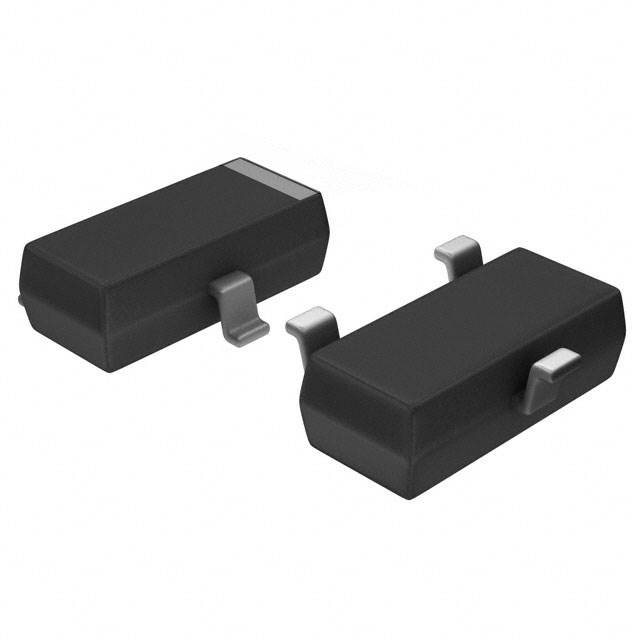
MMBF5485 vs C3M0075120J: A Component Comparison for Power Electronics Engineers
Quick verdict
For low-current, high-frequency RF switching or signal amplification up to 400 MHz, the MMBF5485 is the clear choice due to its JFET technology and low noise figure. Conversely, for high-voltage, high-current power switching applications where SiC technology’s efficiency and thermal performance matter, the C3M0075120J dominates, handling 1200 V and continuous currents up to 30 A.
Spec comparison table
| Spec | MMBF5485 | C3M0075120J | Notes |
|---|---|---|---|
| Configuration | N-Channel | N-Channel | Both N-Channel; no difference in polarity. |
| Current rating (continuous) | 10 mA | 30 A (Tc) | C3M0075120J supports 3000x higher current; critical for power applications. |
| Frequency | 400 MHz | Not specified (power MOSFET) | MMBF5485 designed for RF up to 400 MHz; C3M0075120J unsuitable for RF switching. |
| Gain | - | - | No gain data for either; MMBF5485 is a JFET, typically with inherent gain in RF circuits. |
| Mounting type | Surface Mount (SOT-23-3) | Surface Mount (D2PAK-7) | MMBF5485 in small SOT-23-3 for compact RF; C3M0075120J in large D2PAK-7 for power. |
| Noise figure | 4 dB | Not specified | MMBF5485’s 4 dB noise figure supports low-noise RF applications; C3M0075120J not targeted here. |
| Output power max | Not specified | 113.6 W (Tc) | C3M0075120J can handle substantial power dissipation; MMBF5485 not designed for power. |
| Package case | TO-236-3, SC-59, SOT-23-3 | TO-263-8, D2PAK (7 leads + tab) | Larger package on C3M0075120J for heat sinking and high power dissipation. |
| Supplier device package | SOT-23-3 | D2PAK-7 | See above; footprint difference significant for PCB layout. |
| Technology | JFET | SiCFET (Silicon Carbide) | JFET for RF low-power; SiC MOSFET for high voltage, high power, high temperature. |
| Voltage rated | 25 V | 1200 V | C3M0075120J voltage rating is 48x higher, enabling high-voltage power systems. |
| Voltage test | 15 V | 15 V | Test voltage for MMBF5485; C3M0075120J gate drive voltage max is 15 V for Rds(on). |
| Continuous drain current (Id) at 25°C | 10 mA | 30 A (Tc) | Reinforces current capability difference; C3M0075120J is for power; MMBF5485 for signal. |
| Drive voltage max Rds(on) min Rds(on) | Not specified | 15 V | C3M0075120J gate drive optimized for 15 V; MMBF5485 JFET gate drive differs (JFET gate). |
| Gate charge Qg max @ 15 V | Not specified | 51 nC | C3M0075120J has significant gate charge; impacts switching speed and driver requirements. |
| Gate-source voltage max | Not specified | +19 V / -8 V | C3M0075120J gate voltage limits must be observed to avoid damage. |
| Input capacitance Ciss max @ 1000 V | Not specified | 1350 pF | High input capacitance on C3M0075120J affects switching losses and gate drive requirements. |
| Operating temperature range | Not specified | -55°C to 150°C (TJ) | C3M0075120J supports wide temperature range; MMBF5485 likely more limited (typical for JFET). |
| Power dissipation max | Not specified | 113.6 W (Tc) | Only C3M0075120J rated for high power dissipation. |
| Rds(on) max @ 20A, 15V | Not specified | 90 mΩ | C3M0075120J low Rds(on) at high current reduces conduction losses in power circuits. |
| Vgs threshold max @ 5mA | Not specified | 4 V | C3M0075120J typical threshold voltage for MOSFET gate drive design. |
Design trade-offs
The MMBF5485 and C3M0075120J target fundamentally different application spaces. The MMBF5485 is a low-current JFET optimized for RF signal paths up to 400 MHz, with a very small SOT-23 package minimizing parasitic capacitances and inductances critical in high-frequency circuits. Its 4 dB noise figure and low current handling (10 mA max) make it suitable for low-level analog switching or small-signal amplification, but it is unsuitable for power conversion or switching larger loads.
In contrast, the C3M0075120J is a silicon carbide MOSFET designed for demanding power electronics, with a 1200 V rating and 30 A continuous current capability. Its D2PAK-7 package is much larger and includes a thermal tab, necessary to dissipate up to 113.6 W junction power under ideal cooling conditions. This SiC device enables higher switching frequencies and efficiencies in power conversion due to low Rds(on) (90 mΩ at 20 A) and high-temperature operation (up to 150°C), but requires a robust gate driver capable of delivering 51 nC of gate charge at 15 V. Layout must accommodate larger currents, thermal management, and careful gate drive routing to minimize switching losses and electromagnetic interference.
The gate drive requirements differ substantially. The MMBF5485, as a JFET, typically operates with low input capacitance and no gate charge in the MOSFET sense, often requiring a fixed voltage bias rather than a switching gate drive. The C3M0075120J requires a dedicated MOSFET gate driver capable of sourcing and sinking tens of milliamps to switch the device efficiently without excessive losses or gate ringing.
Thermal considerations are a major factor: the MMBF5485 dissipates negligible power and can be mounted on small, dense PCBs without heat sinking. The C3M0075120J demands a PCB with sufficient copper area or a dedicated heat sink to maintain junction temperature below its 150°C limit under load. This impacts board stack-up, material selection, and mechanical design.
Regarding cost, the MMBF5485 is a low-cost, mass-produced RF transistor in a tiny footprint, suitable for high-volume signal chain applications where power dissipation is minimal. The C3M0075120J, as a SiC MOSFET, is significantly more expensive per unit but justified in high-voltage/high-current power electronics like motor drives, inverters, and high-efficiency power supplies.
Use-case fit
Choose MMBF5485 when…
- Designing RF front-end switches or low-noise amplifiers operating up to 400 MHz, where low noise figure and low parasitic capacitance matter.
- Implementing low-level analog signal switching or buffering with currents under 10 mA in compact, space-constrained circuits.
- Working on small, battery-powered or portable devices needing minimal power consumption and tiny SOT-23 footprints.
- Prototyping or repairing legacy RF circuits requiring direct replacement of JFET-based devices.
- Budget constraints prioritize low-cost, low-power small-signal devices without complex gate drive circuitry.
Choose C3M0075120J when…
- Developing high-voltage switching stages (up to 1200 V) in industrial, automotive, or grid-tied power electronics.
- Designing power converters or motor drives requiring continuous currents up to 30 A and power dissipation exceeding 100 W.
- Needing high-temperature operation up to 150°C junction temperature with reliable thermal performance.
- Targeting efficiency improvements using SiC MOSFETs with low Rds(on) at high current levels.
- Implementing hard-switched or resonant power stages where gate charge and switching losses must be carefully managed with dedicated MOSFET drivers.
Drop-in compatibility
These parts are neither pin-compatible nor footprint-compatible. The MMBF5485 is a 3-pin JFET in a small SOT-23-3 package intended for RF circuits, while the C3M0075120J is a 7-lead SiC MOSFET in a large D2PAK-7 package designed for power applications. Substituting one for the other would require a complete redesign of the PCB footprint, gate drive circuitry, and thermal management strategy. There is no direct drop-in replacement relationship between these devices.
Alternatives to consider
- BSS138 (N-Channel MOSFET, 50 V, 200 mA, SOT-23): A low-voltage MOS