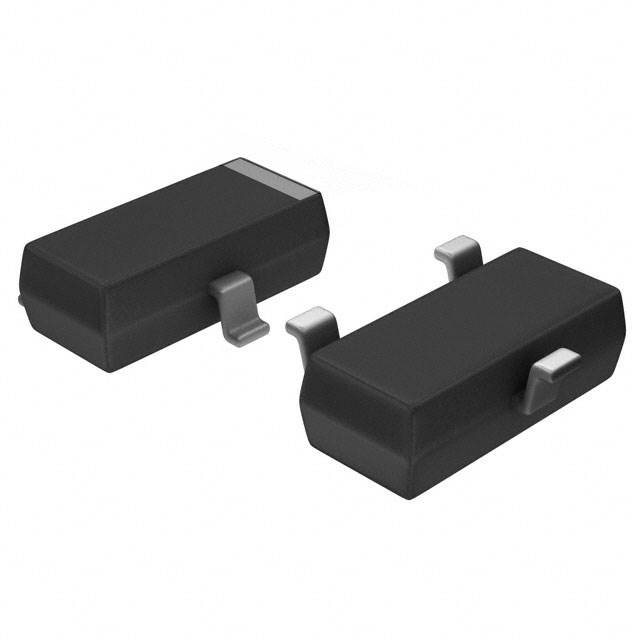
MMBF5485 vs C3M0075120D: Component Comparison for Power Electronics Engineers
Quick verdict
For low-power RF and signal-level switching applications up to a few MHz, the MMBF5485 JFET excels with its low noise figure and small SOT-23 package, making it suitable for sensitive analog front ends. Conversely, the C3M0075120D SiC MOSFET is the clear choice for high-voltage, high-current power conversion, such as in industrial motor drives or power supplies, where its 1200 V rating and 30 A capability dominate.
Spec comparison table
| Spec | MMBF5485 | C3M0075120D | Notes |
|---|---|---|---|
| Configuration | N-Channel JFET | N-Channel SiC MOSFET | Both N-Channel; different transistor types affect drive and switching characteristics |
| Current rating (continuous) | 10 mA | 30 A (Tc) | C3M0075120D supports 3000× higher current, critical for power stages |
| Frequency | 400 MHz | Not specified | MMBF5485 designed for RF frequencies, C3M0075120D for power switching at lower frequencies |
| Gain | Not specified | Not specified | Gain not specified for either; MOSFETs have voltage-controlled resistance, JFETs have transconductance |
| Mounting type | Surface Mount (SOT-23-3) | Through Hole (TO-247-3) | MMBF5485 suits compact PCB layouts; C3M0075120D requires more PCB space, better heat sinking |
| Noise figure | 4 dB | Not specified | MMBF5485 better for low-noise analog/RF circuits |
| Output power max | Not specified | 113.6 W (Tc) | C3M0075120D can handle significantly higher power dissipation |
| Package case | TO-236-3, SC-59, SOT-23-3 | TO-247-3 | Larger package on C3M0075120D allows better thermal management |
| Voltage rated | 25 V | 1200 V | C3M0075120D is rated for 48× higher voltage, enabling use in high-voltage power systems |
| Voltage test | 15 V | 15 V | Similar test voltage, but C3M0075120D max drain-source voltage is much higher |
| Gate charge (Qg) | Not specified | 54 nC @ 15 V | C3M0075120D has significant gate charge impacting switching losses and gate driver sizing |
| Gate-source voltage max | Not specified | +19 V / -8 V | C3M0075120D requires careful gate drive voltage margin management |
| Input capacitance (Ciss) | Not specified | 1350 pF @ 1000 V | High input capacitance on C3M0075120D affects switching speed and requires stronger drivers |
| Rds(on) max | Not specified | 90 mΩ @ 20 A, 15 V | C3M0075120D Rds(on) is low but not ultra-low; no data for MMBF5485 |
| Threshold voltage (Vgs_th) | Not specified | 4 V @ 5 mA | C3M0075120D gate threshold voltage moderate, affects gate drive design |
| Operating temperature range | Not specified | -55°C to 150°C (TJ) | C3M0075120D supports wider temperature range, suitable for harsh environments |
Design trade-offs
The MMBF5485 and C3M0075120D target fundamentally different application domains, reflected in their transistor technologies, voltage/current ratings, and packaging.
The MMBF5485 is a low-current (10 mA), low-voltage (25 V max) JFET optimized for RF applications up to 400 MHz, with a low noise figure of 4 dB. Its small SOT-23 package minimizes PCB area and parasitics, which is beneficial in high-frequency analog front ends. The lack of detailed Rds(on) or gate charge specs suggests it is not intended for power switching but rather for signal amplification or low-level switching. Gate drive requirements are minimal due to JFET nature, and thermal dissipation is negligible at milliamps.
In contrast, the C3M0075120D is a Silicon Carbide MOSFET designed for high power and voltage (1200 V, 30 A continuous) with a robust TO-247 package for effective heat sinking. Its relatively high gate charge (54 nC at 15 V) and input capacitance (1350 pF) mean gate drivers must be capable of delivering significant charge quickly to maintain switching speed and efficiency. The Rds(on) of 90 mΩ at 20 A and 15 V gate drive is reasonable but not extremely low, so conduction losses must be considered in efficiency calculations. Thermal management is critical, as it can dissipate up to 113.6 W at case temperature. The wide operating temperature range (-55 to 150 °C) supports use in demanding environments.
From a layout perspective, MMBF5485’s tiny footprint and low power dissipation simplify routing and cooling, while the C3M0075120D requires careful placement near heatsinks, thick copper planes, and possibly forced air or liquid cooling. The SiC technology of the C3M0075120D offers faster switching and higher blocking voltage compared to silicon MOSFETs but demands specialized gate drivers and snubbers to manage switching transients.
Cost-wise, the MMBF5485 is a low-cost commodity RF transistor, while the C3M0075120D is a specialized SiC device, likely more expensive and reserved for applications where its high voltage and power capabilities justify cost.
Use-case fit
Choose MMBF5485 when…
- Designing low-noise RF front ends or amplifiers operating below 400 MHz requiring a low noise figure (~4 dB).
- Implementing small-signal switching or buffering circuits at milliamps current levels in compact, surface-mount form factors.
- Minimizing PCB area and parasitic capacitances is critical for signal integrity.
- Building prototypes or low-cost consumer RF devices where high voltage and power handling are unnecessary.
- Integrating with analog or mixed-signal ICs that require JFET input stages or switches.
Choose C3M0075120D when…
- Designing high-voltage (up to 1200 V) power converters, such as motor drives, solar inverters, or industrial power supplies.
- Handling continuous currents up to 30 A with efficient thermal dissipation via a TO-247 package and heatsinks.
- Implementing high-speed switching power stages where SiC MOSFET switching speed and robustness extend efficiency and reliability.
- Operating in wide temperature ranges (-55°C to 150°C), including harsh industrial environments.
- Needing a device with a maximum power dissipation of over 100 W at the case, requiring substantial thermal management.
Drop-in compatibility
The MMBF5485 (SOT-23-3) and C3M0075120D (TO-247-3) differ drastically in package, pinout, and electrical characteristics. They are neither pin-compatible nor footprint-compatible. Substituting one for the other requires complete redesign of the PCB, gate driver circuitry, and thermal solution. The MMBF5485 cannot replace the C3M0075120D in power switching applications, nor vice versa in RF or low-level signal roles.
Alternatives to consider
- BSS138 (N-Channel MOSFET, 50 V, SOT-23): A low-voltage MOSFET alternative for low-power switching, offering better Rds(on) than a JFET but still in a small package.
- IPW65R045CFD (SiC MOSFET, 650 V, 45 mΩ, TO-247-3): Mid-voltage SiC MOSFET option for power stages with lower voltage than C3M0075120D but potentially better Rds(on).
- 2N5457 (N-Channel JFET, 25 V, TO-92): Analog JFET alternative with similar voltage rating to MMBF5485 but in a through-hole package, useful for prototyping or discrete analog circuits.