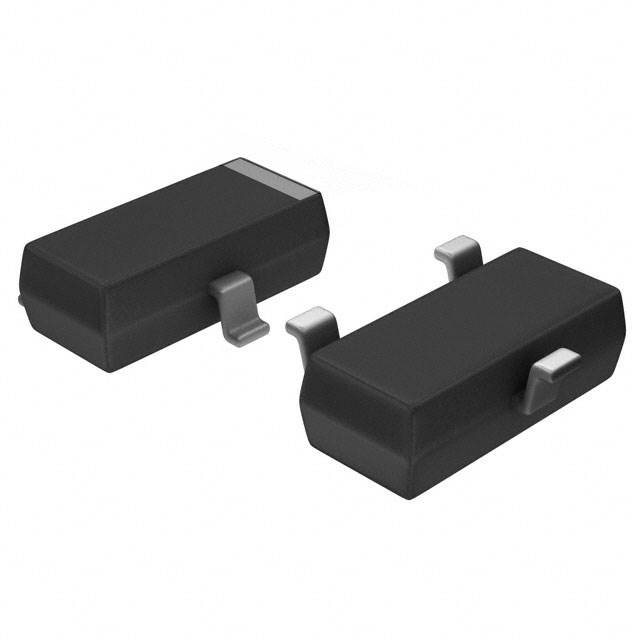
MMBF5485 vs C3M0040120D: Component Comparison for Power and RF Applications
Quick verdict
For low-current, high-frequency analog/RF applications requiring a low-noise JFET, the MMBF5485 is the clear choice due to its 400 MHz operation and low noise figure. For high-voltage, high-current power switching, such as industrial motor drives or power inverters, the C3M0040120D outperforms with a 1200 V rating and 66 A continuous current capability, making it suitable for demanding power electronics.
Spec comparison table
| Spec | MMBF5485 | C3M0040120D | Notes |
|---|---|---|---|
| Configuration | N-Channel JFET | N-Channel SiC MOSFET | Different device types: JFET vs SiC MOSFET; affects drive and switching characteristics |
| Current rating (continuous) | 10 mA | 66 A (Tc) | C3M0040120D supports 6600× higher current; MMBF5485 is for signal-level; C3M0040120D for power |
| Frequency | 400 MHz | Not specified | MMBF5485 optimized for RF; C3M0040120D is power device, unsuitable for RF frequencies |
| Gain | Not given | Not given | Not directly comparable; MMBF5485 is low-noise amplifier type |
| Mounting type | Surface Mount (SOT-23-3) | Through Hole (TO-247-3) | MMBF5485 is compact SMD; C3M0040120D is large TO-247 for heat sinking |
| Noise figure | 4 dB | Not specified | MMBF5485 noise figure relevant for RF design |
| Output power max | Not specified | Not specified | Not comparable; MMBF5485 is low power |
| Package case | TO-236-3, SC-59, SOT-23-3 | TO-247-3 | C3M0040120D physically much larger for thermal dissipation |
| Voltage rating (max) | 25 V | 1200 V | C3M0040120D supports 48× higher voltage |
| Voltage test | 15 V | Not specified | MMBF5485 tested at 15V; C3M0040120D rated for 1200V |
| Max continuous drain current | 10 mA | 66 A (Tc) | Repeats current rating; C3M0040120D handles industrial-level currents |
| Drain-source breakdown voltage | 25 V max | 1200 V min | C3M0040120D capable of high voltage blocking |
| Drain-source on-state resistance | Not specified | 68 mΩ typ @ 33.3 A, 15 V | C3M0040120D low Rds(on) for power efficiency |
| Gate charge (Qg) | Not specified | 101 nC @ 15 V | C3M0040120D requires significant gate drive energy; MMBF5485 gate drive minimal |
| Gate-source leakage current | Not specified | 10 nA typ | Both low leakage; typical for MOSFET and JFET devices |
| Gate threshold voltage | Not specified | 2.2 V typ | C3M0040120D requires gate drive above 2.2 V to turn on fully |
| Gate-source voltage max | 15 V test | +15 V / -4 V operational | Both devices have similar max gate drive voltage limits |
| Power dissipation max | Not specified | 326 W (Tc) | C3M0040120D designed for significant power dissipation with appropriate cooling |
| Operating junction temperature | Not specified | -40 °C to +175 °C | C3M0040120D rated for wide temperature range suitable for power applications |
| Storage temperature | Not specified | -40 °C to +175 °C | C3M0040120D supports industrial storage conditions |
| Thermal resistance junction-case | Not specified | 0.46 °C/W | C3M0040120D allows efficient heat sinking; MMBF5485 data not provided |
| Package dimensions (typical) | SOT-23-3 (small) | TO-247-3 (large) | C3M0040120D physically larger, requires different PCB layout and cooling |
| Switching times (rise/fall) | Not specified | 60 ns rise, 12 ns fall typ | C3M0040120D switching speeds suitable for power switching |
| Reverse recovery time | Not specified | 45–53 ns | C3M0040120D has fast body diode recovery time for switching efficiency |
| Reverse transfer capacitance | Not specified | 5 pF typ | Low capacitance favorable for switching efficiency in power converters |
Design trade-offs
The MMBF5485 is a low-current JFET optimized for RF and low-noise analog front-end designs, with a frequency response up to 400 MHz and a noise figure of 4 dB. Its tiny SOT-23 package facilitates compact, surface-mount layouts with minimal parasitic inductance and capacitance, critical for high-frequency performance. The device operates at very low currents (10 mA max), making it unsuitable for power switching but ideal for amplifier input stages, mixers, or sensitive RF circuits where noise and linearity dominate.
In contrast, the C3M0040120D is a silicon carbide (SiC) MOSFET designed for high-voltage (1200 V), high-current (66 A continuous) power electronics applications. The TO-247 package supports robust heat sinking, essential for managing its 326 W power dissipation rating under thermal load. Its 68 mΩ typical on-resistance at 33.3 A is competitive for a SiC device at this voltage rating, offering efficiency improvements over silicon IGBTs or MOSFETs in similar roles. However, the significant gate charge (101 nC) and gate drive requirements (15 V gate drive) demand a capable gate driver stage, which increases system complexity and cost. Switching times in the tens of nanoseconds range suit medium-to-high frequency power conversion but are orders of magnitude slower than the MMBF5485’s RF-capable operation.
Thermally, the C3M0040120D needs careful layout to minimize junction-to-case resistance and enable effective heat dissipation via a heatsink or PCB copper area. Its large footprint and through-hole mounting contrast with the compact SMD form factor of the MMBF5485, which requires only standard PCB pads and no heatsinking considerations. Cost-wise, the MMBF5485 is a low-cost semiconductor for consumer or communication products, while the C3M0040120D, being a specialized SiC MOSFET, commands a premium price justified by its voltage and current ratings and efficiency gains.
From a firmware perspective, the MMBF5485 requires minimal gate drive and no complex switching control, often operating as a linear device. The C3M0040120D mandates a dedicated gate driver, often with adjustable gate resistance (typical external ~2.5 Ω recommended) and protection features to handle transient voltages and fast switching events.
Use-case fit
Choose MMBF5485 when…
- Designing low-noise RF front-end amplifiers or mixers operating near 400 MHz.
- Developing precision analog circuits needing a low-noise JFET with minimal input current.
- Implementing small-signal switching or buffering in communication circuits where power is in milliwatts.
- Space constraints and surface-mount assembly are critical, and no significant heat dissipation is expected.
- Your design requires a low-voltage device with a simple, low-power gate drive (JFET gate bias).
Choose C3M0040120D when…
- Building industrial or automotive power electronics requiring blocking voltages up to 1200 V.
- Designing motor drives, power inverters, or DC-DC converters demanding continuous currents above 30 A.
- Thermal management with heatsinking is feasible to handle up to 326 W dissipation.
- Fast switching speed with low Rds(on) is needed to improve efficiency at medium switching frequencies.
- You have the budget and PCB space to implement a SiC MOSFET gate driver with proper transient protection.
Drop-in compatibility
These devices are neither pin-compatible nor footprint-compatible. The MMBF5485 is a small SOT-23-3 surface-mount JFET, while the C3M0040120D is a large TO-247-3 through-hole SiC MOSFET. Substituting one for the other requires a complete redesign of the PCB footprint, gate drive circuitry, and thermal management strategy. Their electrical characteristics and applications are so different that drop-in replacement is not feasible.
Alternatives to consider
- BSS138 (N-Channel MOSFET, SOT-23): Low-voltage, small-signal MOSFET alternative to MMBF5485 for switching and analog applications with simpler gate drive.
- C2M0080120D (Wolfspeed SiC MOSFET, TO-247): Similar voltage rating (1200 V)