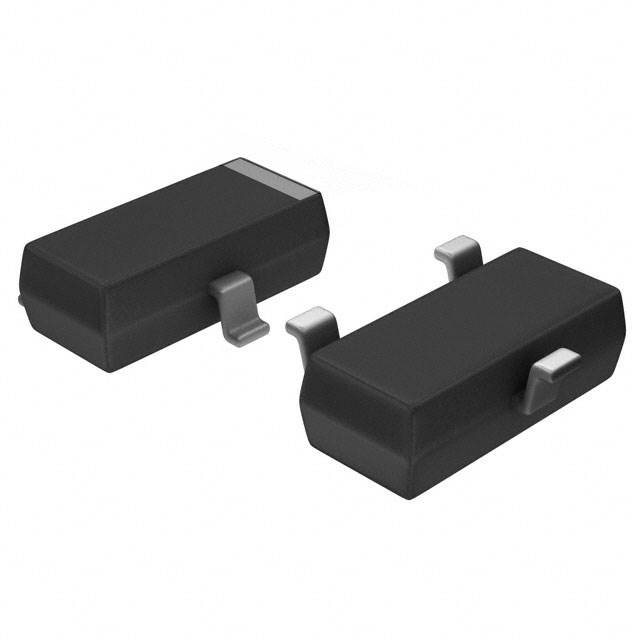
MMBF5485 vs BSC011N03LSIATMA1: Component Comparison for Hardware Engineers
Quick verdict
For low-level RF amplification and switching applications below 400 MHz with minimal current requirements, the MMBF5485 JFET is the clear choice due to its low noise figure and high-frequency capability. Conversely, for high-current power switching or load driving up to 30 V and tens of amps, the Infineon BSC011N03LSIATMA1 MOSFET dominates with its low R_DS(on), high avalanche robustness, and superior thermal dissipation.
Spec comparison table
| Spec | MMBF5485 | BSC011N03LSIATMA1 | Notes |
|---|---|---|---|
| Configuration | N-Channel JFET | N-Channel MOSFET | Different transistor types; JFET better for low-noise RF, MOSFET for power switching |
| Current rating (continuous) | 10 mA | 37 A (Ta), 100 A (Tc) | BSC011N03LSIATMA1 supports 3,700–10,000× higher current |
| Frequency | 400 MHz | Not specified (power MOSFET) | MMBF5485 suitable for RF applications up to 400 MHz |
| Noise figure | 4 dB | Not specified | MMBF5485 designed for low-noise applications |
| Voltage rating (max) | 25 V | 30 V | BSC011N03LSIATMA1 has 20% higher voltage rating |
| Voltage test (V) | 15 V | 30 V | BSC011N03LSIATMA1 rated for higher test voltage |
| Output power max | Not specified | Not specified | Not comparable |
| Package case | TO-236-3 / SC-59 / SOT-23-3 | PG-TDSON-8-7 | Different package types; affects layout and thermal management |
| Mounting type | Surface Mount | Surface Mount | Both surface mount |
| Technology | JFET | MOSFET (Metal Oxide) | Fundamental device difference |
| Gain | Not specified | Not specified | Not comparable |
| Power dissipation max | Not specified | 2.5 W (Ta), 96 W (Tc) | BSC011N03LSIATMA1 supports much higher power dissipation |
| Drain-Source breakdown voltage min | 25 V (typical rating) | 30 V (min) | BSC011N03LSIATMA1 better voltage margin |
| Drain-Source on-state resistance (R_DS(on)) | Not specified | 0.12 mΩ @ 30 A, 10 V | BSC011N03LSIATMA1 extremely low R_DS(on), critical for conduction losses |
| Gate charge (Q_g) max at V_GS | Not specified | 68 nC @ 10 V | BSC011N03LSIATMA1 requires significant gate drive energy |
| Gate threshold voltage (V_GS(th)) | Not specified | 1.2 V (min) to 2 V (max) @ 250 µA | BSC011N03LSIATMA1 has a well-defined MOSFET threshold |
| Gate-source voltage max | ±20 V | ±20 V | Equal gate voltage tolerance |
| Gate-source leakage current max | Not specified | 100 nA | Low leakage typical for MOSFET |
| Avalanche energy max | Not specified | 100 mJ | BSC011N03LSIATMA1 rated for avalanche energy, important for inductive load switching |
| Avalanche current max | Not specified | -50 A | BSC011N03LSIATMA1 can handle avalanche currents |
| Diode continuous forward current max | Not specified | -120 A | BSC011N03LSIATMA1 integrated body diode supports high current |
| Diode forward voltage max | Not specified | 3 V | Typical MOSFET body diode voltage drop |
| Switching frequency min | 400 MHz (RF device) | 554.4 kHz (min) | MMBF5485 supports much higher frequency applications |
| Rise time max | Not specified | 6.2 ns | BSC011N03LSIATMA1 switching speed suitable for high-frequency power switching |
| Fall time max | Not specified | 35 ns | Adequate for typical power switching speeds |
| Gate resistance | Not specified | 0.3 Ω (min) to 1.2 Ω (max) | Affects gate drive circuit design |
| Input capacitance (C_iss) max @ 15 V | Not specified | 4300 pF | BSC011N03LSIATMA1 has significant input capacitance, impacts switching losses |
| Reverse transfer capacitance (C_rss) max | Not specified | 1600 pF | Important for switching performance |
| Operating temp range (TJ) | Not specified | -55°C to 150°C | BSC011N03LSIATMA1 rated for industrial temperature range |
| Package outline dimensions | SOT-23-3 small outline | PG-TDSON-8-7 larger outline | BSC011N03LSIATMA1 physically larger, impacts PCB footprint and thermal design |
Design trade-offs
The MMBF5485 is a low-current N-channel JFET optimized for RF applications up to 400 MHz with a low noise figure of 4 dB. Its maximum current rating of 10 mA and voltage rating of 25 V make it suitable for signal-level amplification rather than power switching. The compact SOT-23-3 package simplifies integration in dense RF front-ends. However, the lack of specified gain and output power limits its use to low-power stages. The JFET technology means gate drive is simpler (no gate charge to drive), but the device is not suitable for switching large currents or dissipating significant power.
In contrast, the BSC011N03LSIATMA1 is a power MOSFET designed for high-current switching and load driving. Its ultra-low R_DS(on) of 0.12 mΩ at 30 A and 10 V gate drive translates into very low conduction losses at high currents, critical for improving efficiency in power converters or motor drives. It supports continuous drain currents of 37 A at ambient and up to 100 A at case temperature, with avalanche robustness rated to 100 mJ, enabling it to handle inductive switching events safely. The PG-TDSON-8-7 package has a larger footprint and requires careful thermal design to fully exploit its power dissipation capability (up to 96 W at case temperature).
The gate charge of the BSC011N03LSIATMA1 is substantial (68 nC max at 10 V), adding gate drive losses and necessitating a gate driver capable of sourcing/sinking tens of milliamps with fast switching transitions. The input and reverse transfer capacitances are large (4300 pF and 1600 pF respectively), which must be considered in high-frequency switching circuits to avoid excessive switching losses and EMI issues. The gate resistance range (0.3–1.2 Ω) impacts driver selection and layout to minimize ringing and overshoot.
Thermally, the BSC011N03LSIATMA1 requires a PCB with adequate copper area and possibly a heat sink or forced airflow for continuous high-current operation, while the MMBF5485 dissipates negligible power and can operate in cramped RF modules with minimal cooling.
Cost-wise, the MMBF5485 is a simple low-current JFET, likely lower cost and simpler sourcing for RF signal chain components. The BSC011N03LSIATMA1 is a more complex high-current MOSFET, likely higher cost but justified by power handling and efficiency improvements.
Use-case fit
Choose MMBF5485 when…
- Designing low-noise RF amplifiers or buffer stages up to 400 MHz where a low noise figure (4 dB) is critical.
- Working with signal-level switching or amplification requiring only milliamps of current and voltages below 25 V.
- Space constraints favor the small SOT-23-3 package in dense RF front-end modules.
- Gate drive simplicity is needed, avoiding complex gate driver circuitry.
- Your design prioritizes low-level analog signal integrity over power handling.
Choose BSC011N03LSIATMA1 when…
- Building power converters, motor controllers, or load switches requiring conduction currents from tens to hundreds of amps.
- Efficiency gains are critical, leveraging the ultra-low R_DS(on) of 0.12 mΩ to reduce conduction losses at high current.
- Your application involves inductive loads needing avalanche energy robustness (100 mJ) and integrated body diode with high forward current rating.
- Thermal management can be accommodated in the PCB design to handle up to 96 W dissipation at case temperature.
- High-speed switching is required, with gate charge and switching times compatible with dedicated MOSFET gate drivers.
Drop-in compatibility
These devices are neither pin-compatible nor footprint-compatible. The MMBF5485 is a 3-pin