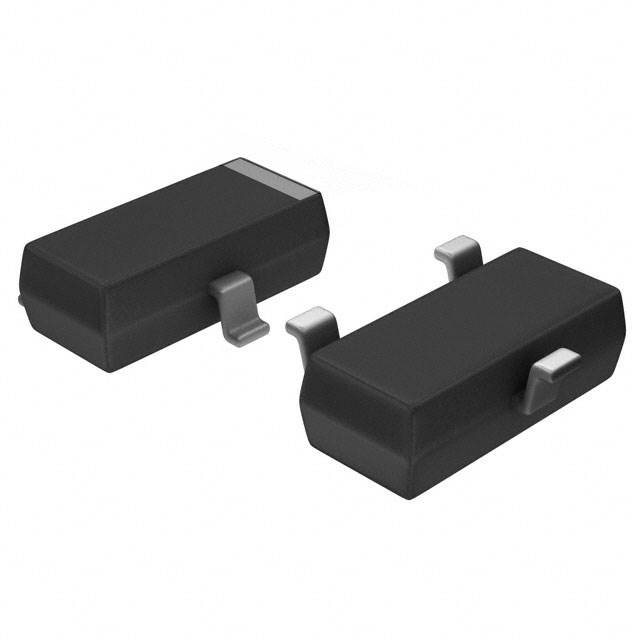
MMBF5485 vs BD6221F-E2: Component Comparison for Hardware Engineers
Quick verdict
For low-current, high-frequency RF switching or signal amplification under 15 V, the MMBF5485 JFET is the clear choice due to its 400 MHz rating and low noise figure. In contrast, for driving small DC motors or inductive loads at currents up to 1 A with integrated protection features, the BD6221F-E2 half-bridge driver offers a ready-to-use power stage and fault management, making it the better fit for power switching and motor control.
Spec comparison table
| Spec | MMBF5485 | BD6221F-E2 | Notes |
|---|---|---|---|
| Configuration | N-Channel JFET | Half Bridge (2 drivers) Power MOSFET | MMBF5485 is a discrete transistor; BD6221F-E2 integrates two MOSFETs and driver logic. |
| Current rating (continuous) | 10 mA | 1 A | BD6221F-E2 supports 100x higher current; better for power loads. |
| Frequency | 400 MHz | Not specified (power device) | MMBF5485 supports RF frequencies; BD6221F-E2 is not suitable for RF applications. |
| Gain | Not specified | Not specified | Neither datasheet provides gain; gain depends on application and circuit design. |
| Mounting type | Surface Mount (SOT-23-3) | Surface Mount (8-SOP) | MMBF5485 is smaller, easier for dense layouts; BD6221F-E2 larger due to integrated driver. |
| Noise figure | 4 dB | Not specified | MMBF5485 low noise figure suits sensitive analog/RF front-ends; BD6221F-E2 not optimized for noise. |
| Output power max | Not specified | Not specified | Not directly comparable; BD6221F-E2 handles power loads via integrated MOSFETs. |
| Package case | TO-236-3, SC-59, SOT-23-3 | 8-SOIC (4.40 mm width) | MMBF5485 smaller footprint; BD6221F-E2 larger due to half-bridge driver integration. |
| Technology | JFET | Power MOSFET | JFET offers low noise, high frequency; MOSFET designed for power switching. |
| Voltage rated | 25 V | 6 V ~ 15 V | MMBF5485 has higher absolute voltage rating; BD6221F-E2 limited to typical 6–15 V motor voltages. |
| Voltage test | 15 V | 6 V ~ 15 V | Both tested at similar voltage ranges relevant to their applications. |
| Current output channel | 10 mA | 1 A | BD6221F-E2 can source 100x more current, critical for motor driving. |
| Fault protection | None | Current Limiting, Over Temperature, Over Voltage, UVLO | BD6221F-E2 has integrated fault protections; MMBF5485 requires external circuitry. |
| Interface | N/A | Logic input | BD6221F-E2 driven by logic signals, simplifying control; MMBF5485 is a discrete transistor. |
| Load type | N/A | Inductive | BD6221F-E2 designed for inductive loads like motors; MMBF5485 not specified. |
| Operating temperature range | Not specified | -40°C ~ 85°C (TA) | BD6221F-E2 specifies industrial TA range; MMBF5485 datasheet does not specify. |
| Rds(on) typical | N/A | 1.5 Ω | BD6221F-E2’s on-resistance affects conduction losses; MMBF5485 not specified. |
Design trade-offs
The MMBF5485 is a low-current, high-frequency JFET optimized for RF switching and low-noise analog front-ends. Its 400 MHz frequency rating and 4 dB noise figure make it suitable for signal paths where bandwidth and noise matter, such as RF mixers, low noise amplifiers, or small-signal switches. The SOT-23-3 package allows placement in dense layouts. However, the 10 mA current rating and lack of integrated protection mean it cannot handle power switching or inductive loads without additional driver and protection circuitry.
In contrast, the BD6221F-E2 integrates a half-bridge power MOSFET driver capable of sourcing 1 A continuous current, targeted at general-purpose DC motor control and inductive load driving. The built-in current limiting, over-temperature, over-voltage protections, and under-voltage lockout simplify system design by reducing external components and firmware complexity. The 1.5 Ω Rds(on) indicates moderate conduction losses; at 1 A, this equates to approximately 1.5 W of conduction power dissipation, which requires thermal management considerations, especially since the package is an 8-SOIC with limited thermal pad area.
From a layout standpoint, the MMBF5485’s small SOT-23-3 footprint is easier to route in RF or analog sections, where parasitic capacitances and inductances must be minimized. The BD6221F-E2’s larger 8-SOIC footprint, along with its power stage, demands careful copper area allocation for heat dissipation and attention to gate drive traces to avoid switching losses and noise coupling.
Efficiency curves are not provided for either device; however, the BD6221F-E2’s MOSFET Rds(on) of 1.5 Ω and 1 A current rating imply significant conduction losses compared to discrete low-Rds(on) MOSFETs. The MMBF5485, being a JFET in a low-current role, is not designed for efficiency in power conversion. Cost-wise, the MMBF5485 is likely less expensive due to its simpler construction and smaller package, but the BD6221F-E2’s integration of two MOSFETs and driver logic may reduce total BOM cost and complexity in motor drive applications.
Gate drive complexity is minimal for the BD6221F-E2 since it accepts logic-level inputs, whereas the MMBF5485 requires appropriate biasing and possibly additional driver circuitry to interface with digital control signals.
Use-case fit
Choose MMBF5485 when…
- Designing RF front-end circuits requiring low noise and high-frequency switching under 15 V.
- Implementing analog signal paths needing low gate leakage and minimal distortion.
- Current demands are minimal (10 mA or less) and device size is critical.
- The application involves discrete transistor stages where control over transistor parameters is required.
- The design requires a low-cost, surface-mount JFET for low-level switching or buffering.
Choose BD6221F-E2 when…
- Driving small DC motors or other inductive loads requiring up to 1 A continuous current.
- Implementing half-bridge power stages with integrated protection to simplify system design.
- Operating within a 6–15 V supply range with robust fault detection and thermal protection.
- Minimizing firmware complexity by offloading current limiting and undervoltage lockout to hardware.
- Designing a compact motor driver module where integrated MOSFETs and logic-level inputs reduce component count.
Drop-in compatibility
These parts are not pin-compatible or footprint-compatible. The MMBF5485 is a discrete, 3-pin JFET in a small SOT-23 package, whereas the BD6221F-E2 is an 8-pin SOIC half-bridge driver IC. Substituting one for the other requires a complete redesign of the PCB footprint, power supply arrangement, and control logic. Their functions differ substantially: a discrete transistor vs. an integrated half-bridge driver.
Alternatives to consider
- BSS138 (N-Channel MOSFET, SOT-23): Low-voltage logic-level MOSFET for general purpose switching, widely used with simple gate drive requirements.
- DRV8833 (Texas Instruments): Dual H-bridge motor driver IC with integrated protection, suitable for higher current motor control applications.
- 2N7002 (N-Channel MOSFET, TO-92/SMD): Popular discrete MOSFET with moderate current handling and low gate charge for switching applications.