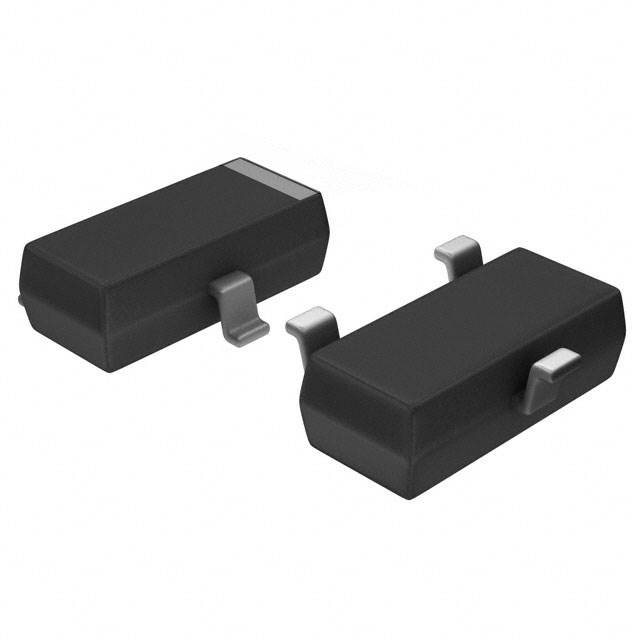
MMBF5485 vs AOSS32338C: Component Comparison for Power Electronics Engineers
Quick verdict
For RF switching or low-current analog front-end applications requiring low noise and high-frequency operation up to 400 MHz, the JFET-based MMBF5485 is the clear choice due to its low noise figure and suitable voltage rating. For power switching or load driving at currents up to 4 A and voltages up to 30 V, the MOSFET AOSS32338C outperforms the MMBF5485 by a wide margin, offering far higher current capacity, lower Rds(on), and better thermal handling.
Spec comparison table
| Spec | MMBF5485 | AOSS32338C | Notes |
|---|---|---|---|
| Configuration | N-Channel JFET | N-Channel MOSFET | Both N-channel; technology differs, impacting drive and switching characteristics |
| Current rating (continuous) | 10 mA | 4 A (Ta) | AOSS32338C supports 400× higher current, critical for load-driving applications |
| Frequency (max) | 400 MHz | Not specified | MMBF5485 supports RF up to 400 MHz; AOSS32338C not intended for RF |
| Gain | Not specified | Not specified | No direct gain data; MMBF5485 likely used in amplification; AOSS32338C as switch |
| Mounting type | Surface Mount | Surface Mount | Both SOT-23-3 packages suitable for compact SMT designs |
| Noise figure | 4 dB | Not specified | MMBF5485 provides low noise figure, important in RF front-ends |
| Output power max | Not specified | Not specified | No data; likely limited for MMBF5485, higher for AOSS32338C |
| Package case | TO-236-3, SC-59, SOT-23-3 | 3-SMD, SOT-23-3 Variant | Physically compatible packages; see drop-in section |
| Technology | JFET | MOSFET | Impacts gate drive, switching speed, and linearity |
| Voltage rated | 25 V | 30 V | AOSS32338C offers slightly higher voltage rating |
| Voltage test | 15 V | Not specified | MMBF5485 tested at 15 V; AOSS32338C max drain-source voltage is 30 V |
| Drive voltage (max Rds(on)) | Not specified | 2.5 V (min Rds(on)) / 10 V | AOSS32338C can be driven at logic-level 2.5 V for low Rds(on) |
| Gate charge (Qg max) | Not specified | 16 nC @ 10 V | AOSS32338C has moderate gate charge, affecting switching losses and driver sizing |
| Gate-source voltage max | Not specified | ±12 V | AOSS32338C supports ±12 V gate-source voltage, standard for MOSFETs |
| Input capacitance (Ciss) | Not specified | 340 pF @ 15 V | AOSS32338C input capacitance affects switching speed and driver requirements |
| Operating temperature range | Not specified | -55°C to 150°C (TJ) | AOSS32338C rated for extended temperature range |
| Power dissipation max | Not specified | 1.3 W (Ta) | AOSS32338C power dissipation rating supports higher power handling |
| Rds(on) max @ Id, Vgs | Not specified | 50 mΩ @ 4A, 10 V | AOSS32338C offers low on-resistance for efficient conduction at high currents |
| Vgs threshold max | Not specified | 1.5 V @ 250 µA | AOSS32338C has a low threshold enabling logic-level drive |
Design trade-offs
The fundamental difference between MMBF5485 and AOSS32338C lies in their device physics and intended application spaces. The MMBF5485 is a JFET optimized for RF front-end use, offering low noise figure (4 dB) and operation up to 400 MHz. This makes it suitable for low-current, high-frequency analog switching or buffering where signal integrity and noise performance matter more than power handling. Its maximum current rating of only 10 mA and relatively low voltage rating (25 V) limit it to signal-level applications rather than power switching.
In contrast, the AOSS32338C is a power MOSFET designed for switching and load driving up to 4 A continuous current at 30 V drain-source voltage. Its low Rds(on) of 50 mΩ at 4 A and 10 V gate drive ensures conduction losses remain manageable in typical low-voltage DC-DC converters, load switches, or motor driver circuits. The 16 nC gate charge at 10 V is moderate, requiring a gate driver capable of sourcing/sinking sufficient current for efficient switching at higher frequencies. Its input capacitance of 340 pF is typical for power MOSFETs but significantly higher than JFETs, demanding attention to gate drive and switching losses.
From a thermal perspective, the AOSS32338C’s 1.3 W maximum power dissipation rating means it can handle power conversion or load switching without aggressive cooling in typical SOT-23-3 footprints. The MMBF5485 lacks explicit power dissipation data but given the low current rating, it is unsuited for power dissipation beyond signal-level currents.
In terms of gate drive, the MMBF5485 as a JFET requires biasing rather than a dedicated gate drive voltage, simplifying drive circuitry for analog applications but limiting its use in digital switching. The AOSS32338C requires a gate voltage above threshold (minimum 1.5 V, recommended 10 V for lowest Rds(on)) and careful gate drive design to optimize switching speed and efficiency. This adds complexity but enables much higher power handling.
Cost-wise, JFETs like the MMBF5485 tend to be niche components and may carry a premium for RF-grade performance. The AOSS32338C, as a power MOSFET in a common package, is likely more cost-effective at volume for power switching applications.
Use-case fit
Choose MMBF5485 when…
- Designing RF front-end switches or buffers operating up to 400 MHz where low noise figure (4 dB) is critical.
- Implementing low-level analog signal routing with maximum current under 10 mA.
- Your circuit requires a JFET’s linearity and low distortion in analog or mixed-signal front-ends.
- Voltage requirements are below 25 V and signal integrity at high frequency outweighs power handling.
- Thermal dissipation is minimal and power losses must be kept very low in small-signal paths.
Choose AOSS32338C when…
- Switching or driving loads up to 4 A at voltages up to 30 V, such as in DC-DC converters, battery protection, or power switches.
- Low Rds(on) (50 mΩ at 4 A) is needed to minimize conduction losses and improve efficiency.
- Operating temperature range from -55°C to 150°C is required for automotive or industrial-grade applications.
- Gate drive circuitry can supply 16 nC gate charge at 10 V for efficient switching.
- You need a standard N-channel MOSFET with logic-level drive capability (threshold ~1.5 V).
Drop-in compatibility
Both devices come in SOT-23-3 packages, but the MMBF5485 is a JFET with different pin functions and biasing requirements compared to the AOSS32338C MOSFET. The pinout is not guaranteed to be identical, and gate/source/drain assignments differ by technology and function. Substituting one for the other without redesigning the surrounding circuit and biasing network is not recommended. No explicit pin compatibility data is available; assume they are not footprint- or pin-compatible for direct substitution.
Alternatives to consider
- BSS138 (N-Channel MOSFET, 50 V, logic-level drive): A widely used SOT-23 MOSFET with moderate current rating, suitable for general-purpose switching.
- 2N5457 (N-Channel JFET): A classic JFET alternative for low-noise, low-current analog applications similar to MMBF5485 but with different voltage/current specs.
- Si2302 (N-Channel MOSFET, 20 V, 2.8 A): Low-voltage power MOSFET with low Rds(on), suitable for moderate power switching in compact packages.