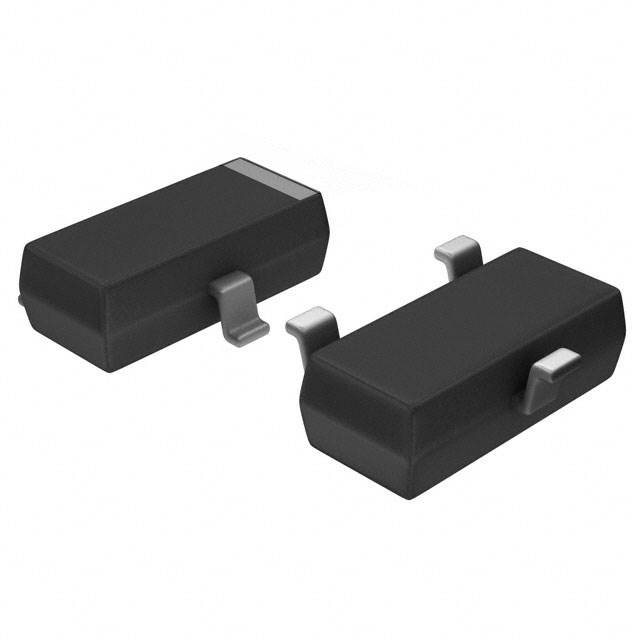
MMBF5485 vs AON7611: Component Comparison for Power Electronics Engineers
Quick verdict
For low-current, high-frequency RF switching or small-signal amplification up to 400 MHz, the JFET-based MMBF5485 is the clear choice due to its low noise figure and suitable frequency response. Conversely, for power switching applications requiring high continuous current (up to 18.5A) and low R_DS(on) with logic-level drive, the AON7611 MOSFET array is the better candidate, offering significantly higher current handling and integrated complementary MOSFETs.
Spec comparison table
| Spec | MMBF5485 | AON7611 | Notes |
|---|---|---|---|
| Configuration | N-Channel JFET | N and P-Channel MOSFET Array (common drain) | AON7611 offers complementary pairs, enabling half-bridge or push-pull configurations. |
| Current rating (continuous) | 10 mA | 9 A (N-Channel), 18.5 A (P-Channel) | AON7611 supports three orders of magnitude higher current, suited for power applications. |
| Frequency | 400 MHz | Not specified (power MOSFET) | MMBF5485 supports RF frequencies; AON7611 is for DC to low MHz switching, not RF. |
| Gain | Not specified | Not specified | Gain not applicable; MMBF5485 is a JFET, AON7611 is a MOSFET array. |
| Mounting type | Surface Mount (SOT-23-3) | Surface Mount (8-DFN-EP 3x3 mm) | Both are SMT, but AON7611 is larger with better thermal dissipation. |
| Noise figure | 4 dB | Not specified | MMBF5485 low noise figure suits low-noise RF front-ends; AON7611 not specified for noise. |
| Output power max | Not specified | 1.5 W | AON7611 can handle higher power dissipation, relevant for power stages. |
| Package case | TO-236-3 / SC-59 / SOT-23-3 | 8-PowerVDFN (3x3 mm) | AON7611’s package supports thermal pad for improved heat dissipation. |
| Technology | JFET | MOSFET (Metal Oxide) | JFET better for RF low-noise; MOSFET better for power switching efficiency. |
| Voltage rated | 25 V | 30 V | AON7611 offers higher voltage margin. |
| Voltage test | 15 V | Not specified | MMBF5485 rated/tested at 15 V; no test voltage listed for AON7611. |
| FET feature | - | Logic Level Gate | AON7611 can be driven directly from 5 V logic; MMBF5485 gate drive is different (JFET). |
| Gate charge (Q_g max @ V_GS) | Not specified | 10 nC @ 10 V | AON7611 has moderate gate charge, relevant for switching losses and gate drive design. |
| Input capacitance (C_iss max) @ 15 V | Not specified | 170 pF | AON7611 input capacitance affects switching speed and gate driver selection. |
| Operating temperature range | Not specified | -55°C to 150°C (TJ) | AON7611 rated for wide junction temperature range, beneficial for power applications. |
| R_DS(on) max @ I_D, V_GS | Not specified | 50 mΩ @ 4A, 10V | AON7611 has known on-resistance for conduction loss calculations. |
| V_GS(th) max @ I_D | Not specified | 2.5 V @ 250 µA | AON7611 threshold voltage suitable for logic-level drive. |
Design trade-offs
The MMBF5485 is a low-current N-channel JFET optimized for RF applications up to 400 MHz, with a low noise figure of 4 dB. This makes it suitable for front-end amplification or switching in RF circuits where linearity and noise figure are critical. Its current rating is very low (10 mA), so it cannot be used for power switching or load driving. The SOT-23 package is compact but offers limited thermal dissipation capability. The JFET structure means gate drive considerations differ from MOSFETs: it requires a bias voltage and cannot be driven by logic-level signals directly.
In contrast, the AON7611 is an integrated MOSFET array containing complementary N- and P-channel devices in an 8-pin DFN package with an exposed pad for improved thermal management. It supports up to 18.5 A continuous current with a maximum drain-source voltage of 30 V, suitable for medium-voltage power switching applications. Its logic-level gate feature and 2.5 V threshold voltage enable direct drive from microcontroller GPIOs or logic ICs, simplifying gate drive circuitry. Its gate charge (10 nC at 10 V) and 170 pF input capacitance are moderate and should be accounted for in gate driver design to optimize switching losses and speed.
Thermally, the AON7611 can dissipate up to 1.5 W, making it suitable for power stages with proper PCB thermal design, whereas the MMBF5485 is limited by package and current capability. The MMBF5485’s JFET technology and high-frequency response come at the cost of low current handling and lack of integrated complementary devices.
From a layout perspective, the AON7611’s DFN package requires good thermal via design and careful PCB layout to realize its low R_DS(on) and power dissipation capabilities. The MMBF5485’s SOT-23 footprint is standard and easier for compact low-power RF circuits but offers no thermal pad for heat sinking.
Cost-wise, the MMBF5485 is expected to be lower cost per unit and simpler to source for RF front-end applications, while the AON7611 is more specialized and likely higher cost but justified in power switching use cases.
Use-case fit
Choose MMBF5485 when…
- Implementing low-noise RF front-end switches or small-signal amplifiers operating up to 400 MHz.
- Designing circuits requiring minimal noise figure (~4 dB) for sensitive RF detection or mixing.
- Working with very low current signals (≤10 mA) where power dissipation is negligible.
- Needing a compact, common SOT-23-3 package footprint for dense board layouts.
- Developing JFET-based circuits or biasing schemes where a depletion-mode device is preferred.
Choose AON7611 when…
- Designing power MOSFET switch stages requiring continuous currents up to 18.5 A.
- Implementing half-bridge or complementary switching topologies using the integrated N- and P-channel devices.
- Driving MOSFETs directly from 3.3 V or 5 V logic with minimal gate drive complexity.
- Requiring a compact power package with good thermal dissipation (8-DFN with exposed pad).
- Operating in applications with junction temperatures up to 150°C and voltage requirements up to 30 V.
Drop-in compatibility
The MMBF5485 and AON7611 are not pin-compatible nor footprint-compatible. MMBF5485 is a three-terminal JFET in a SOT-23-3 package, while AON7611 is an 8-pin DFN with dual complementary MOSFETs and an exposed pad. Substituting one for the other would require significant PCB redesign and circuit-level adjustments, including gate drive, biasing, and thermal management. No direct drop-in replacement is possible.
Alternatives to consider
- BSS138 (N-channel MOSFET, SOT-23) – Widely used, low-voltage logic-level MOSFET for low-current switching; good for replacing similar JFET switches in some applications.
- SI2302 (N-channel MOSFET, SOT-23) – Low R_DS(on) logic-level MOSFET for power switching in small packages; suitable for low-voltage, moderate current loads.
- IRLML6344 (N-channel MOSFET, SOT-23) – Very low gate charge and R_DS(on), logic-level MOSFET for efficient power switching in compact footprints.