MMBF5485 vs AO7400: Component Comparison for Hardware Engineers
Quick verdict
For RF front-end applications requiring low noise and operation up to hundreds of MHz, the MMBF5485 is the clear winner due to its JFET technology and 400 MHz frequency rating. For power switching or load control in low-voltage DC circuits with currents up to 1.7 A, the AO7400 is superior, offering much higher current capacity, lower R_DS(on), and better thermal handling.
Spec comparison table
| Spec | MMBF5485 | AO7400 | Notes |
|---|---|---|---|
| Configuration | N-Channel JFET | N-Channel MOSFET | Different transistor types: JFET vs MOSFET affects drive and switching behavior |
| Current rating (mA / A) | 10 mA | 1.7 A (Ta) | AO7400 supports 170× higher continuous current, critical for power switching |
| Frequency (MHz) | 400 MHz | Not specified | MMBF5485 supports RF frequencies up to 400 MHz; AO7400 is not specified for RF operation |
| Gain | Not specified | Not specified | No direct gain data; MMBF5485 used as RF gain device, AO7400 is a switch |
| Noise figure (dB) | 4 dB | Not specified | MMBF5485 noise figure useful in low-noise RF designs; AO7400 noise figure not relevant |
| Mounting type | Surface Mount | Surface Mount | Both suitable for SMT, but different packages |
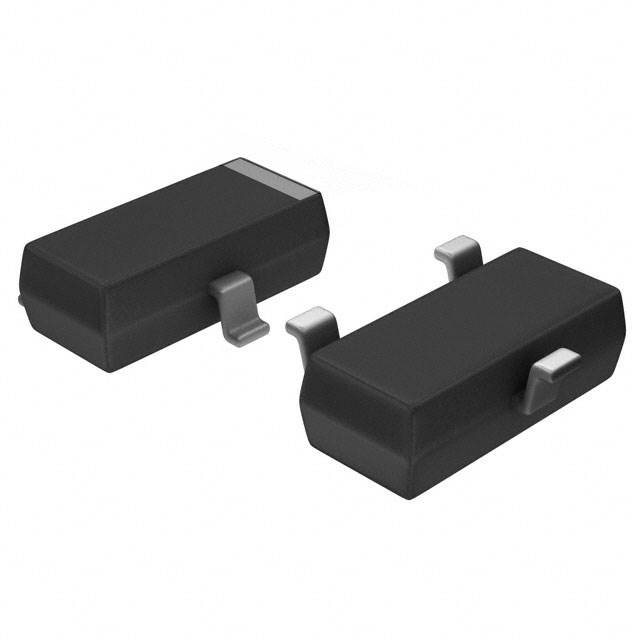
| Package case | TO-236-3, SC-59, SOT-23-3 | SC-70-3 (SOT-323) | AO7400 is smaller SC-70-3; MMBF5485 is slightly larger SOT-23-3 |
| Technology | JFET | MOSFET (Metal Oxide) | JFET better for linear/RF; MOSFET better for switching/efficiency in power applications |
| Voltage rated (max) | 25 V | 30 V | AO7400 has higher voltage rating, allowing more headroom in switching circuits |
| Voltage test | 15 V | Not specified | MMBF5485 tested at 15 V; AO7400 max gate-source ±12 V |
| Continuous drain current (Id) | 10 mA | 1.7 A (Ta) | AO7400 supports much higher continuous current, suitable for load switching |
| Gate charge (Q_g) | Not specified | 4.82 nC @ 4.5 V | AO7400 gate charge relevant for gate drive timing and switching losses |
| Gate-source voltage max (V_gs) | Not specified | ±12 V | AO7400 gate voltage max must be observed to avoid damage |
| Input capacitance (C_iss) | Not specified | 390 pF @ 15 V | AO7400 input capacitance impacts switching speed and gate drive losses |
| Power dissipation (max) | Not specified | 350 mW (Ta) | AO7400 max power dissipation rating guides thermal design |
| R_DS(on) max | Not specified | 85 mΩ @ 1.5 A, 10 V | AO7400 low R_DS(on) reduces conduction losses in power switching |
| Threshold voltage (V_th) | Not specified | 1.4 V @ 250 µA | AO7400 threshold voltage helps determine drive voltage and logic compatibility |
| Operating temp range | Not specified | -55°C to 150°C (TJ) | AO7400 rated for wide temperature range, useful for harsh environments |
Design trade-offs
The MMBF5485 and AO7400 occupy fundamentally different niches despite both being N-channel devices in surface-mount packages. The MMBF5485 is a JFET optimized for RF applications, evident in its 400 MHz frequency rating and 4 dB noise figure. Its current rating at only 10 mA and lack of R_DS(on) data indicate it is not intended for load switching or power applications. Instead, it is suited for low-noise, high-frequency amplification or switching in RF front ends. The JFET’s gate drive is voltage-controlled with essentially zero gate current, simplifying drive circuitry but requiring careful biasing for linear operation.
In contrast, the AO7400 is a power MOSFET designed for DC load switching and power management. It supports continuous currents up to 1.7 A, more than two orders of magnitude greater than the MMBF5485. Its low R_DS(on) of 85 mΩ at 1.5 A and 10 V gate drive enables efficient conduction with minimal losses. The gate charge of 4.82 nC at 4.5 V means that gate drive circuits must be capable of delivering short pulses of current to switch the device quickly, which impacts gate driver selection and switching frequency limits. The maximum gate-source voltage of ±12 V requires careful voltage clamping to avoid device damage, unlike the JFET which can tolerate different bias conditions.
Thermally, the AO7400’s 350 mW power dissipation rating implies it can handle moderate power loads with proper PCB thermal design, including copper area and possible heatsinking. The MMBF5485 does not specify power dissipation, reflecting its low-power RF role. Layout-wise, the AO7400’s lower input capacitance and gate charge help reduce switching losses and EMI in fast switching applications, but require attention to minimize gate ringing and overshoot. The MMBF5485’s RF performance demands careful impedance matching and PCB layout to maintain its noise figure and frequency response.
Cost-wise, the MMBF5485’s specialty as an RF JFET likely makes it more expensive per unit than the AO7400, which is a general-purpose power MOSFET in a smaller SC-70 package. Volume pricing will favor the AO7400 in power switching applications, especially where high current and efficiency matter.
Use-case fit
Choose MMBF5485 when…
- Designing low-noise RF amplifiers or buffers operating near 400 MHz frequencies.
- Implementing low-level signal amplification where a 4 dB noise figure is critical.
- Biasing circuits require a JFET’s high input impedance and low gate current.
- Low current operation (<10 mA) suffices, and linearity or low distortion is needed.
- You need a device with a SOT-23 package compatible with RF front-end modules.
Choose AO7400 when…
- Switching DC loads up to 1.7 A at voltages up to 30 V.
- Designing battery-powered or low-voltage DC power rails requiring low conduction loss.
- Implementing load switches, power distribution, or voltage regulators with surface-mount footprint constraints.
- Operating in wide temperature ranges (-55°C to 150°C junction temperature).
- Gate drive circuits can provide 4.5 to 10 V drive voltage with consideration for gate charge.
Drop-in compatibility
The MMBF5485 is packaged in SOT-23-3 (TO-236-3, SC-59), while the AO7400 is in a smaller SC-70-3 (SOT-323) package. These are not pin-compatible or footprint-compatible. Moreover, the transistor types differ fundamentally (JFET vs MOSFET), so gate drive and biasing requirements differ as well. Substituting one for the other requires redesign of the PCB footprint and the surrounding circuitry, including biasing, drive voltages, and thermal considerations. There is no direct drop-in interchangeability between these parts.
Alternatives to consider
- 2N5485: Another JFET with similar voltage and current rating, suitable for RF and analog signal applications, often available in through-hole packages.
- BSS138: Small-signal N-channel MOSFET with similar voltage rating but higher current capacity than MMBF5485, suitable for low-power switching.
- Si2302: Low-voltage N-channel MOSFET with low R_DS(on) in SOT-23 package for power switching, offering a balance between AO7400 and BSS138 capabilities.