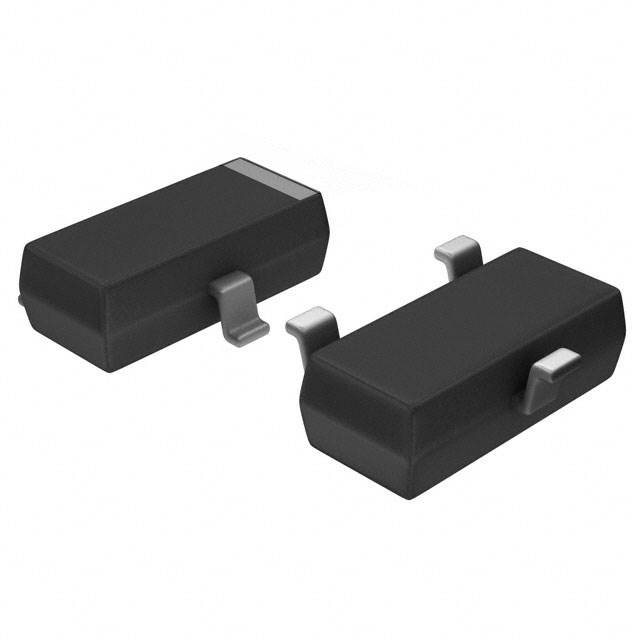
MMBF5485 vs AO6604: Component Comparison for Power Electronics Engineers
Quick verdict
For low-current, high-frequency analog/RF switching or amplification applications, the MMBF5485 JFET offers superior performance due to its 400 MHz frequency capability and low noise figure. Conversely, the AO6604 MOSFET array excels in power switching and digital load driving scenarios, supporting up to 3.4 A with logic-level gate drive and integrated complementary N- and P-channel devices.
Spec comparison table
| Spec | MMBF5485 | AO6604 | Notes |
|---|---|---|---|
| Configuration | N-Channel JFET | N- and P-Channel MOSFET Array | AO6604 offers complementary pairs, enabling push-pull stages; MMBF5485 is single JFET |
| Current rating (continuous) | 10 mA | 3.4 A (N-channel), 2.5 A (P-channel) | AO6604 supports >300× higher continuous current; critical for power stages |
| Frequency | 400 MHz | Not specified (low-frequency power device) | MMBF5485 is suitable for RF up to 400 MHz; AO6604 is not designed for RF applications |
| Gain | Not specified | Not specified | JFETs generally provide intrinsic gain; MOSFETs do not |
| Noise figure | 4 dB | Not specified | MMBF5485’s 4 dB noise figure is relevant for low-noise RF front ends |
| Output power max | Not specified | 1.1 W | AO6604 rated for 1.1 W power dissipation, supporting higher power use |
| Package case | TO-236-3 / SC-59 / SOT-23-3 | SC-74 / SOT-457 (6-pin TSOP) | AO6604 package larger and different pin count; affects PCB footprint |
| Mounting type | Surface Mount | Surface Mount | Both are SMT, suitable for automated assembly |
| Technology | JFET | MOSFET (Metal Oxide) | Different semiconductor technology affects drive and switching characteristics |
| Voltage rated | 25 V | 20 V | MMBF5485 has slightly higher voltage rating |
| Voltage test | 15 V | Not specified | MMBF5485 test voltage specified; AO6604 datasheet does not specify test voltage |
| Drain-source voltage max | Not specified | 20 V | AO6604 maximum voltage rating given; MMBF5485 voltage rating above |
| Gate drive voltage | Not specified (JFET) | 4.5 V logic level gate drive | AO6604 designed for direct drive from logic-level signals |
| Gate charge (Qg) | Not specified | 3.8 nC @ 4.5 V | AO6604’s gate charge relevant for switching losses and gate driver sizing |
| Input capacitance (Ciss) | Not specified | 320 pF @ 10 V | AO6604 input capacitance affects switching speed and gate driver requirements |
| Threshold voltage (Vgs_th) | Not specified | 1 V max @ 250 µA | AO6604 threshold voltage suitable for logic-level drive |
| Operating temperature range | Not specified | -55°C to 150°C (TJ) | AO6604 extended temperature range suitable for harsher environments |
Design trade-offs
The MMBF5485 is a JFET optimized for low-level RF and analog signal roles, with a 400 MHz frequency rating and a 4 dB noise figure. This makes it suitable for front-end amplification or switching in RF circuits where low noise and high-frequency response are essential. However, its continuous current rating is only 10 mA, limiting its use to signal-level applications rather than power switching.
In contrast, the AO6604 is a complementary MOSFET array with much higher continuous current ratings (3.4 A N-channel, 2.5 A P-channel) and a maximum power dissipation of 1.1 W. The logic-level gate drive (4.5 V) and relatively low Rds(on) of 65 mΩ at 3.4 A make it well-suited for low-voltage DC power switching, digital load driving, and small motor control. Its gate charge of 3.8 nC is modest, but much higher than a JFET’s gate capacitance, which impacts switching speed and gate driver design.
Thermally, the AO6604 requires careful PCB layout with adequate copper area or a heat sink to dissipate up to 1.1 W continuously, especially near its maximum current rating. The MMBF5485, with significantly lower power dissipation due to its low current, has minimal thermal concerns in typical applications.
The MMBF5485’s SOT-23-3 package is more compact and common for RF signal transistors, whereas the AO6604’s 6-pin TSOP package is larger and designed to accommodate the dual MOSFET array. This affects PCB footprint and routing complexity, especially in dense designs.
From a firmware and gate drive perspective, the AO6604 requires a dedicated gate drive signal with logic-level voltage and appropriate timing to minimize switching losses and avoid shoot-through in complementary stages. The MMBF5485, being a JFET, does not require gate drive voltage swings and behaves more like a voltage-controlled resistor, simplifying drive circuitry but limiting power handling.
Cost-wise, JFETs like the MMBF5485 tend to be more expensive per unit than discrete MOSFETs, but the AO6604’s integrated complementary array could reduce BOM count and assembly cost in complementary switch designs.
Use-case fit
Choose MMBF5485 when…
- Designing low-noise RF front ends or mixers requiring operation up to 400 MHz.
- Implementing analog switching or chopper circuits at low current (≤10 mA).
- Building voltage-controlled attenuators or amplifiers with minimal noise impact.
- Minimizing PCB area and component count in single-ended low-power signal paths.
- Operating circuits with voltage requirements up to 25 V and low continuous current.
Choose AO6604 when…
- Designing complementary push-pull MOSFET stages for DC/DC converters or motor drivers.
- Switching loads up to 3.4 A at voltages up to 20 V with logic-level gate drive.
- Implementing low-voltage digital load switches or power multiplexers.
- Requiring integrated N- and P-channel MOSFETs to simplify board layout and control.
- Operating in elevated temperature environments (up to 150°C junction).
Drop-in compatibility
These parts are not pin-compatible or footprint-compatible. The MMBF5485 is a 3-pin device in a SOT-23 package (TO-236-3), whereas the AO6604 is a 6-pin complementary MOSFET array in a SC-74 (SOT-457) package. Direct substitution would require a PCB redesign, including layout changes and different gate drive circuitry.
Alternatives to consider
- BSS138 (N-channel MOSFET, 50 V, 200 mA): Widely used logic-level MOSFET with low gate charge, good for low-current switching.
- 2N5457 (N-channel JFET, 25 V): Alternative low-noise JFET for RF and analog switching applications.
- AO3400A (N-channel MOSFET, 30 V, 5.8 A): Logic-level MOSFET with higher current capability in a small SOT-23 package for power switching.