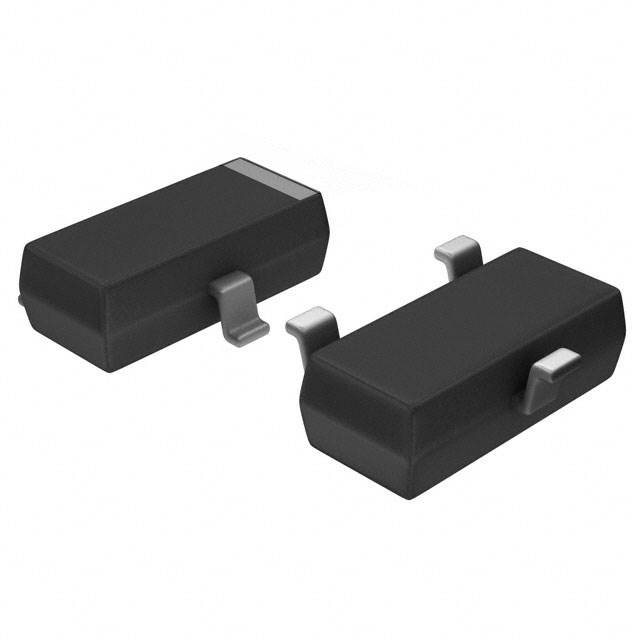
MMBF5485 vs AO3402: Component Comparison for Power Electronics Engineers
Quick verdict
For high-frequency, low-current RF switching and amplification up to ~400 MHz, the MMBF5485 is clearly the better choice due to its JFET technology optimized for low noise and RF operation. For general-purpose low-voltage switching and load driving requiring several amps of current, the AO3402 is superior, offering a 30 V rating and continuous drain current up to 4 A with low R_DS(on).
Spec comparison table
| Spec | MMBF5485 | AO3402 | Notes |
|---|---|---|---|
| Configuration | N-Channel JFET | N-Channel MOSFET | Different transistor technologies; JFET better for RF/noise, MOSFET better for power switching |
| Current rating (continuous) | 10 mA | 4 A (Ta) | AO3402 supports 400× higher continuous current, better for power applications |
| Maximum frequency | 400 MHz | Not specified (low frequency typ 1 MHz) | MMBF5485 optimized for RF applications, AO3402 for low-frequency switching |
| Noise figure | 4 dB | Not specified | MMBF5485’s 4 dB noise figure suits low-noise RF front ends |
| Output power max | Not specified | Not specified | No clear data to compare |
| Mounting type | Surface Mount (SOT-23-3) | Surface Mount (SOT-23-3) | Both have identical package types |
| Package case | TO-236-3 / SC-59 / SOT-23-3 | SOT-23-3 Variant | Physically compatible packages |
| Technology | JFET | MOSFET (Metal Oxide) | JFET better for linear/RF, MOSFET better for power switching |
| Maximum voltage rating | 25 V | 30 V | AO3402 can handle 20% higher voltage, useful in more demanding power circuits |
| Voltage test | 15 V | 15 V | Equal test voltages |
| Drain current max (pulsed) | Not specified | 15 A | AO3402 can handle high pulsed currents |
| Power dissipation max (Ta) | Not specified | 1.4 W | AO3402 rated for significant power dissipation, MMBF5485 not specified |
| Gate threshold voltage | Not specified | 0.5 V (min) – 1.5 V (max), typ 1 V | AO3402’s threshold voltage well characterized, low gate drive voltage |
| Gate charge (Q_g) | Not specified | 4.34 nC @ 4.5 V, typ 12 nC | AO3402 requires moderate gate charge for switching |
| R_DS(on) max @ 4A, 10V | Not specified | 55 mΩ | AO3402 low R_DS(on) suitable for efficient switching at moderate currents |
| Input capacitance (C_iss) | Not specified | 390 pF @ 15 V | AO3402 input capacitance moderate for MOSFET switching |
| Gate leakage current | Not specified | +100 nA | AO3402 gate leakage typical MOSFET levels |
| Turn-on delay time | Not specified | 3.5 ns | AO3402 fast switching suitable for high-speed PWM or switching |
| Turn-off delay time | Not specified | 17.5 ns | AO3402 turn-off delay typical for MOSFET switching |
| Junction temperature max | Not specified | +150 °C | AO3402 supports high junction temperatures for power applications |
| Thermal resistance (junction to ambient) | Not specified | 125 °C/W max | AO3402 thermal data available, useful for thermal design |
| Operating temperature range | Not specified | -55°C to +150°C | AO3402 designed for wide temperature range |
| Gate-source voltage max | Not specified | ±12 V | AO3402 gate voltage rating typical for power MOSFET control |
| Duty cycle | Not specified | 0.5% max (typ), 50% | AO3402 suitable for PWM switching with specified duty cycles |
Design trade-offs
The MMBF5485 and AO3402 target fundamentally different applications despite sharing the same SOT-23-3 package. The MMBF5485 is a JFET optimized for RF frequencies up to 400 MHz with a low noise figure of 4 dB and extremely low current capability (10 mA max). This makes it suitable for analog RF front ends, small-signal switching, or low-noise amplification circuits. Its JFET technology inherently has a high input impedance and low noise but lacks the current and voltage handling capabilities needed in typical power switching roles.
In contrast, the AO3402 is a power MOSFET designed for low-voltage (30 V max), high-current (4 A continuous, 15 A pulsed) switching applications. It features a low R_DS(on) of 55 mΩ at 4A, which translates into lower conduction losses and better efficiency in DC-DC converters, load switches, and general-purpose switching. Its gate charge (4.34 nC at 4.5 V) and fast switching times (3.5 ns turn-on delay) enable efficient gate drive and high-frequency PWM operation, although it is not meant for RF applications.
From a thermal standpoint, the AO3402’s 1.4 W power dissipation rating and 125 °C/W junction-to-ambient resistance allow it to handle moderate power levels without complex cooling, whereas the MMBF5485 provides no thermal dissipation data but is clearly limited by its low current rating.
Gate drive requirements differ significantly: the AO3402 requires a MOSFET gate driver or at least a logic-level input with 4.5–10 V drive to fully turn on, while the MMBF5485, as a JFET, will bias differently and cannot be driven with MOSFET gate drivers. This impacts firmware and hardware control design—AO3402 can be driven directly from microcontrollers or MOSFET drivers, MMBF5485 often needs biasing networks and careful analog control.
Layout sensitivity is also distinct. The MMBF5485’s RF nature demands careful PCB layout with controlled impedance traces and minimal parasitic capacitance/inductance, while the AO3402 demands low-inductance power paths, proper thermal vias, and decoupling to handle switching currents and reduce EMI.
Cost-wise, the AO3402 is likely less expensive at volume due to its widespread use in power switching, while the MMBF5485’s specialized JFET technology and RF optimization typically come at a premium, although exact pricing is vendor-dependent.
Use-case fit
Choose MMBF5485 when…
- Designing low-noise RF front-end amplifiers or switches operating up to 400 MHz frequency.
- Implementing small-signal analog circuits requiring very low gate leakage and low noise figure.
- Working on sensitive sensor interfaces where 10 mA current and 25 V rating suffice.
- Requiring a JFET transistor for its linearity and high input impedance in analog signal paths.
- Developing circuits where RF gain and noise figure dominate over power handling.
Choose AO3402 when…
- Designing power switches or load switches that must handle up to 4 A continuous current at 30 V.
- Building DC-DC converters, PWM power stages, or motor drivers requiring low R_DS(on) for efficiency.
- Needing fast switching MOSFETs with gate charge around 4 nC to optimize gate driver power.
- Operating in environments with wide temperature ranges (-55°C to +150°C) and moderate power dissipation.
- Implementing logic-level driven low-voltage MOSFET switches compatible with microcontroller outputs.
Drop-in compatibility
Both devices come in SOT-23-3 packages, but the MMBF5485 is a JFET and the AO3402 a MOSFET. Pinouts and internal device construction differ, so they are not pin-compatible nor drop-in replacements. Substituting one for the other would require redesigning the biasing network, gate drive circuitry, and possibly the PCB layout. Without explicit pinout data from the datasheets, assume no direct interchangeability.
Alternatives to consider
- BSS138: A general-purpose N-channel MOSFET in SOT-23 with ~50 V rating and low gate charge, suitable for low-current switching.
- 2N7002: Widely used 60 V logic-level N-MOSFET in SOT-23, good for general low-voltage switching with moderate current.
- BFR93A: NPN RF transistor for analog/RF signal applications, alternative to JFETs like MMBF5485 in some RF front-end designs.