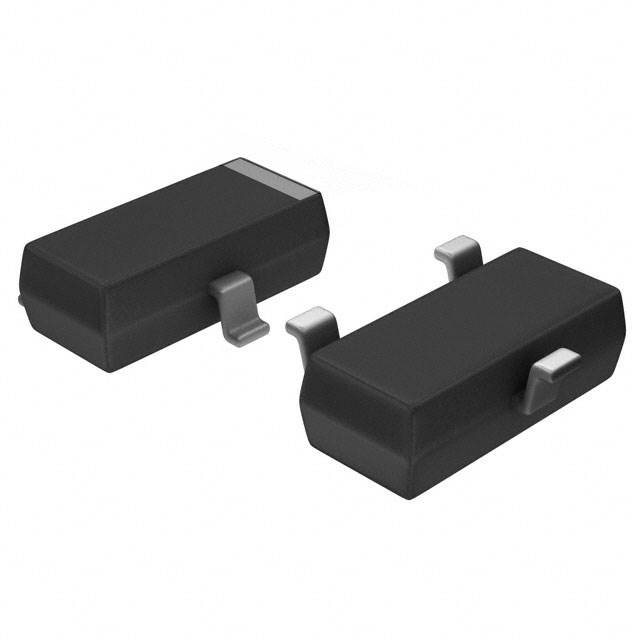
MMBF5485 vs AIMDQ75R016M2HXTMA1: Component Comparison for Hardware Engineers
Quick verdict
For low-current, low-voltage, high-frequency analog/RF switching and amplification, the MMBF5485 is the clear choice due to its JFET technology, low noise figure, and RF-optimized specs. Conversely, for high-voltage power switching and automotive-grade applications requiring robust current handling and high efficiency, the AIMDQ75R016M2HXTMA1 outperforms by orders of magnitude in voltage rating, continuous current, and power dissipation.
Spec comparison table
| Spec | MMBF5485 | AIMDQ75R016M2HXTMA1 | Notes |
|---|---|---|---|
| Configuration | N-Channel JFET | N-Channel SiC FET | Both N-Channel, but different technologies: JFET vs SiC MOSFET, impacting switching behavior and drive. |
| Current rating (continuous) | 10mA | 103A (Tc) | AIMDQ75R016M2HXTMA1 supports 10,300x higher current at case temperature, suitable for power applications. |
| Frequency | 400 MHz | Not specified | MMBF5485 is RF-optimized for up to 400MHz; AIMDQ75R016M2HXTMA1 is not intended for RF. |
| Gain | Not specified | Not specified | No direct gain data; MMBF5485 is a JFET, which can provide low noise gain in RF circuits. |
| Mounting type | Surface Mount (SOT-23-3) | Surface Mount (PG-HDSOP-22) | Both SMT, but package size and thermal characteristics differ significantly. |
| Noise figure | 4 dB | Not specified | MMBF5485’s 4dB noise figure is relevant for low-noise RF front-end designs. |
| Output power max | Not specified | Not specified | No direct output power data available; AIMDQ75R016M2HXTMA1 designed for high power dissipation. |
| Package case | TO-236-3 (SOT-23-3) | 22-PowerBSOP Module (PG-HDSOP-22) | MMBF5485 uses a small 3-pin SOT-23; AIMDQ75R016M2HXTMA1 uses a large 22-pin power module. |
| Voltage rated | 25 V | 750 V | AIMDQ75R016M2HXTMA1 supports 30x higher voltage, enabling high-voltage power applications. |
| Voltage test | 15 V | Not specified | MMBF5485 tested at 15 V; AIMDQ75R016M2HXTMA1 has max gate-source voltage specs instead. |
| Current continuous drain Id @ 25°C | 10mA | 103A (Tc) | Confirms AIMDQ75R016M2HXTMA1’s vastly superior current capability. |
| Drive voltage max / Rds(on) min/max | Not specified | 15 V drive, 14mΩ @ 55.8A, 20 V gate | AIMDQ75R016M2HXTMA1 requires strong gate drive voltage and delivers low Rds(on), crucial for efficiency. |
| Gate charge Qg max @ Vgs | Not specified | 74 nC @ 18 V | AIMDQ75R016M2HXTMA1’s gate charge implies significant gate drive energy and slower switching vs low-Q JFET. |
| Gate-source voltage max | Not specified | +23 V / -7 V | AIMDQ75R016M2HXTMA1’s gate voltage limits must be respected to avoid damage. |
| Grade | Not specified | Automotive (AEC-Q101) | AIMDQ75R016M2HXTMA1 is qualified for automotive applications, indicating higher reliability. |
| Input capacitance Ciss max | Not specified | 2577 pF @ 500 V | Large input capacitance in AIMDQ75R016M2HXTMA1 affects switching speed and drive requirements. |
| Operating temperature range | Not specified | -55°C to 175°C (TJ) | AIMDQ75R016M2HXTMA1 supports wide temperature range for harsh environments. |
| Power dissipation max | Not specified | 394 W (Tc) | AIMDQ75R016M2HXTMA1 can handle very high power dissipation at case temperature. |
| Supplier device package | SOT-23-3 | PG-HDSOP-22 | Packages are completely different in size and pin count, not interchangeable. |
| Technology | JFET | SiC FET | Different semiconductor tech affects efficiency, switching speed, and ruggedness. |
| Vgs threshold max at Id | Not specified | 5.6 V @ 12.3mA | Useful for gate drive design in AIMDQ75R016M2HXTMA1; no data for MMBF5485. |
Design trade-offs
The MMBF5485 and AIMDQ75R016M2HXTMA1 serve fundamentally different applications despite both being N-channel devices. The MMBF5485 is a JFET optimized for low noise and high-frequency analog/RF applications up to 400 MHz, with ultra-low current rating (10mA). The low noise figure (4 dB) and small SOT-23 package make it ideal for front-end RF circuits where linearity and minimal noise are priorities. Its low voltage rating (25 V) and minimal current handling limit it strictly to signal-level roles, not power switching.
In contrast, the AIMDQ75R016M2HXTMA1 is a high-voltage (750 V), high-current (103A) silicon carbide MOSFET designed for power conversion, automotive traction inverters, or industrial motor drives. Its SiC technology allows for high blocking voltage with low on-resistance (14 mΩ @ 55.8A, 20V gate) and high power dissipation (394 W at case temperature). This device demands a robust gate driver capable of supplying 74 nC gate charge at 18 V, and the large input capacitance (2577 pF) necessitates careful gate driver selection and PCB layout to minimize switching losses and EMI.
Thermally, the AIMDQ75R016M2HXTMA1 requires substantial heat sinking or cooling, given its high power dissipation, and its large PG-HDSOP-22 package facilitates thermal management. The MMBF5485’s small SOT-23 package and low current limit mean thermal issues are negligible.
From a layout perspective, the MMBF5485’s small footprint and simple 3-lead pinout simplify integration in dense RF boards, while the AIMDQ75R016M2HXTMA1’s pin count and package size require more PCB real estate and careful power/thermal layout.
Cost-wise, the MMBF5485 is a low-cost, commodity RF JFET, while the AIMDQ75R016M2HXTMA1 is a specialized, likely higher-cost automotive-grade SiC MOSFET with complex packaging and qualification.
Use-case fit
Choose MMBF5485 when…
- Designing RF front-end amplifiers or low-noise mixers operating up to 400 MHz.
- Implementing analog signal switching or low-level current control in sensitive measurement circuits.
- Working within tight PCB real estate constraints requiring a tiny 3-pin SOT-23 package.
- Needing a low-noise device with a noise figure around 4 dB for front-end stages.
- Operating at low bias currents (around 10 mA max) and low voltage (≤25 V).
Choose AIMDQ75R016M2HXTMA1 when…
- Designing high-voltage (up to 750 V) power conversion systems such as motor drives or inverters.
- Developing automotive-grade power electronics requiring AEC-Q101 qualification and extended temperature range (-55°C to 175°C).
- Handling continuous currents over 100 A with low conduction losses enabled by 14 mΩ Rds(on).
- Implementing systems where high power dissipation (up to 394 W) must be managed with advanced thermal solutions.
- Using SiC technology to improve efficiency and switching speed in high-voltage, high-current applications.
Drop-in compatibility
These two devices are not pin-compatible or footprint-compatible. The MMBF5485 is a 3-pin SOT-23 JFET, whereas the AIMDQ75R016M2HXTMA1 is a 22-pin PG-HDSOP power module SiC MOSFET. Substituting one for the other requires a complete redesign of the PCB footprint, gate drive circuitry, and thermal management. No direct drop-in substitution is possible.
Alternatives to consider
- BSS138 (N-Channel MOSFET, 50 V, 200 mA, SOT-23): For low-voltage, low-current switching with MOSFET technology instead of JFET, providing easier gate drive but higher noise figure.
- C3M0065090K (Infineon SiC MOSFET, 900 V, 50 A, TO-247): A high-voltage SiC MOSFET alternative for power applications similar to AIMDQ75R016M