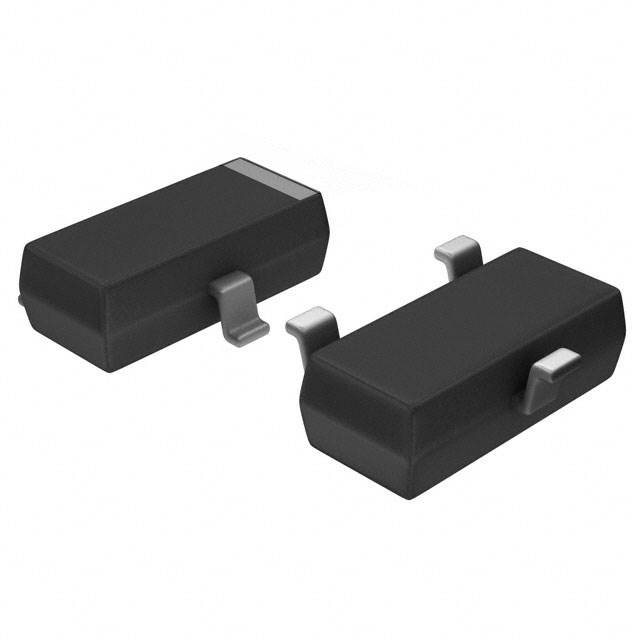
MMBF5485 vs 2SK3019TL: Component Comparison for Hardware Engineers
Quick verdict
For low-noise RF front-end switching or small-signal amplification up to 400 MHz, the MMBF5485 JFET is the better choice due to its low noise figure and RF-optimized characteristics. For general-purpose low-voltage switching or digital load driving with modest current (up to 100 mA) and higher voltage headroom, the 2SK3019TL MOSFET offers a more robust, higher-current, and thermally resilient solution.
Spec comparison table
| Spec | MMBF5485 | 2SK3019TL | Notes |
|---|---|---|---|
| Configuration | N-Channel JFET | N-Channel MOSFET | Both N-channel; technology difference impacts gate drive and noise. |
| Current rating (continuous) | 10 mA | 100 mA (Ta) | 2SK3019TL supports 10x higher current, better for switching loads. |
| Frequency | 400 MHz | Not specified | MMBF5485 rated for RF use up to 400 MHz; 2SK3019TL not specified, likely lower frequency use. |
| Gain | Not specified (-) | Not specified | No gain figures; MMBF5485 is a JFET, generally better for low-noise gain stages. |
| Mounting type | Surface Mount (SOT-23-3) | Surface Mount (EMT3 / SOT-416) | Both SMT; different packages and footprints. |
| Noise figure | 4 dB | Not specified | MMBF5485 has known low noise figure, suitable for RF front-ends. |
| Output power max | Not specified | 150 mW (Ta) | 2SK3019TL rated for 150 mW dissipation, supports higher power handling. |
| Package case | TO-236-3, SC-59, SOT-23-3 | SC-75, SOT-416 | Different packages; affects PCB layout and thermal dissipation. |
| Technology | JFET | MOSFET (Metal Oxide) | JFET better for low noise, MOSFET better for switching and power. |
| Voltage rated | 25 V | 30 V | 2SK3019TL has higher voltage rating, increasing design margin. |
| Voltage test | 15 V | Not specified | MMBF5485 tested at 15 V; 2SK3019TL max V_DS is 30 V. |
| Drain-Source On-resistance (R_DS(on)) | Not specified | 8 Ω @ 10mA, 4V | 2SK3019TL R_DS(on) is relatively high but acceptable for low-current switching. |
| Gate-Source Voltage max | Not specified | ±20 V | 2SK3019TL gate voltage tolerance ±20 V; MMBF5485 unspecified. |
| Drive voltage for R_DS(on) | N/A (JFET) | 2.5 V (min), 4 V (typ) | 2SK3019TL requires 2.5–4 V drive for conduction; MMBF5485 gate drive differs. |
| Threshold voltage (V_GS(th)) | N/A | 1.5 V @ 100 µA | 2SK3019TL threshold voltage indicates logic-level drive possible. |
| Input capacitance (C_iss) | Not specified | 13 pF @ 5 V | 2SK3019TL input capacitance relatively low, but higher than typical RF JFET input. |
| Operating temperature range | Not specified | 150 °C (TJ) | 2SK3019TL supports higher junction temperature, better thermal margin. |
Design trade-offs
The MMBF5485 is a JFET optimized for RF applications up to 400 MHz, with a low noise figure of 4 dB, making it suitable for analog front-end stages where noise performance is critical. Its current rating is only 10 mA, and it lacks a specified R_DS(on) because the JFET operates differently than a MOSFET, typically in depletion mode with a gate-source voltage controlling channel resistance. This means the MMBF5485 is most efficient in low-current, high-frequency analog roles, not for switching power loads.
In contrast, the 2SK3019TL is a MOSFET designed for low-voltage, low-current switching applications with a continuous drain current rating of 100 mA and a power dissipation of 150 mW at ambient temperature. Its maximum drain-source voltage of 30 V is higher than the MMBF5485’s tested voltage, offering more headroom for digital or power switching. The R_DS(on) of 8 Ω at 10 mA is relatively high, so conduction losses will be significant if currents approach the maximum rating, but this is acceptable for signal-level switching.
Gate drive requirements differ substantially: the 2SK3019TL requires a gate drive voltage of around 2.5–4 V to achieve R_DS(on), which suits 3.3 V or 5 V logic systems, but the MMBF5485’s JFET gate is a reverse-biased diode junction requiring careful biasing and no continuous gate current. This affects driver design: the MMBF5485 can be driven with a simple bias network at RF frequencies, whereas the 2SK3019TL needs a defined gate drive voltage swing for switching.
Thermally, the 2SK3019TL’s 150 mW power dissipation rating and 150 °C junction temperature capability allow it to handle higher power applications with proper PCB layout and heat sinking. The MMBF5485, with no specified power dissipation or junction temperature, is limited to low-power, low-current roles where thermal management is less critical.
Package and footprint differences matter for layout. The MMBF5485’s SOT-23-3 package is common and compact, often used in RF modules. The 2SK3019TL’s SC-75 (SOT-416) package is physically smaller but may require different footprint and thermal considerations. The different pinouts and package thermal resistances impact PCB design and thermal pathways.
Cost at volume is not specified here, but generally JFETs like the MMBF5485, specialized for RF, may be more expensive per unit than a generic small MOSFET like the 2SK3019TL. This should be weighed against performance needs.
Use-case fit
Choose MMBF5485 when…
- Designing low-noise RF switches or buffer amplifiers operating up to 400 MHz where noise figure is critical.
- Implementing analog front-end circuits in small-signal RF signal paths requiring minimal insertion loss and low gate leakage.
- Working with low current levels (<10 mA) where the JFET’s characteristics provide better linearity and lower noise than MOSFETs.
- Space is constrained but RF performance cannot be compromised, and a standard SOT-23 footprint is required.
- The circuit requires a device with a simple biasing scheme for analog control rather than digital switching.
Choose 2SK3019TL when…
- Switching low-voltage digital loads or small power signals up to 100 mA at voltages up to 30 V.
- Designing logic-level driven switches or load drivers compatible with 3.3 V or 5 V gate drive voltages.
- Thermal dissipation up to 150 mW is expected and must be managed with standard PCB copper.
- Applications require a MOSFET with defined R_DS(on) and threshold voltage for predictable switching behavior.
- Space is limited but the design can accommodate the SC-75 (SOT-416) footprint and requires higher voltage margin.
Drop-in compatibility
The MMBF5485 and 2SK3019TL have different packages (SOT-23-3 vs SC-75/SOT-416) and likely different pinouts due to their distinct technologies and intended use cases. There is no indication from the source data that they are pin-compatible or footprint-compatible. Substituting one for the other would require PCB layout changes and potentially redesigning gate drive or bias circuits. Their different electrical characteristics (JFET vs MOSFET) also mean that driver and bias circuitry are not directly interchangeable.
Alternatives to consider
- 2N5457 (N-Channel JFET): Another low-noise JFET with higher current capability, often used in RF and analog front-ends.
- BSS138 (N-Channel MOSFET): Widely used logic-level MOSFET with low R_DS(on), suitable for switching up to ~50 V and moderate currents.
- 2N7002 (N-Channel MOSFET): Popular surface-mount MOSFET with better R_DS(on) and power handling than 2SK3019TL, ideal for low-voltage switching.