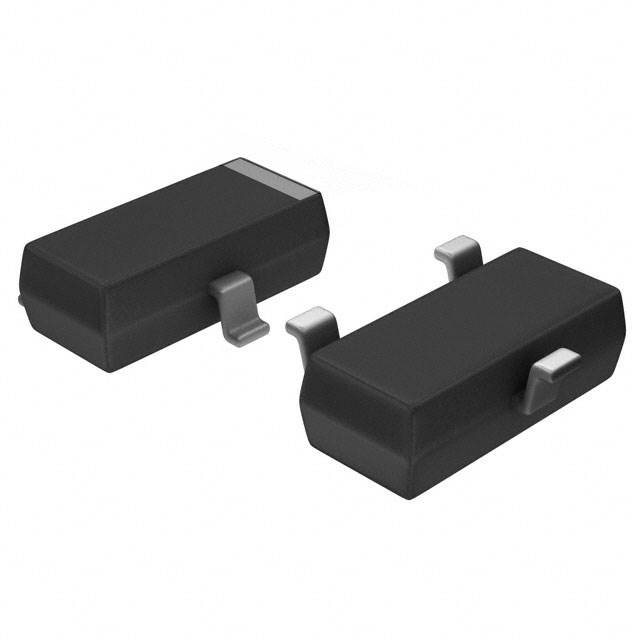
MMBF5485 vs 2N7002HSX: Component Comparison for Power Electronics Engineers
Quick verdict
For high-frequency, low-current analog/RF switching or small-signal amplification up to 400 MHz, the MMBF5485 is the better choice due to its JFET technology and low noise figure. For general-purpose digital switching or low-voltage load switching up to 60 V and 320 mA, the 2N7002HSX wins, offering higher current capacity, better thermal margins, and an automotive-grade qualification.
Spec comparison table
| Spec | MMBF5485 | 2N7002HSX | Notes |
|---|---|---|---|
| Configuration | N-Channel JFET | 2 x N-Channel MOSFET (dual) | 2N7002HSX offers dual devices per package, useful for complementary or parallel designs. |
| Current rating (continuous) | 10 mA | 320 mA (Ta) | 2N7002HSX supports 32x higher continuous current, critical for load switching applications. |
| Frequency | 400 MHz | Not specified (digital switch) | MMBF5485 supports high-frequency operation, ideal for RF or analog switching. |
| Voltage rated | 25 V | 60 V | 2N7002HSX supports more than double the voltage, enabling higher voltage applications. |
| Voltage test | 15 V | - | Only MMBF5485 specifies voltage test; limited relevance. |
| Noise figure | 4 dB | Not specified | MMBF5485 better suited for low-noise applications. |
| Output power max | Not specified | 420 mW | 2N7002HSX power dissipation capability is defined, important for thermal design. |
| Mounting type | Surface Mount (SOT-23-3) | Surface Mount (6-TSSOP) | MMBF5485 smaller footprint (SOT-23 vs 6-TSSOP) — relevant for dense layouts. |
| Package case | TO-236-3, SC-59, SOT-23-3 | 6-TSSOP, SC-88, SOT-363 | Different package types affect PCB layout and thermal dissipation. |
| Technology | JFET | MOSFET | JFET for MMBF5485 offers low noise and high-frequency; MOSFET for 2N7002HSX offers higher current. |
| Current continuous drain Id 25°C | 10 mA | 320 mA (typ) | 2N7002HSX can handle substantially higher continuous drain current. |
| Ambient temperature range | Not specified | -55°C to 150°C | 2N7002HSX rated for automotive temperature range, better for harsh environments. |
| Breakdown voltage | Not specified | 60 V (drain-source) | 2N7002HSX higher voltage withstand improves robustness. |
| Drain-source on-state resistance | Not specified | 1.6 Ω @ 500 mA, 10V | 2N7002HSX Rds(on) is moderate; no data for MMBF5485 limits direct comparison. |
| Gate charge (Qg) | Not specified | 0.5 nC @ 4.5 V | Low gate charge in 2N7002HSX improves switching efficiency. |
| Forward transconductance (gfs) | Not specified | 400 mS (typ) | 2N7002HSX transconductance indicates good drive capability. |
| Gate-source threshold voltage | Not specified | 2.4 V (min), 3.5 V (typ) | 2N7002HSX gate threshold is typical for logic-level MOSFETs. |
| Power max dissipation | Not specified | 420 mW | 2N7002HSX explicitly rated for power dissipation, guiding thermal design. |
| Switching times (turn-on/off delay) | Not specified | ~6 ns (typ) | 2N7002HSX fast switching suitable for digital circuits; no data for MMBF5485. |
| Operating voltage max | 25 V | 60 V | 2N7002HSX supports higher voltage operation. |
| Storage temperature range | Not specified | -65°C to 150°C | 2N7002HSX better storage temperature range. |
| Package size (approx.) | SOT-23-3 (~2.9 x 1.3 mm) | 6-TSSOP (2.5 x 1.8 mm) | MMBF5485 smaller footprint; 2N7002HSX package is larger but contains dual devices. |
Design trade-offs
The MMBF5485 is a JFET designed for high-frequency (400 MHz) and low-current applications, commonly found in RF switching and small-signal analog circuits. Its low noise figure (~4 dB) and small SOT-23 package make it suitable for space-constrained and noise-sensitive designs. However, its maximum continuous current rating is only 10 mA, limiting its use to signal-level switching or buffering rather than load driving.
In contrast, the 2N7002HSX is a dual N-channel MOSFET array optimized for general-purpose switching with a much higher current rating of 320 mA continuous at room temperature and a maximum voltage rating of 60 V. This makes it suitable for low-voltage load switching, level shifting, or digital switching applications. The MOSFET technology offers lower on-resistance (1.6 Ω @ 500 mA), faster switching (~6 ns delay), and a defined gate charge (~0.5 nC @ 4.5 V), which are critical for efficient switching and power management circuits.
Thermally, the 2N7002HSX supports up to 150 °C junction temperature and has a maximum power dissipation rating of 420 mW, enabling more robust operation under higher load and temperature conditions. The MMBF5485 does not specify power dissipation limits, implying it is not intended for power switching or load driving.
From a layout perspective, the MMBF5485’s smaller SOT-23 footprint allows tighter component density, beneficial in RF front-end modules or space-constrained analog boards. The 2N7002HSX’s 6-TSSOP package is larger but contains two MOSFETs, which can save board area if a dual device is needed. The 2N7002HSX’s MOSFET gate requires a drive voltage above its threshold (2.4-3.5 V typical), so gate drive circuitry must be designed accordingly. The MMBF5485 JFET gate is generally voltage-controlled with different characteristics, potentially simpler in some analog applications.
Cost-wise, the 2N7002HSX is automotive-qualified (AEC-Q101), which usually comes at a premium but assures reliability in harsh environments. The MMBF5485 is a more specialized device, likely less common and possibly more expensive in small volumes due to its niche.
Use-case fit
Choose MMBF5485 when…
- Designing RF or analog switches requiring operation at frequencies up to 400 MHz.
- Low noise figure (~4 dB) is critical, e.g., in front-end low-noise amplifiers or signal conditioning.
- Switching very low currents (≤10 mA) where MOSFET leakage or capacitance would degrade performance.
- Space constraints demand a very small SOT-23 package.
- JFET’s linearity and input impedance characteristics are required for analog signal integrity.
Choose 2N7002HSX when…
- Switching loads up to 320 mA at voltages up to 60 V, such as in power management or level shifting.
- Dual MOSFET configuration can simplify circuit design requiring two matched switches.
- Automotive or industrial temperature range (-55°C to 150°C) and AEC-Q101 qualification are needed.
- Fast switching with low gate charge (~0.5 nC) is required for efficient digital or PWM control.
- Thermal dissipation up to 420 mW is necessary without additional heatsinking.
Drop-in compatibility
These parts are not pin- or footprint-compatible. The MMBF5485 is a single JFET in a SOT-23-3 package, while the 2N7002HSX is a dual MOSFET array in a 6-TSSOP package. Substituting one for the other requires redesigning the PCB footprint, considering pinout differences and package size. Additionally, differing electrical characteristics and technology (JFET vs MOSFET) affect circuit behavior, so substitution is non-trivial and generally not recommended without a full redesign.
Alternatives to consider
- BSS138: A widely used small-signal N-channel MOSFET with low gate charge and similar SOT-23 package, suitable for low-voltage switching.
- 2N7002: Single N-channel MOSFET with similar characteristics but in SOT-23, useful for general-purpose switching with smaller footprint than 2N7002HSX.
- BS170: Through-hole N-channel MOSFET with higher current rating (~500 mA), if PCB space and