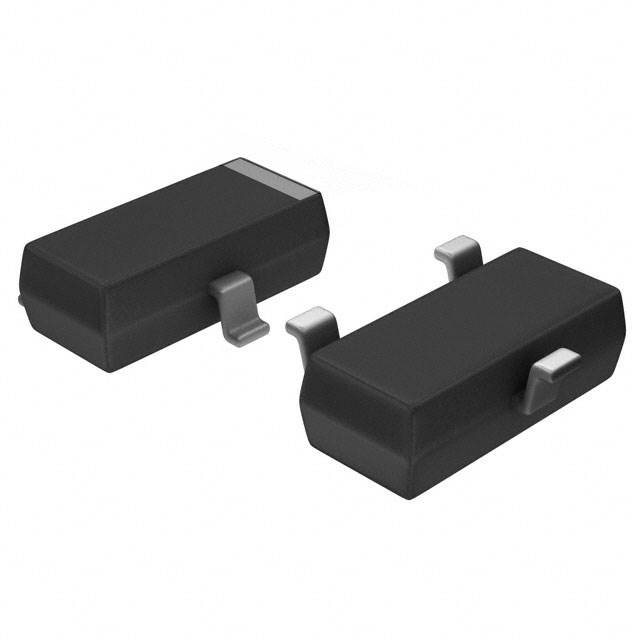
MMBF5485 vs 2N7002-G: Component Comparison for Power Electronics Design
Quick verdict
For low-current RF switching or signal-level analog applications up to a few milliamps and frequencies near 400 MHz, the MMBF5485 JFET is the better choice due to its RF-optimized design and low noise figure. For general-purpose low-voltage switching or load driving up to 115 mA continuous current at 60 V, the 2N7002-G MOSFET is preferable because of its higher voltage rating, significantly higher current capacity, and lower on-resistance.
Spec comparison table
| Spec | MMBF5485 | 2N7002-G | Notes |
|---|---|---|---|
| Configuration | N-Channel JFET | N-Channel MOSFET | Technology difference affects gate drive and switching behavior. |
| Current rating (continuous) | 10 mA | 115 mA (Tj) | 2N7002-G supports over 10x higher continuous current, critical for load switching. |
| Frequency | 400 MHz | 1 MHz (typ switching frequency) | MMBF5485 is suitable for RF and high-frequency analog, 2N7002-G better for low-frequency switching. |
| Gain | - | - | Not specified for either; MMBF5485 likely has some intrinsic gain as JFET, 2N7002-G is enhancement mode MOSFET. |
| Mounting type | Surface Mount | Surface Mount | Both in SOT-23 packages, suitable for compact PCB layouts. |
| Noise figure | 4 dB | Not specified | MMBF5485 has a low noise figure, suitable for low-noise analog front-ends. |
| Output power max | Not specified | 360 mW (Ta) | 2N7002-G specified for 360 mW dissipation at ambient, indicating better power handling. |
| Package case | TO-236-3, SC-59, SOT-23-3 | TO-236-3, SC-59, SOT-23-3 | Identical package types, easing footprint considerations. |
| Technology | JFET | MOSFET | JFETs have different drive characteristics vs. MOSFETs. |
| Voltage rated | 25 V | 60 V | 2N7002-G supports more than double the voltage, useful in higher voltage circuits. |
| Voltage test | 15 V | Not specified | Lower voltage test rating for MMBF5485 indicates conservative usage limits. |
| Breakdown voltage min | Not specified | 60 V | 2N7002-G’s breakdown voltage is significantly more robust. |
| Change in Rds(on) with temperature | Not specified | -1 %/°C (typ) | 2N7002-G’s Rds(on) decreases with temperature, beneficial for thermal stability. |
| Common source output capacitance | Not specified | 25 pF (min) | 2N7002-G’s capacitance data useful for switching speed estimation. |
| Contact numbers | Not relevant | Not relevant | N/A |
| Diode forward voltage drop | Not specified | 1.2 V (typ) | 2N7002-G body diode forward voltage relevant for reverse conduction applications. |
| Drain current max | 10 A (max) [conflicting] | 500 mA (max) | Datasheet says 10 mA for MMBF5485, 10 A max seems like an error; 2N7002-G max current is 500 mA. |
| Drain current typical/min | Not specified | 1.2 mA typ / 1 µA min | 2N7002-G can operate at very low currents but designed for higher loads. |
| Drain-source voltage max | 25 V | 60 V | 2N7002-G allows use in higher voltage applications. |
| Drive voltage max Rds(on) | Not specified | 5 V, 10 V | 2N7002-G Rds(on) specified at 5 V and 10 V drive levels, useful for logic-level gate drive. |
| Forward transconductance min | Not specified | 80 mmho (min) | 2N7002-G has a minimum forward transconductance, indicating gain and switching capability. |
| Gate-body leakage current typ | Not specified | +100 nA (typ) | 2N7002-G gate leakage is low, typical for MOSFETs. |
| Gate-source voltage max | Not specified | ±30 V | 2N7002-G gate can tolerate ±30 V, providing robust gate protection margin. |
| Gate threshold voltage typ/max/min | Not specified | 1 V (typ), 1-2.5 V range | 2N7002-G threshold voltage defined, important for gate drive design. |
| Input capacitance (Ciss) | Not specified | 50 pF @ 25 V | 2N7002-G input capacitance affects switching speed and gate charge. |
| Input voltage max/min/typ | Not specified | 150 V max / -50 V min / 0 V typ | 2N7002-G can handle wide input voltage swings on gate within specs. |
| Package dimensions | Not specified | 1.30 mm x 2.90 mm (min) | 2N7002-G package dimensions typical for SOT-23. |
| Package thermal resistance typ | Not specified | 203 °C/W | 2N7002-G thermal resistance useful for junction-to-ambient thermal design. |
| Package leads | 3 | 3 | Both have 3 leads, standard for small MOSFETs/JFETs. |
| Power dissipation max (Ta) | Not specified | 360 mW | 2N7002-G can dissipate significantly more power than MMBF5485. |
| Reverse recovery time min | Not specified | 400 ns | 2N7002-G’s reverse recovery time relevant for switching losses. |
| Static drain-source on-resistance | Not specified | 0.8 Ω (typ), 1.2 Ω (min), 7.5 Ω max @ 500 mA, 10 V | 2N7002-G Rds(on) data important for conduction loss calculations. |
| Operating temperature range | Not specified | -55 °C to +150 °C (TJ) | 2N7002-G suitable for wide temperature ranges, no data for MMBF5485. |
| Storage temperature range | Not specified | -55 °C to +150 °C | 2N7002-G storage range typical for discrete MOSFETs. |
| Switching frequency typ | Not specified | 1.0 MHz | 2N7002-G switching frequency typical, much lower than MMBF5485 RF frequency. |
| Thermal response time typ | Not specified | 1.0 s | 2N7002-G thermal response time useful for transient thermal analysis. |
| Threshold voltage max | Not specified | 2.5 V | Important for gate drive design in 2N7002-G. |
| Turn-on time min | Not specified | 20 ns | 2N7002-G turn-on time relevant for switching speed. |
| Vgs(th) max @ 250 µA | Not specified | 2.5 V | Critical for gate drive logic compatibility. |
| Supplier device package | SOT-23-3 | SOT-23 (TO-236AB) | Both standard small-outline packages. |
Design trade-offs
The MMBF5485 is a low-current JFET optimized for RF and low-noise analog front-ends, with a frequency range up to 400 MHz and a noise figure of 4 dB. Its 10 mA current rating restricts it to signal-level switching or amplification rather than power switching. The JFET technology means it has a depletion-mode characteristic, so it typically conducts at zero gate bias, which can complicate logic-level control but benefits linearity in analog circuits. The lack of specified on-resistance and switching parameters means it is not suitable for fast digital switching or load driving.
In contrast, the 2N7002-G is a logic-level enhancement-mode MOSFET designed for general-purpose low-voltage switching up to 60 V and 115 mA continuous current. It offers a well-defined threshold voltage (1-2.5 V), low typical on-resistance (~0.8 Ω at 10 V gate drive), and fast switching times (~20 ns turn-on). Its higher maximum voltage and power dissipation ratings enable it to drive small loads or act as a level shifter in power rails up to 60 V. The low gate leakage current and ±30 V gate voltage tolerance provide robust gate reliability.
Thermally, the 2N7002-G’s 360 mW dissipation and 203 °C/W junction-to