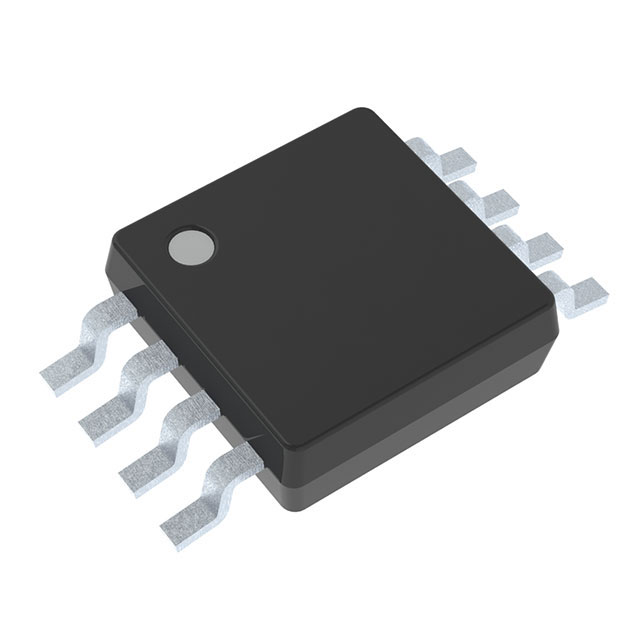
Key Specs
| Spec | Value | Condition | Source |
|---|---|---|---|
| Clock Sync | No | Digi-Key | |
| Control Features | Frequency Control | Digi-Key | |
| Duty Cycle (Max) | 96% | Digi-Key | |
| Function | Step-Up, Step-Down, Step-Up/Step-Down | Digi-Key | |
| Mounting Type | Surface Mount | Digi-Key | |
| Number Of Outputs | 1 | Digi-Key | |
| Operating Temperature Range | -40°C ~ 85°C (TA) | Digi-Key | |
| Output Configuration | Positive, Isolation Capable | Digi-Key | |
| Output Phases | 1 | Digi-Key | |
| Output Type | Transistor Driver | Digi-Key | |
| Package Case | 8-TSSOP, 8-MSOP (0.118”, 3.00mm Width) | Digi-Key | |
| Serial Interfaces | - | Digi-Key | |
| Supplier Device Package | 8-MSOP | Digi-Key | |
| Supply Voltage (Typ) | 7.6V ~ 20V | Digi-Key | |
| Switching Frequency (Typ) | 500kHz | Digi-Key | |
| Synchronous Rectifier | Yes | Digi-Key | |
| Topology | Buck, Boost, Flyback, Forward Converter | Digi-Key |
When To Use
Use the MIC38C43YMM in applications requiring a single-output, isolated or non-isolated DC-DC converter with flexible topology support (Buck, Boost, Flyback, Forward Converter) and synchronous rectification to maximize efficiency. Its wide supply voltage range of 7.6 V to 20 V and maximum duty cycle of 96% make it well-suited for regulated power supplies in industrial control systems, battery-powered equipment, and telecommunications infrastructure operating over an ambient temperature range of -40°C to 85°C.
Avoid using this device in multi-output power supplies or applications requiring integrated serial interfaces, as it supports only a single output and lacks serial communication capabilities. In such cases, consider a multi-output controller with integrated digital interfaces for enhanced system control.
When Not To Use
-
High current output >10A at 12V: The single output transistor driver and package limit maximum current capability. Use a multi-phase buck controller to distribute current across phases and avoid thermal runaway or device overstress.
-
Low power, battery-powered sensor needing μA standby current: The MIC38C43YMM’s quiescent current is not optimized for ultra-low IQ operation. Use a low-IQ PFM buck to prevent premature battery drain during standby.
-
Input voltage above 20V or requiring >500kHz switching: The maximum supply voltage and typical switching frequency of 500kHz limit high-voltage or high-frequency applications. Use a high-frequency buck controller designed for switching frequencies beyond 500kHz.
Application Notes
The switching node connected to the external inductor and output diode or synchronous MOSFET is the primary switching node and must have the smallest possible loop area to minimize electromagnetic interference and switching losses. Careful PCB layout is critical to reduce parasitic inductance and noise coupling.
The feedback pin is noise-sensitive and should be routed away from high-current switching nodes and noisy traces to maintain stable output voltage regulation.
At typical operating conditions within the supply voltage range of 7.6 V to 20 V and switching frequency of 500 kHz, a heatsink is generally not required due to the device’s efficient synchronous rectification and optimized package thermal characteristics (8-TSSOP or 8-MSOP). However, thermal management should be verified under maximum load and elevated ambient temperatures up to 85°C to ensure reliable operation.
Gotchas
-
[Frequency control misapplication]: Assuming the frequency control input can accept an external clock synchronization signal leads to asynchronous switching behavior. The device does not support clock sync, so injecting a clock causes jitter and unpredictable EMI. Fix by using frequency control only with a DC voltage reference per datasheet guidance.
-
[Minimum load requirement ignored]: Running the converter at very light loads or no load can cause output voltage overshoot and instability due to lack of internal minimum load regulation. Symptoms include output voltage ringing on startup or load removal. Fix by adding a small bleed resistor or minimum load to stabilize regulation.
-
[Output capacitor ESR undervalued]: Using low-ESR ceramic capacitors alone on the output can destabilize the control loop due to insufficient damping, causing oscillations or subharmonic ripple. Fix by paralleling a small tantalum or polymer capacitor with moderate ESR or adding a small series resistor.
-
[Ground routing error]: Returning the driver ground and feedback ground separately or routing them through different PCB layers causes ground bounce and feedback errors, resulting in output voltage drift and switching noise coupling. Fix by creating a single, low-impedance ground plane under the device and separating power and signal grounds only at a single star point.