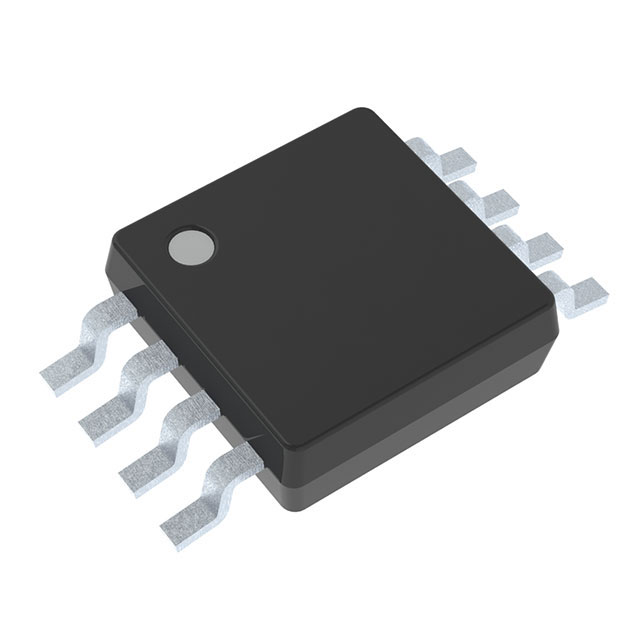
Key Specs
| Spec | Value | Condition | Source |
|---|---|---|---|
| Clock Sync | No | Digi-Key | |
| Control Features | Frequency Control | Digi-Key | |
| Duty Cycle (Max) | 96% | Digi-Key | |
| Function | Step-Up, Step-Down, Step-Up/Step-Down | Digi-Key | |
| Mounting Type | Surface Mount | Digi-Key | |
| Number Of Outputs | 1 | Digi-Key | |
| Operating Temperature Range | -40°C ~ 85°C (TA) | Digi-Key | |
| Output Configuration | Positive, Isolation Capable | Digi-Key | |
| Output Phases | 1 | Digi-Key | |
| Output Type | Transistor Driver | Digi-Key | |
| Package Case | 8-TSSOP, 8-MSOP (0.118”, 3.00mm Width) | Digi-Key | |
| Serial Interfaces | - | Digi-Key | |
| Supplier Device Package | 8-MSOP | Digi-Key | |
| Supply Voltage (Typ) | 7.6V ~ 20V | Digi-Key | |
| Switching Frequency (Typ) | 500kHz | Digi-Key | |
| Synchronous Rectifier | Yes | Digi-Key | |
| Topology | Buck, Boost, Flyback, Forward Converter | Digi-Key |
When To Use
-
12V automotive rail → 5V @ 3A: The input voltage range of 7.6V to 20V accommodates typical automotive battery variations including cold crank and load dump scenarios. Using a non-synchronous controller here risks excessive diode conduction losses causing thermal runaway under continuous high load.
-
Battery-powered industrial equipment, 9V nominal → 3.3V @ 1.5A: The MIC38C43ABMM’s ability to operate as a step-up, step-down, or buck-boost converter with a maximum duty cycle of 96% ensures stable regulation over a wide input range near or below output voltage. A fixed buck controller would drop out of regulation or cause output undervoltage during input dips.
-
Isolated DC-DC flyback converter, 15V input → isolated 12V output @ 2A: The positive output configuration combined with isolation capability and integrated synchronous rectifier driver simplifies flyback topology design. Using a non-synchronous flyback controller here would increase conduction losses and risk excessive heat dissipation.
When Not To Use
-
>5A output current applications: The single-phase transistor driver and 8-MSOP package limit continuous output current capability. Use a multi-phase buck controller to distribute current and reduce thermal stress.
-
Sub-1V dropout linear regulation or noise-sensitive analog supplies: The switching topology and minimum input voltage of 7.6V make this unsuitable for low dropout, low-ripple requirements. Use an LDO regulator instead.
-
Battery-powered sensor nodes requiring ultra-low quiescent current: With no specified low-IQ mode and a switching frequency fixed at 500kHz, this part consumes more standby power than acceptable. Use a low-IQ PFM buck designed for μA sleep currents.
Application Notes
-
The switching node (SW) pin must have a compact, low-inductance copper area with a local high-frequency decoupling capacitor to minimize voltage ringing and EMI. Avoid routing sensitive analog signals near SW.
-
Pins associated with synchronous rectifier control are noise-sensitive; route gate drive traces short and shielded from noisy switching currents to prevent false triggering or shoot-through.
-
Frequency control is available but clock synchronization is not; external synchronization attempts can cause phase jitter or erratic switching. Use frequency adjustment only within the specified 500kHz nominal.
-
The 8-MSOP package requires careful thermal relief and grounding to maintain junction temperature within the -40°C to 85°C operating range; use thermal vias under the exposed pad if available.
-
When used in isolated flyback or forward topologies, ensure primary-to-secondary isolation clearance and creepage distances meet system safety requirements; the device supports isolation-capable outputs but does not provide isolation itself.
Gotchas
-
[High duty cycle causes instability]: Operating near the 96% duty cycle maximum, especially during step-up or buck-boost modes, can cause subharmonic oscillations or erratic switching waveforms. This is not always obvious in simulation with ideal components. Fix by limiting maximum duty cycle in firmware to ~90% and verifying loop stability margins with real components.
-
[Incorrect bootstrap capacitor sizing]: The internal synchronous rectifier driver requires a properly sized bootstrap capacitor referenced to the SW node. Undersizing this capacitor leads to insufficient gate drive voltage, causing increased conduction losses and possible thermal runaway. Verify bootstrap capacitor value per datasheet recommendations and confirm gate drive voltage with an oscilloscope.
-
[Output capacitor ESR impacts stability]: Using low-ESR ceramic capacitors exclusively on the output can lead to loop instability and output voltage ringing due to the MIC38C43ABMM’s control loop compensation design. Add a small bulk capacitor with moderate ESR or include a series resistor to ensure stable operation.
-
[No internal clock sync leads to beat frequency noise]: External noise injection or switching frequency drift can produce audible or RF interference since clock synchronization input is absent. Avoid routing noisy signals near the frequency control pin and keep switching frequency stable under varying load and temperature conditions.