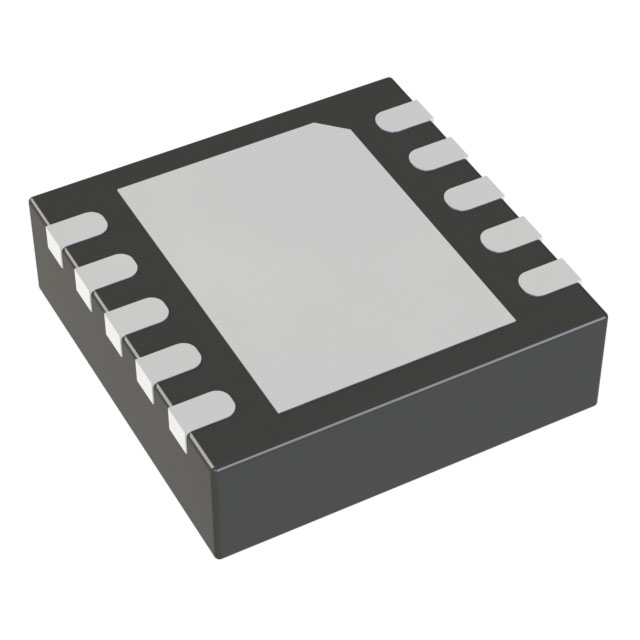
Key Specs
| Spec | Value | Condition | Source |
|---|---|---|---|
| Battery Chemistry | Lithium Ion/Polymer | Digi-Key | |
| Number Of Cells | 1 | Digi-Key | |
| Current Charging | Constant - Programmable | Digi-Key | |
| Programmable Features | Current | Digi-Key | |
| Fault Protection | Over Temperature | Digi-Key | |
| Charge Current (Max) | 1A | Digi-Key | |
| Battery Pack Voltage | 4.2V | Digi-Key | |
| Voltage Supply (Max) | 6V | Digi-Key | |
| Interface | - | Digi-Key | |
| Operating Temperature Range | -40°C ~ 85°C (TA) | Digi-Key | |
| Mounting Type | Surface Mount | Digi-Key | |
| Package Case | 10-VFDFN Exposed Pad | Digi-Key | |
| Supplier Device Package | 10-DFN (3x3) | Digi-Key |
When To Use
Use the MCP73833T-FCI/MF in single-cell Lithium Ion or Lithium Polymer battery charging applications requiring a programmable constant charging current up to 1A, with a maximum battery pack voltage of 4.2V. It is ideal for surface mount designs where space is limited, utilizing the 10-VFDFN Exposed Pad package. Applications such as portable consumer electronics, wearables, and small IoT devices benefit from its over-temperature fault protection and operating temperature range of -40°C to +85°C. The device supports input voltages up to 6V and is suitable for systems powered by typical 5V supplies, making it well suited for USB-powered chargers or similar power sources.
When Not To Use
Do not use the MCP73833T-FCI/MF for multi-cell battery packs or chemistries other than single-cell Lithium Ion/Polymer due to its fixed single-cell voltage regulation of up to 4.5V maximum. For applications requiring charging currents above 1A or battery voltages exceeding 4.5V, choose a dedicated multi-cell charger or a device designed for higher current and voltage ratings. Additionally, avoid using this device in environments where the operating temperature exceeds +85°C, as it is not rated beyond this range.
Application Notes
The MCP73833T-FCI/MF’s BAT pin switches the charging current and must have the smallest possible loop area with the output capacitor to minimize EMI and voltage noise. The PROG pin is noise-sensitive and should be routed away from noisy signals to maintain accurate current programming. Proper heatsinking is required at typical operating points near 1A charge current; the exposed pad on the 10-VFDFN package must be soldered to a PCB thermal pad with multiple vias to ensure junction temperature remains within the -40°C to +85°C operating range. Input and output capacitors should be placed close to the device pins to reduce voltage ripple and improve regulation accuracy. The device’s thermal shutdown timer adds robustness against over-temperature conditions, but proper PCB thermal design is critical to avoid frequent thermal shutdown events.
Gotchas
-
Incorrect Programming Resistor Value:
Mistake: Using a programming resistor value outside the recommended range (e.g., much higher than 1 kΩ).
Failure Mode: The charge current will be significantly lower or higher than intended, leading to slow charging or battery damage due to overcurrent.
Fix: Use a precision resistor close to 1 kΩ as specified to ensure accurate current regulation. -
Insufficient Input or Output Capacitance:
Mistake: Omitting or undersizing the input/output capacitors (less than 1 µF input or 4.7 µF output).
Failure Mode: The device may exhibit unstable operation, voltage spikes, or increased noise, causing unreliable charging or device resets.
Fix: Place recommended ceramic capacitors as close as possible to the device pins to maintain stability. -
Ignoring Thermal Management:
Mistake: Failing to implement proper PCB layout with sufficient heatsinking vias under the exposed pad.
Failure Mode: Device junction temperature rises excessively during 1A charging, triggering thermal shutdown or reducing reliability.
Fix: Follow PCB layout guidelines with multiple thermal vias and keep the exposed pad soldered to a large copper area to dissipate heat.