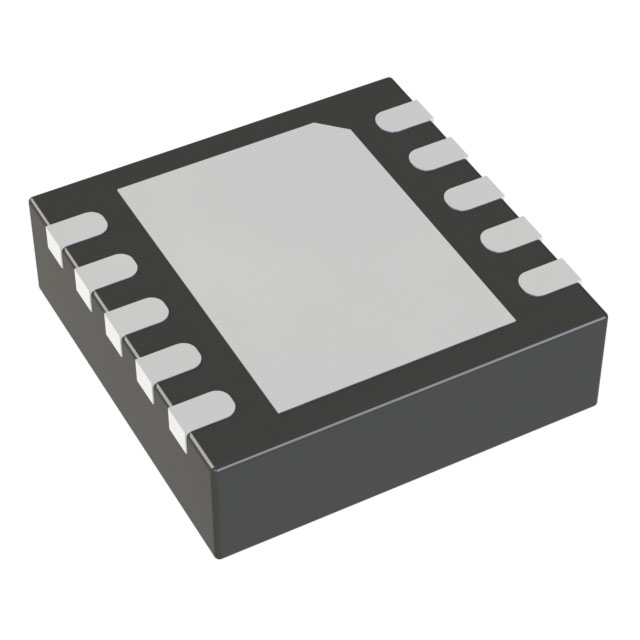
Key Specs
| Spec | Value | Condition | Source |
|---|---|---|---|
| Battery Chemistry | Lithium Ion/Polymer | Digi-Key | |
| Number Of Cells | 1 | Digi-Key | |
| Current Charging | Constant - Programmable | Digi-Key | |
| Programmable Features | Current | Digi-Key | |
| Fault Protection | Over Temperature | Digi-Key | |
| Charge Current (Max) | 1.1A | Digi-Key | |
| Battery Pack Voltage | 4.2V | Digi-Key | |
| Voltage Supply (Max) | 6V | Digi-Key | |
| Interface | - | Digi-Key | |
| Operating Temperature Range | -40°C ~ 85°C (TA) | Digi-Key | |
| Mounting Type | Surface Mount | Digi-Key | |
| Package Case | 10-VFDFN Exposed Pad | Digi-Key | |
| Supplier Device Package | 10-DFN (3x3) | Digi-Key |
When To Use
-
1-cell Li-Ion battery @ 1A charge current: The programmable constant-current charging capability up to 1.1A and preset voltage options up to 4.5V make this device ideal for single-cell Li-Ion/polymer packs requiring accurate charge termination and safety. Using a generic linear regulator here risks thermal runaway due to high power dissipation during charging.
-
Battery-powered system with supply up to 6V: The input voltage max of 6V and internal over-temperature fault protection enable safe operation from typical USB or wall adapters without external protection. Switching to an LDO regulator in this scenario would cause excessive heat dissipation and possible thermal shutdown.
-
Embedded systems requiring small footprint and surface-mount: The 10-VFDFN exposed pad package (3x3 mm) allows dense PCB layouts with efficient thermal dissipation, ideal for space-constrained portable devices. Using a larger through-hole or non-exposed pad package in the same footprint would lead to poor thermal performance and potential junction overheating.
When Not To Use
-
>1A charge current requirement: The max charge current rating of 1.1A limits this device for higher current applications. Use a high-current synchronous buck with external FETs to handle larger currents efficiently and safely.
-
Input voltage above 6V: The maximum supply voltage rating of 6V disqualifies this device for systems powered from higher voltage rails. A synchronous buck controller designed for higher input voltage ranges is required to avoid device breakdown or latch-up.
-
Applications needing galvanic isolation: This device has no isolation features and cannot safely be used in isolated power domains or medical designs requiring isolation. An isolated flyback controller is necessary to maintain safety and functional isolation.
Application Notes
-
Place the ceramic input and output capacitors (minimum 1µF, recommended 4.7µF) as close as possible to the device’s VDD (pin 1) and BAT (pin 3) pins to minimize voltage ripple and ensure stable regulation.
-
The exposed thermal pad beneath the 10-VFDFN package must be connected to a large copper area with multiple thermal vias to the inner PCB layers for effective heat dissipation and to maintain junction temperature within safe limits.
-
the STAT1 pin and the STAT2 pin are open-drain status outputs; route these with pull-up resistors and keep traces short and shielded to reduce noise pickup, especially in noisy switching environments.
-
The PROG pin (pin 7) requires a resistor to program charge current; use low-noise, precision resistors and keep the PROG trace away from switching nodes to avoid interference with current regulation accuracy.
-
The THERM pin (pin 8) is designed for thermistor input; ensure low-leakage routing and guard traces to prevent false thermal trip signals triggered by PCB contamination or humidity.
Pin numbers are package-specific. Verify against the datasheet pinout diagram before routing.
Gotchas
-
[PROG resistor value vs. thermal dissipation]: Engineers sometimes select a PROG resistor too low to maximize charge current without verifying package power dissipation. The device’s internal current regulation max is 1.1A, but exceeding recommended resistor power ratings leads to resistor heating, drifting, and eventual charge current instability. Fix: Use a resistor with at least 1% tolerance and power rating > 0.25W; verify resistor temperature under worst-case charging.
-
[Thermistor bias current mismatch]: Assuming any thermistor or NTC sensor works without matching the 50µA bias current leads to incorrect temperature monitoring and premature thermal fault triggers. Symptoms include premature charge termination or stuck fault status. Fix: Use thermistors specified for 50µA bias or add a buffer stage; verify thermistor voltage at room temperature before final assembly.
-
[Insufficient PCB thermal vias under exposed pad]: Neglecting to place adequate thermal vias causes junction temperature rise beyond the rated 125°C max, triggering thermal shutdown or reducing reliability. Symptoms include intermittent charge cycle aborts and elevated device temperature on IR camera. Fix: Follow recommended PCB design guidelines with multiple vias (≥10) of 0.3mm diameter beneath the exposed pad connected to a large copper plane.
-
[Startup with input voltage near UVLO threshold]: Applying input voltage close to the 3.4V UVLO start threshold can cause erratic startup behavior, including incomplete charge cycles or oscillation, as device may repeatedly enter and exit UVLO. Symptoms: intermittent charge status LED, fluctuating output current. Fix: Ensure input supply voltage is at least 3.7V (UVLO max threshold) at startup or add a voltage supervisor circuit.