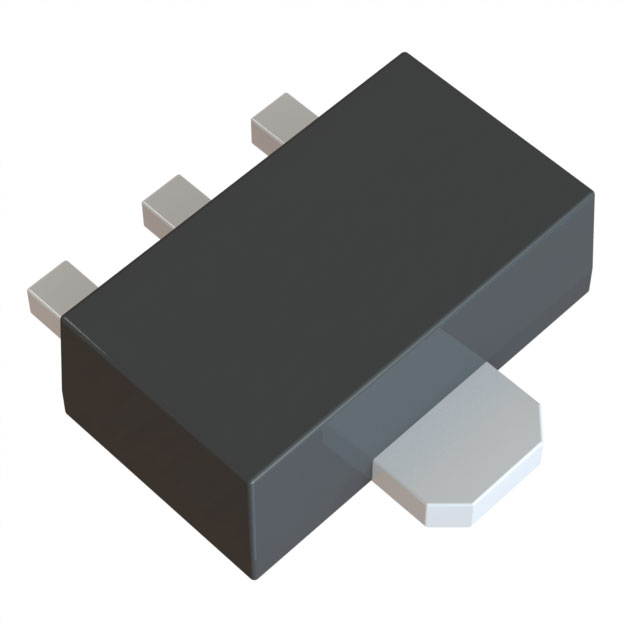
Key Specs
| Spec | Value | Condition | Source |
|---|---|---|---|
| Control Features | - | Digi-Key | |
| Current Quiescent IQ | 4 µA | Digi-Key | |
| Input Voltage (Max) | 6V | Digi-Key | |
| Mounting Type | Surface Mount | Digi-Key | |
| Number Of Regulators | 1 | Digi-Key | |
| Operating Temperature Range | -40°C ~ 125°C | Digi-Key | |
| Output Configuration | Positive | Digi-Key | |
| Output Current (Max) | 200mA | Digi-Key | |
| Output Type | Fixed | Digi-Key | |
| Output Voltage (Max) | - | Digi-Key | |
| Output Voltage (Min) | 2.3V | Digi-Key | |
| Package Case | TO-243AA | Digi-Key | |
| Protection Features | Over Current, Over Temperature, Short Circuit | Digi-Key | |
| Psrr | 44dB (100Hz) | Digi-Key | |
| Supplier Device Package | SOT-89-3 | Digi-Key | |
| Voltage Dropout (Max) | 0.35V @ 200mA | Digi-Key |
When To Use
-
3.3V @ 150mA for low-power microcontroller: The 4 µA quiescent current and 200mA max output current suit low-power digital loads with modest current needs. Using a switching regulator here risks excessive noise and complexity, while a linear regulator with higher dropout would cause thermal issues if input voltage approaches 6V.
-
Battery-powered sensor node running at 2.3V fixed output: The fixed 2.3V output voltage and ultra-low dropout voltage (0.35V @ 200mA) enable efficient regulation from a 3.3V or 5V battery source while minimizing battery drain from quiescent current. A switching regulator would add noise that complicates analog front-end measurements.
-
Powering analog circuitry requiring clean 2.3–3.3V rails under 200mA: The 44dB PSRR at 100Hz and built-in short-circuit plus over-temperature protection ensures stable and safe supply to sensitive analog blocks. A synchronous buck controller would introduce switching ripple requiring additional filtering and layout complexity.
When Not To Use
-
High-current load above 200mA: Output current max of 200mA is too low for power-hungry loads; use a high-current synchronous buck with external FETs to deliver higher current efficiently without thermal runaway.
-
Input-output voltage differential less than 0.35V (e.g. 3.3V in, 3.0V out): The dropout voltage of up to 0.35V at full load prevents stable regulation in low headroom conditions; use an LDO regulator designed for ultra-low dropout to avoid output voltage sag.
-
Battery-powered device where quiescent current dominates lifetime: With 4 µA quiescent current, this part is not optimal for μA or sub-μA sleep currents; use a low-IQ PFM buck regulator to maximize battery life during standby.
Application Notes
-
The output capacitor must have low ESR to maintain stability; standard ceramic capacitors near the output pin (pin 3) are recommended to minimize output voltage ripple and avoid oscillations.
-
the GND pin and the VIN pin require short, low-inductance traces to reduce input noise coupling and improve transient response; keep the input capacitor close to VIN and GND pins.
-
Thermal vias underneath the SOT-89-3 package’s exposed pad improve heat dissipation; ensure a sufficient copper area on the PCB connected to GND for effective heat spreading.
-
Avoid routing sensitive analog signals adjacent to the VIN input trace to minimize coupling of switching noise, especially when input voltage is near the max 6V rating.
-
The device’s protection features (over-current, over-temperature, short circuit) rely on accurate PCB layout for thermal sensing; poor thermal contact or excessive trace length to ground can delay fault detection.
Pin numbers are package-specific. Verify against the datasheet pinout diagram before routing.
Gotchas
-
[Startup sequence with low input voltage margin]: Designers sometimes assume the device will regulate correctly if VIN starts just above the dropout voltage. In reality, at 200mA load, dropout can spike to 0.35V causing the output voltage to sag or ripple until VIN rises sufficiently. This causes intermittent undervoltage at the load. Fix by ensuring VIN exceeds VOUT + 0.5V under worst-case conditions or reducing load during startup.
-
[Output capacitor ESR too high]: It’s tempting to use electrolytic capacitors for bulk capacitance, but their high ESR can destabilize the regulator’s feedback loop, resulting in output voltage oscillations visible on the scope as ringing or periodic spikes. Fix by using low-ESR ceramic capacitors (X7R or better) directly at the output.
-
[Thermal derating not followed]: The maximum ambient temperature range is -40°C to 125°C, but power dissipation limits in the SOT-89-3 package mean the device will enter thermal shutdown at high load and ambient temperature. Designers relying solely on the absolute max rating without thermal simulation may see unexpected shutdown during peak load. Fix by verifying thermal resistance and adding heatsinking or de-rating load/current accordingly.
-
[Misinterpretation of protection features]: The built-in over-current and short-circuit protection does not guarantee indefinite fault tolerance; repeated or prolonged short circuits can cause latent device degradation or erratic restart cycles. Fix by adding external current limiting or fusing to protect the part and system robustness.