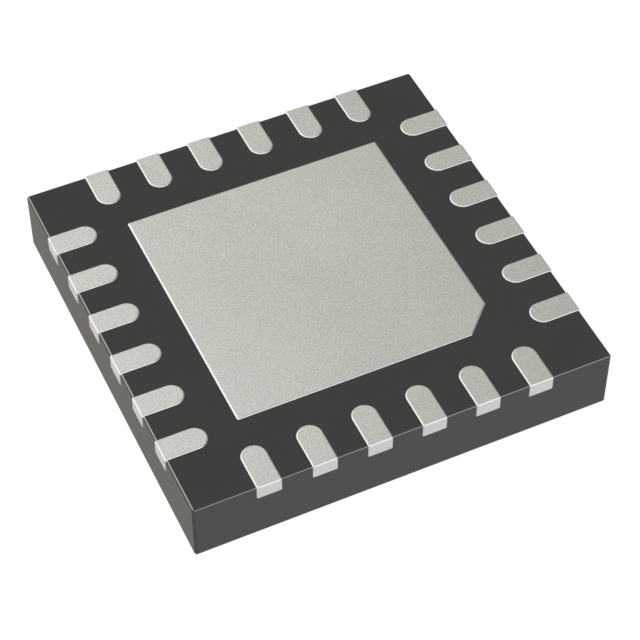
Key Specs
| Spec | Value | Condition | Source |
|---|---|---|---|
| Battery Chemistry | Lithium Ion/Polymer | Digi-Key | |
| Fault Protection | Over Current, Over Temperature, Over/Under Voltage, Short Circuit | Digi-Key | |
| Function | Fuel Gauge | Digi-Key | |
| Interface | 1-Wire | Digi-Key | |
| Mounting Type | Surface Mount | Digi-Key | |
| Number Of Cells | 1 ~ 4 | Digi-Key | |
| Operating Temperature Range | -40°C ~ 85°C (TA) | Digi-Key | |
| Package Case | 24-WFQFN Exposed Pad | Digi-Key | |
| Supplier Device Package | 24-TQFN (4x4) | Digi-Key |
When To Use
-
Single-cell to 4-cell Li-ion battery pack fuel gauge: The MAX17320G10+ supports 1 to 4 cells, perfectly matching multi-cell Li-ion/Polymer packs for accurate capacity tracking and protection. Using a gauge without cell count flexibility risks inaccurate state-of-charge calculations or premature cutoffs due to improper voltage scaling.
-
Battery pack with harsh environmental conditions (-40°C to 85°C): Its extended operating temperature range covers automotive and industrial applications where temperature extremes cause device drift or latch-up in lesser-rated parts. Parts rated for narrower temperature windows may experience unpredictable shutdown or permanent damage under these conditions.
-
Systems requiring a 1-Wire interface for minimal pin count: The integrated 1-Wire communication simplifies wiring and system complexity compared to I²C or SMBus gauges. Choosing a part without this interface could force additional external components or software overhead, increasing system cost and risk of bus contention failures.
When Not To Use
-
Battery packs exceeding 4 cells in series: The MAX17320G10+ supports up to 4 cells only, disqualifying it for higher cell count packs. Use a multi-phase buck controller for power conversion and monitoring in larger battery stacks where cell balancing and higher voltage range are required.
-
Applications demanding galvanic isolation between battery and system: This device lacks isolation capability, making it unsuitable for medical or industrial systems requiring electrical separation. An isolated flyback converter or controller is necessary to maintain safety and prevent ground loops.
-
Low quiescent current critical systems (coin cell or ultra-low power): Its quiescent current is not optimized below 1mA, which can drain small batteries prematurely in standby. A low-IQ PFM buck regulator should be used to extend battery life in these scenarios.
Application Notes
-
The exposed pad on the 24-WFQFN package must be soldered to a large PCB copper area with multiple thermal vias to ensure proper heat dissipation and maintain junction temperature within limits.
-
The switching node (SW) pin sees rapid voltage transitions and high di/dt; keep its loop area minimal and route it away from sensitive signal traces, especially the 1-Wire interface pins, to avoid communication errors due to noise coupling.
-
Noise-sensitive pins such as the 1-Wire data line and voltage sense inputs require careful placement and guard traces to minimize EMI and ensure stable voltage measurements.
-
Input and output decoupling capacitors should be placed as close as possible to the device pins to reduce ripple and voltage spikes that can cause false fault triggers or measurement inaccuracies.
-
Ensure battery pack connections are robust and low resistance; contact bounce or intermittent connections can cause transient faults or erroneous fuel gauge readings.
Gotchas
-
[Incorrect cell count configuration]: Assuming the device auto-detects cell count leads to miscalculated battery voltage and capacity, causing premature cutoff or overdischarge. Symptom: Fuel gauge reports incorrect SoC, system shuts down unexpectedly. Fix: Explicitly configure cell count in firmware or hardware setup per datasheet instructions.
-
[Improper switching node PCB layout]: Routing the SW node trace near the 1-Wire data pin causes high-frequency noise injection into the communication line, resulting in intermittent data corruption or loss. Symptom: Erratic 1-Wire communication, failed battery readings. Fix: Separate SW and sensitive signal traces with a grounded guard trace or physical distance.
-
[Minimum load requirements ignored]: Operating the gauge with no or very light load on the battery can cause unstable voltage sensing or failure to enter correct measurement mode. Symptom: Fuel gauge output locked or incorrect voltage readings. Fix: Include a small constant load resistor or ensure load current above the minimum threshold recommended in the datasheet.
-
[ESR of external capacitors too high]: Using electrolytic capacitors with high ESR on input or output lines leads to unstable internal reference and inaccurate voltage measurement. Symptom: Fluctuating fuel gauge readings, false overvoltage or undervoltage faults. Fix: Use low-ESR ceramic capacitors for decoupling and filtering as specified.