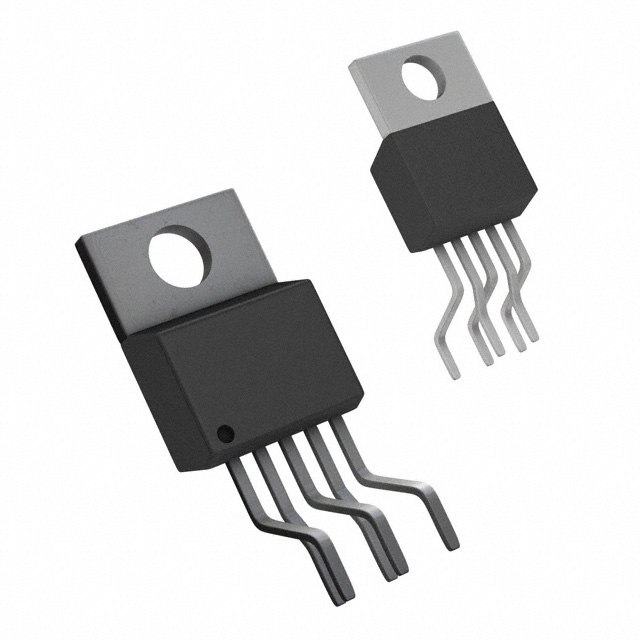
LM2596T-ADJ/NOPB vs. MAXM38643AEMB+T: A Practical Comparison
Quick verdict: For applications requiring a wide input voltage range (12V battery power, for example) and a through-hole solution, the LM2596T-ADJ/NOPB remains a viable, if dated, option. However, for modern, space-constrained designs with lower input voltages (typically 3.3V or 5V) where efficiency and small size are paramount, the MAXM38643AEMB+T offers a significantly better solution, despite its limited input voltage range.
Spec comparison table
| Spec | LM2596T-ADJ/NOPB | MAXM38643AEMB+T | Notes |
|---|---|---|---|
| Function | Step-Down | DC DC Converter | Both perform step-down conversion. |
| Output Configuration | Positive | Positive | Both provide positive output voltage. |
| Topology | Buck | Buck | Both utilize a buck topology. |
| Output Type | Adjustable | N/A (Fixed) | The LM2596 is adjustable; the MAXM38643 has a fixed output. |
| Number of Outputs | 1 | 1 | Both provide a single output. |
| Input Voltage Min | 4.5V | 1.8V | MAXM38643 has a significantly lower minimum input voltage. |
| Input Voltage Max | 40V | 5.5V | LM2596’s wide input range is a key advantage for some applications. |
| Operating Temperature Range | -40°C ~ 125°C | -40°C ~ 85°C | LM2596 has a wider operating temperature range. |
| Mounting Type | Through Hole | Surface Mount | Significant difference impacting PCB layout and assembly. |
| Package Case | TO-220-5 Formed Leads | 10-SMD Module | LM2596 is larger and requires through-hole soldering. |
| Supplier Device Package | TO-220-5 | 10-eMGA (2.6x2.1) | MAXM38643 is significantly smaller. |
Design trade-offs
The most immediate difference is the packaging. The LM2596T-ADJ/NOPB’s TO-220 package dictates a through-hole mounting solution, increasing board size and assembly complexity. The MAXM38643AEMB+T’s 10-eMGA module offers a compact surface-mount footprint, crucial for space-constrained designs. This size difference directly impacts thermal management; the larger LM2596 has more surface area for heat dissipation, but its through-hole nature can also hinder airflow.
The MAXM38643AEMB+T’s lower input voltage range (1.8V - 5.5V) is a critical limitation. It’s well-suited for applications powered by 3.3V or 5V rails, but unsuitable for higher voltage sources. The LM2596’s 4.5V-40V range provides flexibility, but this comes at the cost of lower efficiency, especially at lower input voltages. The LM2596 lacks synchronous rectification, contributing to higher quiescent current and lower efficiency, particularly when the output voltage is close to the input voltage. While specific efficiency curves are not provided, expect the MAXM38643 to outperform the LM2596 at typical operating points within its input voltage range.
Gate drive requirements are significantly different. The LM2596 requires external components (inductor, capacitors, resistors) which necessitate careful selection and layout to minimize parasitic inductance and capacitance. The MAXM38643 is a complete module, integrating these components, simplifying the design process but limiting customization. Layout sensitivity is also reduced with the MAXM38643, as the internal layout is already optimized.
Cost at volume is difficult to predict without requesting quotes, but the LM2596, being a mature and widely available part, is likely to be cheaper in very high volumes. However, the cost savings need to be weighed against the increased design and assembly costs associated with its through-hole package.
Use-case fit
Choose LM2596T-ADJ/NOPB when…
- You need to convert a 12V battery voltage down to a lower voltage (e.g., 5V for a microcontroller).
- Through-hole mounting is required due to existing board design or manufacturing constraints.
- Cost is the absolute primary concern and efficiency is secondary.
- You need a wide input voltage range (e.g., 9V-40V) to accommodate varying power source conditions.
- You are prototyping and need a simple, readily available solution.
Choose MAXM38643AEMB+T when…
- You are designing a compact, surface-mount device powered by a 3.3V or 5V rail.
- High efficiency is a priority.
- You want to minimize design complexity and BOM count.
- Space is limited and a small footprint is essential.
- You are designing a portable device where power consumption is critical.
Drop-in compatibility
These parts are not pin-compatible. The LM2596 has five leads, while the MAXM38643 is a 10-SMD module. The footprints are also completely different. Substituting one for the other requires a complete redesign of the power supply section of the board. The different input voltage ranges also necessitate changes to any protection circuitry.
Alternatives to consider
- LM2596S: A synchronous version of the LM2596, offering improved efficiency.
- TPS54331: A smaller, more efficient synchronous buck regulator from Texas Instruments.
- MP2307: A lower-cost, compact synchronous buck regulator from Monolithic Power Systems.