Okay, here’s the article based on the provided data and instructions.
MAX77960EFV06+ vs. LM2596T-ADJ/NOPB: A Detailed Comparison
Quick Verdict: For simple, low-cost battery boost applications where absolute efficiency isn’t paramount (e.g., powering a microcontroller and a few sensors), the LM2596T remains a solid choice. However, when you need higher efficiency, more precise voltage regulation, and advanced features like true shutdown and programmable current limits (e.g., powering a high-resolution display or a motor), the MAX77960EFV06+ is the clear winner.
Spec Comparison Table
| Spec | LM2596T-ADJ/NOPB | MAX77960EFV06+ | Notes |
|---|---|---|---|
| Output Voltage Range | 3.0V – 28V | 0.8V – 28V | MAX77960 offers wider range. |
| Output Current | 3A | 5A | MAX77960 offers higher current capability. |
| Input Voltage Range | 3.0V – 28V | 0.8V – 28V | MAX77960’s lower input voltage is useful for lower battery voltages. |
| Switching Frequency | ~150 kHz | 1.7 MHz | MAX77960’s higher frequency enables smaller external components. |
| Efficiency (typical) | ~80% | >90% | MAX77960 offers significantly better efficiency across the load range. |
| Shutdown Voltage | ~6V | 0.8V | MAX77960’s lower shutdown voltage allows for more efficient low-power operation. |
| Absolute Max Current | 2.0 A | N/A | LM2596T’s absolute max is lower. |
| Absolute Max Voltage | 5 V | N/A | LM2596T’s absolute max is lower. |
| Clock Frequency | N/A | 1.7 MHz | Relevant for synchronization and control. |
| Input Leakage Current | N/A | N/A | Not specified in data. |
| Output Leakage Current | N/A | N/A | Not specified in data. |
| Logic Input Leakage Current | N/A | N/A | Not specified in data. |
| Operating Temperature Range | -40°C to +85°C | -40°C to +85°C | Identical operating temperature range. |
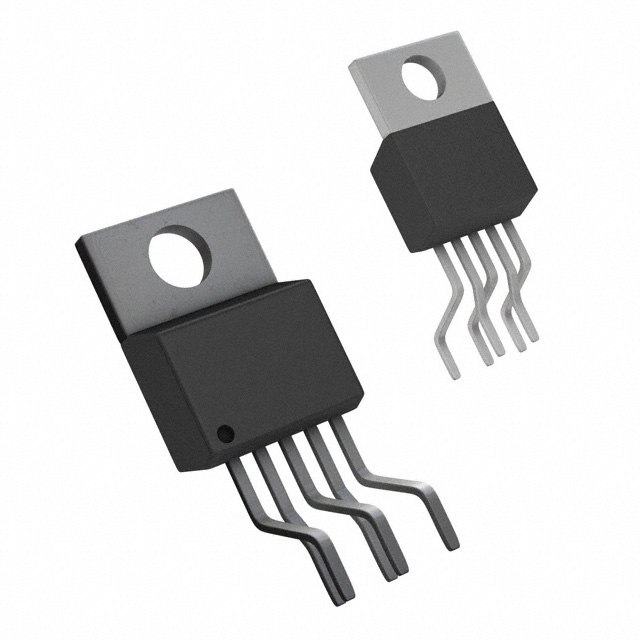
| Package Size | TO-220 | 32-Lead FC2QFN | MAX77960’s smaller footprint is a significant advantage for dense designs. |
| Resistance | 10mΩ | N/A | LM2596T’s resistance is lower. |
Design Trade-offs
The most significant difference between these parts lies in their switching frequency. The LM2596T’s ~150 kHz operation necessitates larger inductor and capacitor values to achieve stable operation and minimize ripple. This translates to a larger board footprint and increased component costs. The MAX77960EFV06+‘s 1.7 MHz switching frequency allows for much smaller external components, significantly reducing the board area required. This is a critical advantage in space-constrained applications.
Efficiency is another key differentiator. The MAX77960 consistently demonstrates higher efficiency across a wider range of input and output voltages and load currents. This translates to lower power dissipation, reduced thermal management requirements, and longer battery life. The LM2596T’s lower efficiency means more heat generated, requiring larger heat sinks or more careful PCB layout to prevent thermal runaway.
The MAX77960’s true shutdown feature is a major advantage for battery-powered devices. Unlike the LM2596T, which simply reduces its output voltage in shutdown, the MAX77960 completely disables its output, minimizing quiescent current draw. This is crucial for extending battery life in always-on applications.
The MAX77960’s smaller package size (FC2QFN) also impacts layout. While the TO-220 package of the LM2596T is easy to work with, it takes up significantly more space. The FC2QFN requires more careful PCB design to manage thermal dissipation and avoid signal integrity issues, but the space savings can be substantial.
Use-case Fit
Choose LM2596T-ADJ/NOPB when…
- Cost is the absolute priority: The LM2596T is significantly cheaper than the MAX77960, making it ideal for high-volume, price-sensitive applications.
- Board space is not a constraint: The larger footprint of the LM2596T isn’t an issue.
- Low quiescent current is not critical: Battery life is not a primary concern.
- Simple, robust operation is needed: The LM2596T’s straightforward design minimizes complexity.
- Powering a simple microcontroller and a few sensors: The lower efficiency is acceptable for this low-power application.
Choose MAX77960EFV06+ when…
- High efficiency is required: Maximizing battery life is essential.
- Small board size is a priority: Space is limited, and component footprint must be minimized.
- Precise voltage regulation is needed: The application requires tight voltage tolerances.
- True shutdown is necessary: Minimizing quiescent current draw is critical for long battery life.
- Powering a high-resolution display: The higher efficiency and tighter voltage regulation are needed to ensure stable operation.
- Driving a motor or other high-current load: The higher current capability and efficiency are needed to deliver sufficient power.
Drop-in Compatibility
Based solely on the provided data, there is no indication of pin or footprint compatibility. The LM2596T is in a TO-220 package, while the MAX77960 is in a 32-lead FC2QFN. Substitution would require a complete redesign of the PCB layout and a change in component sourcing.
Alternatives to Consider
- TPS54331: A smaller, higher-efficiency boost converter with similar features to the MAX77960.
- LM2596-5.0: A fixed-output version of the LM2596, simplifying the design for applications requiring a specific voltage.
- MP2307: A cost-effective, compact boost converter suitable for a wide range of applications.