## LM2596T-ADJ/NOPB vs. LT1372HVCS8#PBF: A Practical Comparison

**Quick verdict:** For simple, cost-sensitive step-down applications where board space isn's a primary concern and 3A is sufficient, the LM2596T-ADJ/NOPB remains a viable option. However, the LT1372HVCS8#PBF is the clear winner when you need a more versatile regulator capable of buck, boost, or SEPIC topologies, higher switching frequency, and a wider input voltage range, even if it means sacrificing some cost and current capability.

**Spec Comparison Table**

| Spec | LM2596T-ADJ/NOPB | LT1372HVCS8#PBF | Notes |
|---|---|---|---|
| Function | Step-Down | Step-Up, Step-Down, Step-Up/Step-Down | LT1372's versatility is a significant advantage for flexible designs. |
| Output Configuration | Positive | Positive or Negative | LT1372’s negative output capability can simplify designs in certain scenarios. |
| Topology | Buck | Buck, Boost, Cuk, Flyback, Forward Converter, SEPIC | LT1372's wider topology support allows for more complex power architectures. |
| Output Type | Adjustable | Adjustable | Both offer adjustable output voltage. |
| Number of Outputs | 1 | 1 | Both are single-output regulators. |
| Input Voltage Min | 4.5V | 2.7V | LT1372's lower input voltage allows for operation from lower-voltage sources. |
| Input Voltage Max | 40V | 30V | LM2596 has a higher input voltage range, useful for higher-voltage battery systems. |
| Output Voltage Min | 1.2V | 1.245V | Minimal difference, but LT1372’s fixed minimum might require more adjustment. |
| Output Voltage Max | 37V | 42V (Switch) | LM2596 has a slightly higher maximum output voltage. |
| Output Current Max | 3A | 1.5A (Switch) | LM2596 provides significantly higher current capability. |
| Switching Frequency Typ | 150kHz | 500kHz | LT1372's higher frequency generally reduces component size and improves transient response, but can also increase switching losses. |
| Synchronous Rectifier | No | No | Neither part includes synchronous rectification. |
| Operating Temperature Range | -40°C ~ 125°C | 0°C ~ 125°C | LM2596 has a slightly wider operating temperature range. |
| Mounting Type | Through Hole | Surface Mount | LT1372’s surface mount package is preferred for modern, compact designs. |
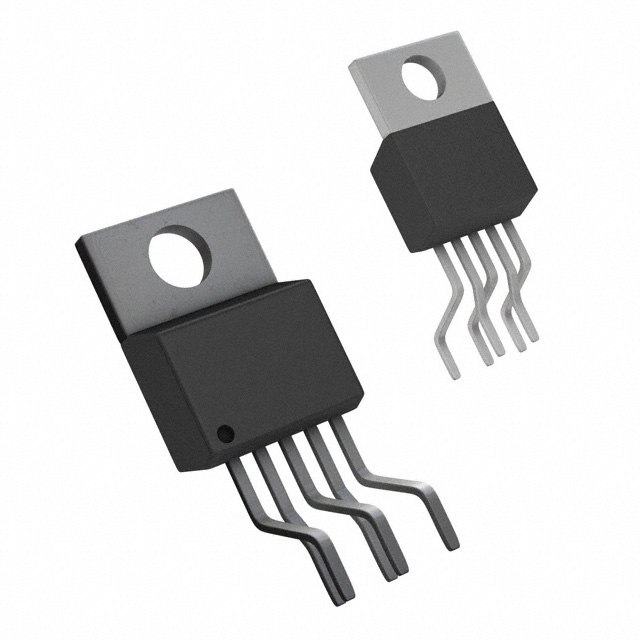
| Package Case | TO-220-5 Formed Leads | 8-SOIC (0.154", 3.90mm Width) | LM2596’s TO-220 package is larger and less suited for high-density layouts. |
| Supplier Device Package | TO-220-5 | 8-SO |  Package size difference significantly impacts board layout and thermal management. |

**Design Trade-offs**

The most immediate difference is the package type. The LM2596’s TO-220 package necessitates through-hole mounting, increasing board size and potentially complicating automated assembly. The LT1372’s SOIC package allows for surface mount technology, enabling smaller, denser designs.  The LM2596’s lower switching frequency (150kHz vs. 500kHz) can lead to larger inductor and capacitor requirements, further impacting board size. While the lower frequency *can* reduce switching losses at lower currents, the increased ripple current and slower transient response are drawbacks.

Efficiency curves are not provided in the datasheets, but a reasonable assumption is that the LM2596 will exhibit slightly better efficiency at lower currents (due to lower switching losses) and higher input voltages, but will be significantly less efficient at higher currents due to its fixed switching frequency and lack of synchronous rectification.  The LT1372’s higher switching frequency increases gate drive losses, which can become significant at higher currents.

Thermal management is also a key consideration. The LM2596's TO-220 package offers better exposed heat sinking potential, but its larger size makes it more difficult to integrate into tight spaces.  The LT1372 requires careful attention to thermal vias and copper area on the PCB to prevent overheating.

Gate drive requirements are relatively straightforward for both parts, but the LT1372’s higher switching frequency may necessitate more robust gate drive circuitry to minimize ringing and ensure reliable switching.

Layout sensitivity is generally higher for the LT1372 due to its higher switching frequency and smaller package size. Careful attention to grounding, decoupling, and trace impedance is crucial for stable operation.

**Use-case Fit**

**Choose LM2596T-ADJ/NOPB when…**

*   You need a simple, cost-effective step-down regulator for a low-volume application.
*   Board space is not a primary concern, and through-hole mounting is acceptable.
*   You're working with a higher input voltage (40V) that the LT1372 cannot handle.
*   You need a regulator with a slightly higher maximum output current (3A) and are willing to sacrifice efficiency and transient response.
*   You are retrofitting an existing design and minimizing component changes is paramount.

**Choose LT1372HVCS8#PBF when…**

*   You need a versatile regulator capable of buck, boost, or SEPIC operation.
*   You’re designing a compact, high-density PCB.
*   You require a faster transient response and smaller external components.
*   You need to operate from a lower input voltage (below 30V).
*   You need to implement a flyback or forward converter topology.

**Drop-in Compatibility**

These parts are *not* pin-compatible or footprint-compatible. The LM2596 uses a TO-220 package with five leads, while the LT1372 uses an 8-SOIC package. Substituting one for the other requires significant PCB layout modifications and potentially changes to the external component selection. The pin assignments are also different, requiring a complete re-routing of signals.

**Alternatives to Consider**

*   **LM2596-ADJ:** A slightly different variant of the LM2596, offering similar functionality.
*   **TPS54061:** A synchronous buck regulator from TI offering higher efficiency and improved performance.
*   **LM3406:** A versatile switching regulator IC that can be configured for various topologies, offering a good balance of performance and flexibility.