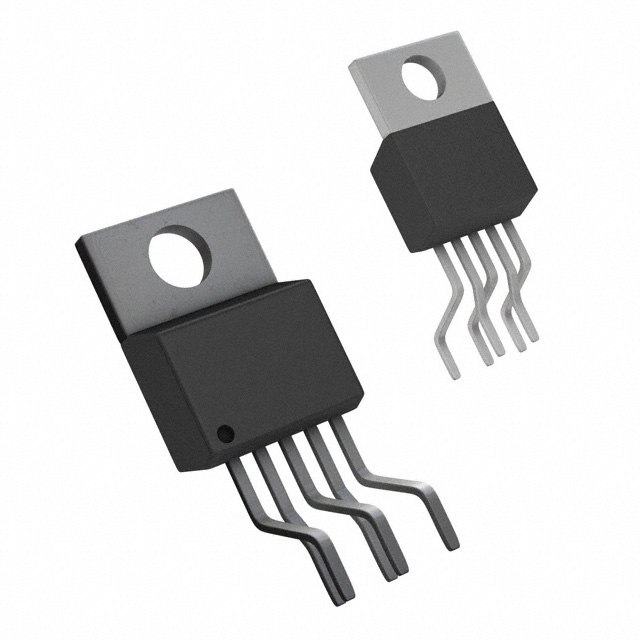
LM2596T-ADJ/NOPB vs. LM2596T-5.0/NOPB: A Practical Comparison
Quick verdict: For designs requiring a specific output voltage other than 5V, the LM2596T-ADJ/NOPB is the only choice. However, if your application reliably needs 5V and you want to minimize BOM cost and simplify initial bring-up, the LM2596T-5.0/NOPB offers a straightforward, if somewhat inflexible, solution.
Spec Comparison Table
| Spec | LM2596T-ADJ/NOPB | LM2596T-5.0/NOPB | Notes |
|---|---|---|---|
| Function | Step-Down | Step-Down | Identical. |
| Output Configuration | Positive | Positive | Identical. |
| Topology | Buck | Buck | Identical. |
| Output Type | Adjustable | Fixed | Key difference; ADJ offers flexibility, Fixed simplifies design. |
| Number of Outputs | 1 | 1 | Identical. |
| Input Voltage Min | 4.5V | 4.5V | Identical. |
| Input Voltage Max | 40V | 40V | Identical. |
| Output Voltage Min | 1.2V | 5V | ADJ offers significantly wider range. |
| Output Voltage Max | 37V | - | Fixed output limits design choices. |
| Output Current Max | 3A | 3A | Identical. |
| Switching Frequency Typ | 150kHz | 250kHz | Identical. |
| Synchronous Rectifier | No | No | Identical. |
| Operating Temperature Range (TJ) | -40°C ~ 125°C | -40°C ~ 125°C | Identical. |
| Mounting Type | Through Hole | Through Hole | Identical. |
| Package Case | TO-220-5 Formed Leads | TO-220-5 Formed Leads | Identical. |
| Supplier Device Package | TO-220-5 | TO-220-5 | Identical. |
Design Trade-offs
The most significant trade-off is the adjustable output versus the fixed 5V. The LM2596T-ADJ/NOPB requires external resistors to set the output voltage. This introduces a few design considerations. First, resistor selection impacts the feedback loop stability. Poor resistor choices can lead to oscillation or sluggish transient response. Second, resistor tolerances directly impact output voltage accuracy. 1% tolerance resistors are often required for moderately accurate output voltages. The LM2596T-5.0/NOPB bypasses this complexity entirely, simplifying initial prototyping and reducing BOM cost.
Efficiency curves for both parts are virtually identical given identical external components. Both parts suffer from significant conduction losses at higher currents due to the MOSFET’s RDS(on) and the inductor’s DCR. There’s no meaningful difference in this regard. Thermal considerations are also similar. Both parts are encapsulated in a TO-220 package, requiring adequate heatsinking if operating near the maximum current rating (3A) and ambient temperatures. The datasheet provides thermal resistance values for guidance.
Gate drive requirements are identical; both parts utilize an internal gate driver to switch the external MOSFET. Layout sensitivity is typical of older buck regulator designs – short, wide traces are crucial for minimizing parasitic inductance and ensuring loop stability. The adjustable version will require careful routing of the feedback network to avoid noise pickup. The fixed version benefits from a slightly simpler layout. Cost at volume will be lower for the LM2596T-5.0/NOPB due to the elimination of the external resistors.
Use-case Fit
Choose LM2596T-ADJ/NOPB when…
- You need an output voltage other than 5V, such as 3.3V for powering a microcontroller and a separate analog section requiring 1.8V.
- You require dynamic voltage adjustment, such as for powering a load with varying current demands and needing to maintain a specific voltage level.
- Your design incorporates a programmable voltage rail, where the output voltage needs to be changed during operation based on software control.
- You are prototyping a new product and need flexibility to experiment with different voltage levels.
- Your application requires a precise output voltage, necessitating careful resistor selection and trimming to achieve the desired accuracy.
Choose LM2596T-5.0/NOPB when…
- You exclusively need a regulated 5V output and want to minimize BOM cost and design complexity.
- You’re building a simple power supply for a device that consistently requires 5V.
- You are replacing an existing LM2596T-5.0/NOPB in a legacy design and want a direct, drop-in replacement.
- You are working on a high-volume production run where the cost savings of eliminating the external resistors outweigh the minor design convenience of the adjustable version.
- You need a quick and easy solution for a non-critical application where precise voltage regulation is not paramount.
Drop-in Compatibility
Pin-compatibility is likely, but not guaranteed without a direct comparison of the pinout diagrams. Footprint compatibility is also likely given the identical TO-220-5 package, but a visual inspection is recommended before assembly. The key difference – the adjustable feedback network – will necessitate significant board modifications when substituting one part for the other. The fixed version requires no external components for voltage setting.
Alternatives to Consider
- LM2596S: A slightly more efficient variant with a lower RDS(on) MOSFET.
- LM2576: A smaller, lower-power alternative for less demanding applications.
- TPS5430: A synchronous buck regulator offering significantly higher efficiency, but with increased complexity.