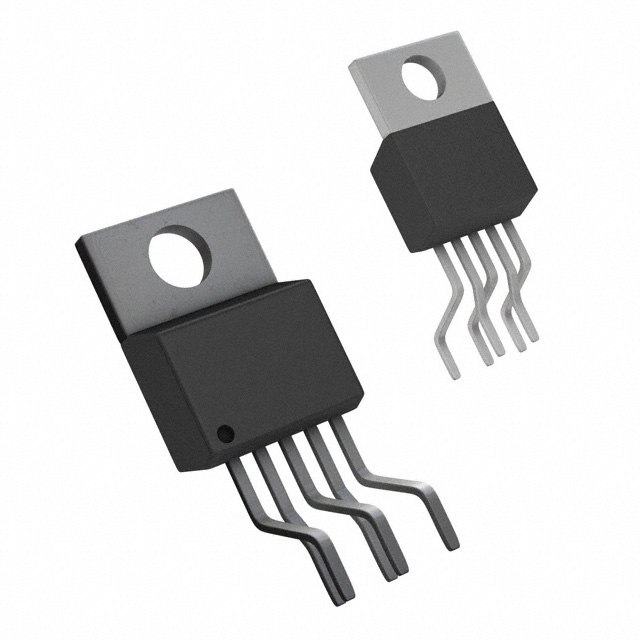
LM2596T-ADJ/NOPB vs. LM2596T-3.3/NOPB: A Practical Comparison
The LM2596 family remains a workhorse for simple, cost-sensitive step-down applications. For designs requiring a fixed 3.3V output, the LM2596T-3.3/NOPB is the obvious choice. However, if you need flexibility in your output voltage, the LM2596T-ADJ/NOPB offers a significant advantage, but comes with the added complexity of external component selection and tuning.
Spec Comparison Table
| Spec | LM2596T-ADJ/NOPB | LM2596T-3.3/NOPB | Notes |
|---|---|---|---|
| Function | Step-Down | Step-Down | Identical. |
| Output Configuration | Positive | Positive | Identical. |
| Topology | Buck | Buck | Identical. |
| Output Type | Adjustable | Fixed | Key difference. The adjustable version requires external resistors for voltage setting. |
| Number of Outputs | 1 | 1 | Identical. |
| Input Voltage Min | 4.5V | 4.5V | Identical. |
| Input Voltage Max | 40V | 40V | Identical. |
| Output Voltage Min | 1.2V | 3.3V | The adjustable part can achieve lower voltages. |
| Output Voltage Max | 37V | - | The adjustable part can achieve higher voltages. The fixed part is limited to 3.3V. |
| Output Current Max | 3A | 3A | Identical. |
| Switching Frequency Typ | 150kHz | 150kHz | Identical. |
| Synchronous Rectifier | No | No | Identical. |
| Operating Temperature Range | -40°C ~ 125°C (TJ) | -40°C ~ 125°C (TJ) | Identical. |
| Mounting Type | Through Hole | Through Hole | Identical. |
| Package Case | TO-220-5 Formed Leads | TO-220-5 Formed Leads | Identical. |
| Supplier Device Package | TO-220-5 | TO-220-5 | Identical. |
Design Trade-offs
The primary trade-off is the adjustable output versus a fixed 3.3V. The LM2596T-ADJ/NOPB requires careful selection of external resistors to set the output voltage. This introduces a potential source of error and requires calibration during manufacturing, although a reasonable tolerance can be achieved with good component selection. The fixed version eliminates this step, simplifying the design and reducing BOM cost.
Efficiency curves are unlikely to differ significantly between the two parts if the adjustable version is properly configured. However, a poorly chosen resistor divider in the adjustable part can introduce significant voltage drops, reducing efficiency. The fixed version’s pre-set voltage inherently optimizes for a reasonable load range.
Thermal considerations are similar for both parts, as they both dissipate heat based on input voltage, output current, and switching frequency. However, the adjustable version’s potential for a higher voltage drop across the resistor divider could slightly increase power dissipation and therefore thermal demands. Both parts require adequate heatsinking at higher current draws.
Gate drive requirements are identical, as both are using the same internal circuitry. Layout sensitivity is also similar; both require careful attention to ground plane integrity and minimizing parasitic inductance around the inductor and feedback network. The adjustable version’s feedback network is slightly more complex, requiring more precise routing to avoid noise pickup.
Cost at volume is likely to be slightly lower for the fixed version due to the simplified manufacturing process. The adjustable version’s BOM includes the two feedback resistors, adding a small but noticeable cost.
Use-Case Fit
Choose LM2596T-ADJ/NOPB when…
- You need to generate multiple output voltages from a single input voltage to power different components in a system.
- You are designing a configurable power supply where the output voltage is user-selectable.
- You are prototyping a design and need to quickly experiment with different output voltages.
- You require a voltage lower than 3.3V.
- You are designing a system that requires a voltage higher than 3.3V.
Choose LM2596T-3.3/NOPB when…
- Your design requires a fixed 3.3V output voltage.
- You need to minimize BOM cost and simplify manufacturing.
- You are designing a simple power supply for a single device that requires 3.3V.
- You are looking for a drop-in replacement for an existing 3.3V power supply.
- You need to reduce design complexity and time-to-market.
Drop-in Compatibility
Pin compatibility is likely, but footprint compatibility is guaranteed. Both parts are packaged in a TO-220-5. However, the resistor divider network is unique to the adjustable part and will not be present on the fixed version. Substituting one for the other will require significant board modifications and re-layout. The feedback network on the ADJ part is not present on the 3.3 part.
Alternatives to Consider
- LM2596S-ADJ: A synchronous version of the LM2596, offering improved efficiency at higher load currents.
- LM2576: A slightly smaller and lower-cost alternative for lower-power applications.
- TPS5430: A more modern, higher-performance buck regulator with integrated power MOSFETs.