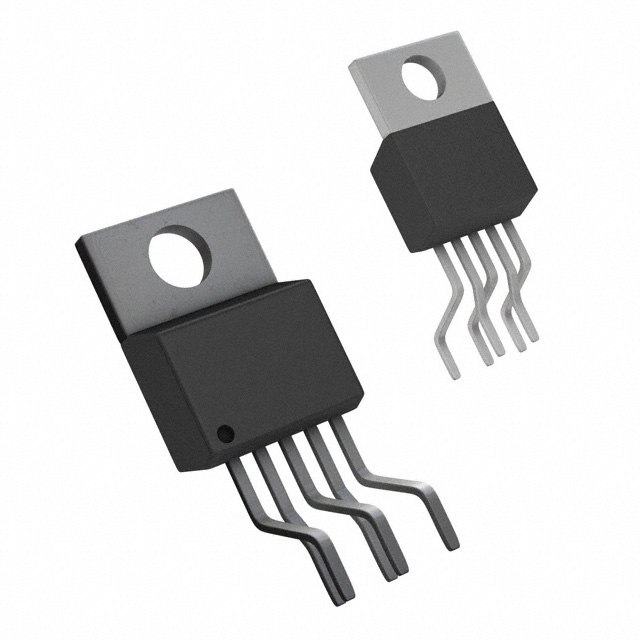
LM2596T-ADJ/NOPB vs. LM2596T-3.3: A Practical Comparison
The LM2596 family remains a workhorse for simple, cost-sensitive buck conversions. The LM2596T-ADJ/NOPB provides flexibility for variable output voltages, while the LM2596T-3.3 offers a fixed 3.3V output. For applications requiring adjustable voltage to accommodate different system needs, the ADJ version is the clear winner. However, for simple 3.3V regulation where component count and board space are paramount, the fixed-voltage part offers a slight edge in simplicity and potentially lower cost.
Spec Comparison Table
| Spec | LM2596T-ADJ/NOPB | LM2596T-3.3 | Notes |
|---|---|---|---|
| Function | Step-Down | Step-Down | Identical |
| Output Configuration | Positive | Positive | Identical |
| Topology | Buck | Buck | Identical |
| Output Type | Adjustable | Fixed | ADJ offers voltage programmability. |
| Number of Outputs | 1 | 1 | Identical |
| Input Voltage Min | 4.5V | - | LM2596T-3.3 datasheet doesn’t specify a minimum. Assume it’s similar to the ADJ version, 4.5V. |
| Input Voltage Max | 40V | 40V | Identical |
| Output Voltage Min | 1.2V | 3.3V | ADJ offers a wider range of voltages. |
| Output Voltage Max | 37V | - | LM2596T-3.3 datasheet doesn’t specify a maximum. Assume it’s similar to the ADJ version, 37V. |
| Output Current Max | 3A | 3A | Identical |
| Switching Frequency Typ | 150kHz | 150kHz | Identical |
| Synchronous Rectifier | No | No | Identical |
| Operating Temperature Range | -40°C ~ 125°C | -40°C ~ 125°C | Identical |
| Mounting Type | Through Hole | Through Hole | Identical |
| Package Case | TO-220-5 Formed Leads | TO-220-5 | Slight difference in lead form; likely footprint compatible but verify. |
| Supplier Device Package | TO-220-5 | TO-220-5L | TO-220-5L has slightly longer leads; likely footprint compatible but verify. |
Design Trade-offs
The most significant design difference is the adjustable output of the LM2596T-ADJ/NOPB. This requires external resistors to set the output voltage, adding two components and increasing the potential for error in the output voltage. The LM2596T-3.3, on the other hand, eliminates this complexity. However, the ADJ version’s programmability allows for adapting to varying system voltage requirements, which can be critical in some designs.
Thermal considerations are similar for both parts given their identical current rating and power dissipation characteristics. Both operate at 150kHz, which dictates a minimum trace width for switching loop integrity to avoid excessive EMI. Layout sensitivity is typical of older buck converters; careful attention to ground plane continuity and minimizing loop area is essential for both parts. Gate drive requirements are identical; both rely on the internal MOSFETs and don’t offer external gate drive control.
Efficiency curves are not provided in the datasheets, but it’s reasonable to assume they are similar. The fixed output voltage of the LM2596T-3.3 might offer a marginal improvement in efficiency due to slightly optimized internal components, but this would be minimal and difficult to measure without detailed testing. Cost at volume will likely favor the LM2596T-3.3 due to the reduced component count.
Use-Case Fit
Choose LM2596T-ADJ/NOPB when…
- You need to regulate a variable voltage based on system needs (e.g., powering different types of sensors).
- You are designing a product with multiple voltage rails and want to minimize the number of regulator ICs.
- You need to adjust the output voltage during manufacturing or calibration.
- You are prototyping a design and need to quickly experiment with different output voltages.
- You are designing a battery-powered device where the battery voltage varies significantly over its discharge cycle.
Choose LM2596T-3.3 when…
- You need a simple, fixed 3.3V output for a specific application (e.g., powering a microcontroller).
- You are designing a high-volume product where minimizing component count and cost is paramount.
- You are designing a product where the output voltage is known and fixed.
- You need a regulator for a legacy design where a fixed 3.3V output is sufficient.
- You are building a simple power supply where ease of implementation is more important than flexibility.
Drop-in Compatibility
Pin compatibility is likely, but not guaranteed. The TO-220 package is standard, but the lead form on the LM2596T-ADJ/NOPB is “formed,” while the LM2596T-3.3 is a standard TO-220. Footprint compatibility is also likely, but the slightly longer leads on the LM2596T-3.3 (TO-220-5L) necessitate verification of the PCB layout. Substitution requires careful review of the PCB layout and component placement.
Alternatives to Consider
- LM2596-5.0: (Texas Instruments) Provides a fixed 5V output, useful when that voltage is appropriate and avoids the adjustable resistor network.
- XL4015: (Diodes Incorporated) A similar, cost-effective buck regulator offering slightly higher current capability.
- SR2000: (Supertex) A simpler, synchronous step-down regulator that can offer better efficiency at lower currents.