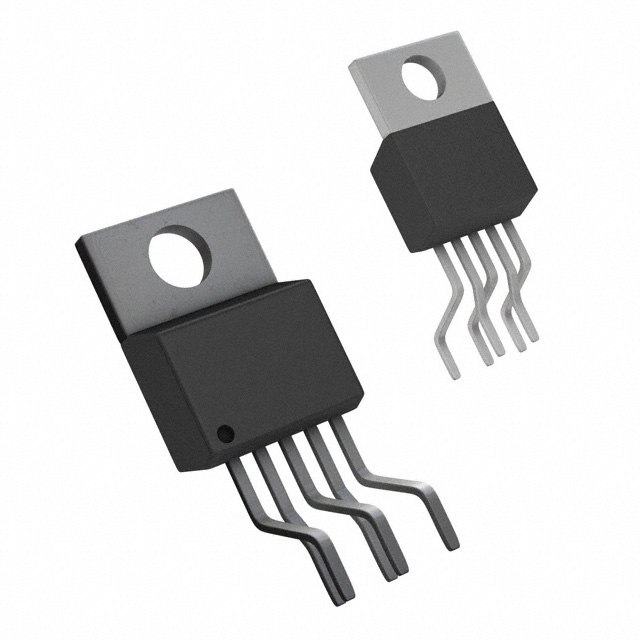
LM2596T-ADJ/NOPB vs. LM2596S-ADJ-EV: A Practical Comparison
Quick verdict: For hobbyists and low-volume projects where ease of prototyping and manual soldering are paramount, the LM2596T-ADJ/NOPB’s through-hole package wins. However, for production designs prioritizing smaller board area and automated assembly, the LM2596S-ADJ-EV’s surface mount package is the clear choice, despite the potentially higher initial learning curve with layout and soldering.
Spec Comparison Table
| Spec | LM2596T-ADJ/NOPB | LM2596S-ADJ-EV | Notes |
|---|---|---|---|
| Function | Step-Down | Step-Down | Identical. |
| Output Configuration | Positive | Positive | Identical. |
| Topology | Buck | Buck | Identical. |
| Output Type | Adjustable | Adjustable | Identical. |
| Number of Outputs | 1 | 1 | Identical. |
| Input Voltage Min | 4.5V | - | LM2596S-ADJ-EV datasheet lacks this specification. |
| Input Voltage Max | 40V | 40V | Identical. |
| Output Voltage Min | 1.2V | 1.2V | Identical. |
| Output Voltage Max | 37V | 37V | Identical. |
| Output Current Max | 3A | 3A | Identical. |
| Switching Frequency Typ | 150kHz | 150kHz | Identical. |
| Synchronous Rectifier | No | No | Identical. |
| Operating Temperature Range (TJ) | -40°C ~ 125°C | -40°C ~ 125°C | Identical. |
| Mounting Type | Through Hole | Surface Mount | Significant difference impacting layout and assembly. |
| Package Case | TO-220-5 Formed Leads | TO-263-6, D2PAK (5 Leads + Tab), TO-263BA | Major difference; impacts board space and assembly process. |
| Supplier Device Package | TO-220-5 | TO-263-5L | Reflects the package case difference. |
Design Trade-offs
The most significant difference lies in the package type. The LM2596T-ADJ/NOPB’s TO-220 package simplifies prototyping and manual assembly, making it ideal for one-off projects or low-volume builds. However, the larger footprint contributes to a larger overall board size, which can be a constraint in space-sensitive applications. The LM2596S-ADJ-EV’s surface mount package (TO-263 or D2PAK) offers a smaller footprint, enabling denser board layouts and reducing overall system size. This comes at the cost of increased complexity during layout and assembly, requiring more careful thermal management considerations and potentially specialized equipment for reflow soldering.
Thermal considerations are amplified with the surface mount package. While both parts share the same TJ range, the smaller package of the LM2596S-ADJ-EV has less exposed surface area for heat dissipation. This necessitates a more robust heatsinking solution or careful layout to minimize thermal resistance. The TO-220 package offers inherently better convection cooling, which can be advantageous in applications with limited airflow.
Gate drive requirements are largely similar due to the identical switching frequency. However, the smaller package of the LM2596S-ADJ-EV might exhibit slightly higher parasitic inductance, which could lead to slightly more ringing on the gate drive signal. This can be mitigated with careful layout techniques, such as minimizing trace lengths and using ground planes.
Layout sensitivity is also higher with the surface mount package. The smaller trace lengths and tighter spacing required for the LM2596S-ADJ-EV increase the potential for stray inductance and capacitance, which can affect switching performance and stability. Careful attention to ground plane continuity and signal routing is crucial.
Cost at volume is likely to favor the LM2596S-ADJ-EV. Automated assembly processes are significantly more efficient than manual soldering, leading to lower per-unit costs at higher volumes. The TO-220 package’s manual soldering requirement increases labor costs.
Use-case Fit
Choose LM2596T-ADJ/NOPB when…
- Prototyping a project with frequent design iterations: The ease of manual soldering and component replacement makes it ideal for experimentation.
- Building a low-volume project where board space is not a critical constraint: The larger footprint is acceptable.
- Working with limited resources and no access to automated assembly equipment: Manual soldering is the only viable option.
- Retrofitting into an existing design with a TO-220 footprint: Simplifies replacement and minimizes layout changes.
- Educational projects: The through-hole package is easier for students to learn with.
Choose LM2596S-ADJ-EV when…
- Designing a product for mass production: Automated assembly processes significantly reduce costs.
- Minimizing board size is a priority: The smaller footprint enables denser layouts.
- Developing a portable device with limited space: The smaller size is essential.
- Seeking to improve thermal performance through better heatsinking options: The smaller footprint allows for more compact heatsink integration.
- Working with a PCB layout team experienced in surface mount technology: Ensures proper layout and assembly.
Drop-in Compatibility
The parts are not pin-compatible. While the pinout is the same, the physical spacing and lead configuration differ significantly. The LM2596T-ADJ/NOPB’s TO-220 package has formed leads, while the LM2596S-ADJ-EV has surface mount pins. Footprint compatibility is also absent. Substituting one for the other requires a complete redesign of the PCB layout, including modifications to the board silkscreen and drill patterns.
Alternatives to Consider
- LM2596-ADJ: A slightly older, but functionally equivalent, version of the LM2596. Worth considering for cost savings in low-volume applications.
- TPS5430: A synchronous buck regulator offering higher efficiency, especially at lower input voltages.
- LM2576: A lower-cost, but less feature-rich, alternative for simpler applications.