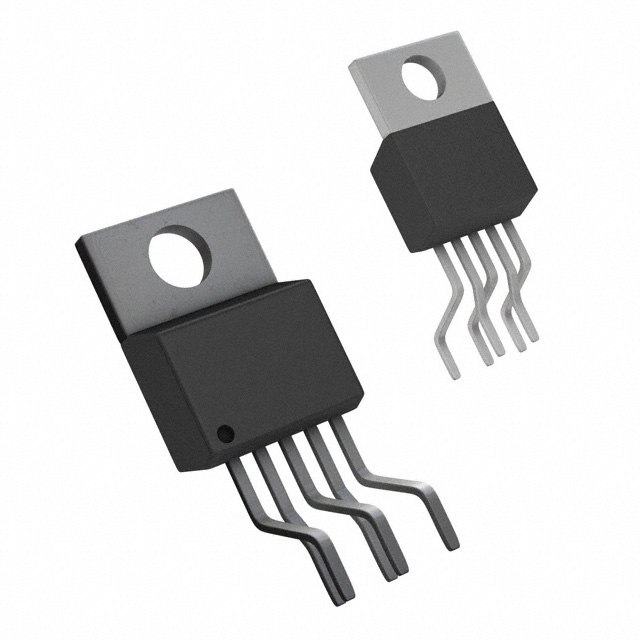
LM2596T-ADJ/NOPB vs. LM2596S-5.0-EV: A Practical Comparison
Quick verdict: For applications requiring precise output voltage control and flexibility, the LM2596T-ADJ/NOPB is the clear winner. However, if you need a fixed 5V output, reduced BOM count, and are comfortable with slightly lower design flexibility, the LM2596S-5.0-EV offers a compelling, and often cheaper, solution.
Spec comparison table
| Spec | LM2596T-ADJ/NOPB | LM2596S-5.0-EV | Notes |
|---|---|---|---|
| function | Step-Down | Step-Down | Both perform the same basic function. |
| output_configuration | Positive | Positive | Identical. |
| topology | Buck | Buck | Identical. |
| output_type | Adjustable | Fixed 5V | This is the most significant difference. |
| number_of_outputs | 1 | 1 | Identical. |
| input_voltage_min | 4.5V | up to 40V | Both accept wide input ranges. |
| input_voltage_max | 40V | up to 40V | Both have the same maximum input voltage. |
| output_voltage_min | 1.2V | 1.2V | Identical. |
| output_voltage_max | 37V | 37V | Identical. |
| output_current_max | 3A | 3A ±4% | LM2596S-5.0-EV’s current rating has a tighter tolerance. |
| switching_frequency_typ | 150kHz | 150kHz | Identical. |
| synchronous_rectifier | No | No | Identical. |
| operating_temperature_range | -40°C ~ 125°C | -40°C ~ 125°C | Identical. |
| mounting_type | Through Hole | Surface Mount | TH vs. SMD impacts board layout and assembly. |
| package_case | TO-220-5 Formed Leads | TO-263-6, D2PAK (5 Leads + Tab), TO-263BA | SMD package enables higher density designs. |
| input_voltage_HV_version | N/A | 57V | LM2596S-5.0-EV has a higher input voltage rating. |
| output_switching_frequency_typ | 150kHz | 150kHz | Identical. |
| output_voltage_adjustable_range_min | 1.2V | 1.2V | Identical. |
| output_voltage_adjustable_range_max | 37V | 37V | Identical. |
| oscillator_frequency_min | N/A | 127/110 kHz | LM2596S-5.0-EV has a wider frequency range. |
| oscillator_frequency_max | N/A | 150kHz | LM2596S-5.0-EV has a narrower frequency range. |
| feedback_bias_current | N/A | 10 nA | LM2596S-5.0-EV has a lower feedback bias current. |
| feedback_bias_current_max | N/A | 50/100 nA | LM2596S-5.0-EV has a higher feedback bias current limit. |
| saturation_voltage_typ | N/A | 1.16 V | LM2596S-5.0-EV has a lower saturation voltage. |
| max_duty_cycle | 100% | 100% | Identical. |
| min_duty_cycle | 0 | 0 | Identical. |
| peak_current_min | N/A | 3.6/3.4 A | LM2596S-5.0-EV has a higher peak current rating. |
| peak_current_typ | N/A | 4.5 A | LM2596S-5.0-EV has a higher peak current rating. |
| peak_current_max | N/A | 6.9/7.5 A | LM2596S-5.0-EV has a higher peak current rating. |
| output_leakage_current_typ | N/A | 2 mA | LM2596S-5.0-EV has a higher output leakage current. |
| quiescent_current_typ | N/A | 5 mA | LM2596S-5.0-EV has a lower quiescent current. |
| standby_current_typ | N/A | 80 µA | LM2596S-5.0-EV has a lower standby current. |
| thermal_resistance_TO_220_to_case | N/A | N/A | N/A |
| thermal_resistance_TO_263_to_case | N/A | N/A | N/A |
| on_off_pin_logic_input_voltage_high | N/A | N/A | N/A |
| input_filter_capacitor_min | N/A | N/A | N/A |
| inductor_value_typ | N/A | 33µH | LM2596S-5.0-EV has a specific inductor value. |
Design trade-offs
The most significant difference is the fixed 5V output of the LM2596S-5.0-EV versus the adjustable output of the LM2596T-ADJ/NOPB. This impacts the BOM. The adjustable version requires external resistors to set the output voltage, adding cost and potentially increasing noise. The fixed output simplifies the design and can reduce BOM count.
Thermal considerations are influenced by the package type. The TO-220 package of the LM2596T-ADJ/NOPB requires a larger heatsink in high-current applications, while the smaller footprint of the LM2596S-5.0-EV demands careful PCB layout to manage heat dissipation. The lower saturation voltage of the LM2596S-5.0-EV suggests potentially slightly better efficiency at higher load currents, but this is highly dependent on component selection and PCB layout.
The fixed inductor value in the LM2596S-5.0-EV means you must use that specific inductor value. The adjustable part offers more flexibility in inductor selection for optimization. The slightly higher output leakage current in the LM2596S-5.0-EV is a minor concern, but should be considered in sensitive applications. The lower quiescent current of the LM2596S-5.0-EV translates to slightly better efficiency in battery-powered applications.
Use-case fit
Choose LM2596T-ADJ/NOPB when…
- You need to generate a wide range of output voltages (e.g., 3.3V, 5V, 12V) from a single regulator.
- You are designing a programmable power supply where the output voltage is determined by software.
- You require precise output voltage control and are willing to accept the added complexity of external resistors.
- You’re prototyping a design and want to easily experiment with different output voltages.
- You need to adjust the output voltage to compensate for component aging or variations.
Choose LM2596S-5.0-EV when…
- You need a simple, cost-effective 5V power supply.
- You are designing a high-volume product where BOM count is critical.
- You are space-constrained and need a smaller footprint.
- You are designing a battery-powered device where low quiescent current is important.
- You are looking for a pre-configured solution that requires minimal design effort.
Drop-in compatibility
Pin compatibility is likely, but footprint compatibility is not guaranteed. The TO-220 package of the LM2596T-ADJ/NOPB is significantly larger than the TO-263/DPAK packages of the LM2596S-5.0-EV. Substituting one for the other will require PCB layout modifications. The fixed inductor value of the LM2596S-5.0-EV also means that if you are swapping, you’re also swapping the inductor.
Alternatives to consider
- LM2596-5.0: Similar functionality to the LM2596S-5.0-EV, but in a TO-220 package.
- TPS5430: Synchronous buck regulator offering higher efficiency and more features.
- LM317: Adjustable regulator, a simpler but less efficient alternative to the LM2596.