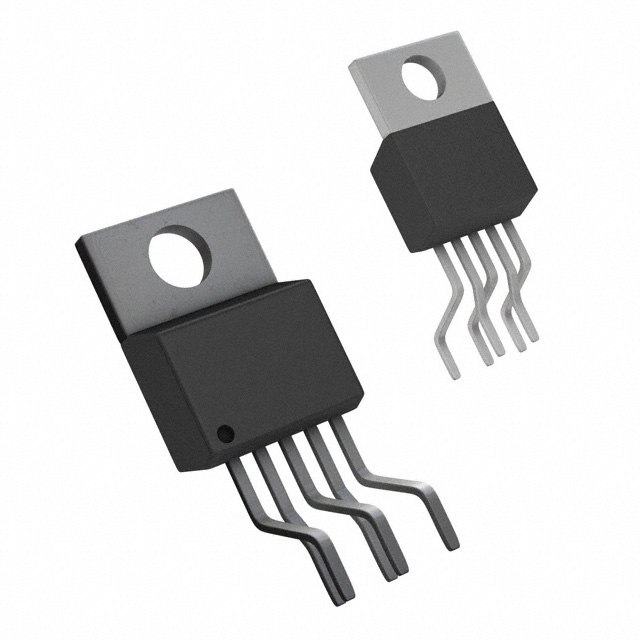
LM2596 Regulator Comparison: Adjustable vs. Fixed 5.0V
The LM2596T-ADJ/NOPB takes the crown for applications demanding flexible output voltages, particularly in battery-powered devices or systems with varying load requirements. Conversely, the LM2596S-5.0 shines in simpler, cost-sensitive applications where a fixed 5V output is sufficient and the adjustable version’s complexity adds unnecessary overhead.
Spec Comparison Table
| Spec | LM2596T-ADJ/NOPB | LM2596S-5.0 | Notes |
|---|---|---|---|
| Input Voltage Range | 3.0–40V | 3.0–40V | Identical |
| Output Voltage | Adjustable (1.2–37V) | Fixed 5.0V | ADJ wins for flexibility. |
| Output Voltage Accuracy | ±1% | ±1% | Identical |
| Output Current Limit | 3A | 3A | Identical |
| Switching Frequency | ~150kHz | ~150kHz | Identical |
| Quiescent Current | 10mA | 10mA | Identical |
| Shutdown Current | <5mA | <5mA | Identical |
| Maximum Load Current | 3A | 3A | Identical |
| Input Capacitor Voltage Rating | Not specified | Not specified | Not specified |
| Input Capacitor RMS Current Rating | Not specified | Not specified | Not specified |
| Input Capacitor Power Rating | Not specified | Not specified | Not specified |
| Output Voltage Max Limit | 37V | 20V | ADJ allows higher voltage applications. |
| Output Current Min | 4.5A | N/A | ADJ allows for lower current applications |
| Shutdown Voltage Min | 1.3V | N/A | ADJ allows for lower shutdown voltages |
| Shutdown Voltage Typ | 1.3V | N/A | ADJ allows for lower shutdown voltages |
| Shutdown Voltage Max | 1.3V | N/A | ADJ allows for lower shutdown voltages |
Design Trade-offs
The primary difference, and the defining characteristic, is the adjustability of the output voltage. This flexibility comes at a small cost in terms of design complexity – you need external resistors to set the output voltage, which introduces a small potential for error in the output voltage, although the ±1% accuracy spec applies to both. For applications where a fixed 5V is all that’s needed, the LM2596S-5.0 offers a simpler, potentially slightly lower-cost solution.
Thermal considerations are largely identical for both parts, given they both operate at the same power levels and switching frequencies. Both require adequate heatsinking if operating close to their maximum current rating. The layout sensitivity is also comparable; both benefit from short, wide traces for the power paths to minimize parasitic inductance and voltage ripple.
Gate drive requirements are similar; both parts are driven by an internal MOSFET, and the switching frequency is fixed. The fixed 5.0V output of the LM2596S-5.0 simplifies the feedback loop design, as there’s no need to implement a voltage divider and op-amp for voltage regulation. However, this simplification also means it’s not adaptable to changing voltage requirements.
The data sheet doesn’t provide efficiency curves. However, it’s reasonable to assume that efficiency will be very similar between the two parts, as the core switching circuitry is identical. The slight differences in quiescent current due to the adjustable output circuitry are unlikely to have a significant impact on overall efficiency in most applications.
Use-case Fit
Choose LM2596T-ADJ/NOPB when…
- You need to power a microcontroller with a specific voltage that isn’t 5V (e.g., 3.3V for an ARM Cortex-M).
- You’re designing a battery-powered device where the battery voltage varies significantly over its discharge cycle, and you need to maintain a stable output voltage.
- You’re creating a modular power supply where the output voltage needs to be configurable for different modules.
- You’re building a system that requires multiple voltage rails, and you want to minimize the number of different regulator ICs.
- You need to adjust the output voltage for testing or calibration purposes.
Choose LM2596S-5.0 when…
- You need to power a standard 5V peripheral (e.g., a USB device or a legacy serial port).
- You’re designing a cost-sensitive application where a fixed 5V output is sufficient.
- You want to minimize the number of external components and simplify the power supply design.
- You’re building a simple power supply for a fixed-voltage device, such as a small fan or LED strip.
- You need a power supply for a device that operates reliably at 5V, and you don’t anticipate needing to change the voltage.
Drop-in Compatibility
Based solely on the provided datasheet, pin compatibility is likely but not definitively confirmed. The LM2596T-ADJ/NOPB has an adjustable output, requiring external resistors. The LM2596S-5.0 has a fixed 5V output, eliminating the need for these external components. Footprint compatibility is also likely, as both parts are housed in the TO-220 package. However, a thorough review of the package dimensions is recommended before substitution. The biggest change is the addition of external resistors for the adjustable version.
Alternatives to Consider
- LM2596-ADJ: A functionally equivalent adjustable regulator, offering similar performance and features.
- LM317: A classic adjustable regulator, offering a versatile and cost-effective solution for various applications.
- TPS5430: A synchronous buck regulator offering higher efficiency and a smaller footprint for more demanding applications.