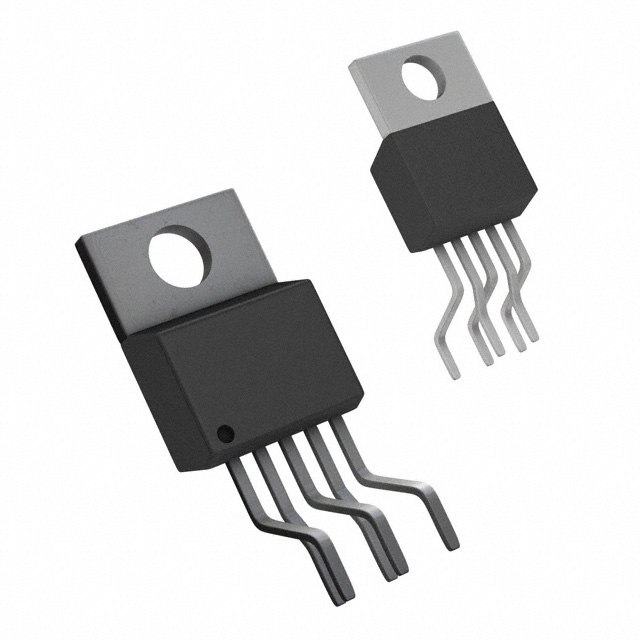
LM2596T-ADJ/NOPB vs. CLB40I1200PZ-TRL: A Practical Comparison
Quick Verdict: For low-power, adjustable voltage applications where simplicity and cost are paramount, the LM2596T-ADJ/NOPB remains a reasonable choice. However, for higher-power applications (up to 40A) requiring significantly reduced conduction losses and a wider input voltage range, the CLB40I1200PZ-TRL, despite its complexity, offers a compelling advantage – but be prepared for substantially different design considerations.
Spec Comparison Table
| Spec | LM2596T-ADJ/NOPB | CLB40I1200PZ-TRL | Notes |
|---|---|---|---|
| function | Step-Down | Thyristor | Fundamentally different topologies. |
| output_configuration | Positive | N/A | Thyristors are bidirectional. |
| topology | Buck | SCR | Completely different architectures. |
| output_type | Adjustable | N/A | Thyristors are inherently on/off devices. |
| number_of_outputs | 1 | N/A | Thyristors are typically used in circuits requiring controlled switching. |
| input_voltage_min | 4.5V | 18.3V | CLB requires a higher minimum input voltage. |
| input_voltage_max | 40V | 1200V | CLB handles a dramatically wider input voltage range. |
| output_voltage_min | 1.2V | N/A | Output voltage is determined by external circuitry. |
| output_voltage_max | 37V | N/A | Output voltage is determined by external circuitry. |
| output_current_max | 3A | 40A | CLB offers significantly higher current capability. |
| switching_frequency_typ | 150kHz | 50Hz | Lower frequency for CLB, impacting switching losses and EMI. |
| synchronous_rectifier | No | N/A | Thyristors don’t have a synchronous rectification equivalent. |
| operating_temperature_range | -40°C ~ 125°C | -40°C ~ 150°C | CLB has a higher maximum operating temperature. |
| mounting_type | Through Hole | Through Hole | Both are through-hole, simplifying mechanical design. |
| package_case | TO-220-5 | TO-263D2 | Different footprints; not directly interchangeable. |
| reverse_current_typ | N/A | 10 µA | Not applicable to LM2596. |
| forward_voltage_drop_typ_40a | N/A | 1.30 V | Not applicable to LM2596. |
| forward_voltage_drop_typ_80a | N/A | 6.59 V | Not applicable to LM2596. |
| forward_voltage_drop_typ_40a_125c | N/A | 1.26 V | Not applicable to LM2596. |
| forward_voltage_drop_typ_80a_125c | N/A | 1.64 V | Not applicable to LM2596. |
| rms_forward_current_typ | N/A | 63 A | Not applicable to LM2596. |
| threshold_voltage_max_150c | N/A | 0.85 V | Not applicable to LM2596. |
| slope_resistance_typ | N/A | 9.9 mΩ | Not applicable to LM2596. |
| thermal_resistance_jc_typ | N/A | 0.4 K/W | Not applicable to LM2596. |
| thermal_resistance_ch_typ | N/A | 0.25 K/W | Not applicable to LM2596. |
| total_power_dissipation_max_25c | N/A | 310 W | Not applicable to LM2596. |
| forward_surge_current_typ_50hz_10ms | N/A | 520 A | Not applicable to LM2596. |
| i2t_fusing_value_typ_50hz_10ms_45c | N/A | 1.35 kA²s | Not applicable to LM2596. |
| junction_capacitance_typ_25c | N/A | 22 pF | Not applicable to LM2596. |
| max_gate_power_dissipation_typ_150c_300us | N/A | 5 W | Not applicable to LM2596. |
| gate_trigger_voltage_typ | N/A | 1.7 V | Not applicable to LM2596. |
| critical_rate_of_rise_current_150c_50hz | N/A | 150 A/µs | Not applicable to LM2596. |
Design Trade-offs
The LM2596T-ADJ/NOPB is a relatively simple, cost-effective solution for low-power buck conversion. However, its 150kHz switching frequency introduces switching losses and EMI concerns that require careful filtering. The CLB40I1200PZ-TRL, on the other hand, operates at a much lower 50Hz frequency, significantly reducing switching losses. This lower frequency also simplifies EMI filtering, but introduces the need for larger inductor and capacitor values to manage ripple. The CLB’s gate drive requirements are also considerably more complex, requiring a dedicated driver circuit capable of providing the necessary current and voltage to trigger the thyristor. Thermal management is critical for the CLB, given its higher power dissipation (up to 310W). The thermal resistance (0.4 K/W) is relatively low, but a robust heatsinking solution will still be necessary to maintain junction temperatures within acceptable limits. Layout sensitivity is also a concern with the CLB; careful attention must be paid to minimizing stray inductance and capacitance to prevent oscillations and ensure stable operation. The CLB’s significantly higher input voltage range (up to 1200V) offers design flexibility, but also introduces safety considerations.
Use-case Fit
Choose LM2596T-ADJ/NOPB when…
- You need a simple, low-cost buck converter for a 5V to 3.3V conversion in a battery-powered device.
- You’re designing a small, low-power LED driver where efficiency isn’t the primary concern.
- You need an adjustable output voltage for prototyping and experimentation.
- You’re working with a very tight budget and minimizing component count is critical.
- You’re comfortable with the design complexities of 150kHz switching and its associated EMI challenges.
Choose CLB40I1200PZ-TRL when…
- You need to convert a high-voltage DC source (e.g., solar panel array) to a lower voltage for battery charging.
- You’re building a high-current LED lighting system where minimizing conduction losses is paramount.
- You’re designing a DC-DC power supply for a motor drive application requiring high efficiency and low ripple.
- You need to handle surge currents up to 520A.
- You have the engineering expertise and budget to implement a robust gate drive circuit and thermal management system.
Drop-in Compatibility
These parts are not pin-compatible or footprint-compatible. The LM2596T-ADJ/NOPB uses a TO-220-5 package, while the CLB40I1200PZ-TRL uses a TO-263D2 package. Substituting one for the other would require significant board redesign and changes to the surrounding circuitry. Furthermore, the fundamental difference in topology means the control circuitry and feedback loops would need to be completely re-implemented.
Alternatives to Consider
- LM2596-ADJ: A slightly more efficient version of the LM2596 for similar low-power applications.
- IR2110: A dedicated gate driver IC for SCRs, offering improved performance and protection.
- Texas Instruments TPS63020: A synchronous buck converter offering higher efficiency than the LM2596 for similar applications.