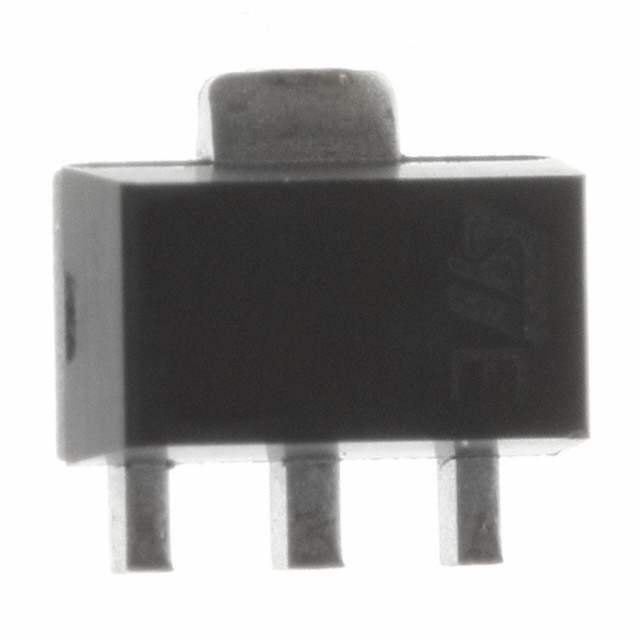
L78L33ABUTR vs ZXTR2105F-7: Linear Voltage Regulator Comparison
Quick verdict
For low-power 3.3 V linear regulation up to 100 mA with moderate thermal dissipation and basic protection, the L78L33ABUTR is the better choice due to its higher current capability and integrated protection features. For automotive-grade applications requiring wider temperature range, lower quiescent current, and operation up to 5 V output at nearly 90 mA, the ZXTR2105F-7 is preferable, especially where efficiency and extended environmental robustness matter.
Spec comparison table
| Spec | L78L33ABUTR | ZXTR2105F-7 | Notes |
|---|---|---|---|
| Control features | Over Current, Over Temperature, Short Circuit | None specified | L78L33ABUTR offers protection features, reducing external circuitry and increasing reliability. ZXTR2105F-7 lacks these. |
| Current quiescent (Iq) | 5.5 mA | 800 µA | ZXTR2105F-7 has ~7x lower quiescent current, beneficial for battery-powered or low-load scenarios. |
| Current supply max | 6 mA | 6.7 mA | Similar supply current; ZXTR2105F-7 slightly higher but not a significant difference. |
| Input voltage max | 30 V | 60 V | ZXTR2105F-7 supports double the input voltage, suited for automotive or industrial rails. |
| Mounting type | Surface Mount (SOT-89-3) | Surface Mount (SOT-23-3) | Both are surface mount; ZXTR2105F-7 uses smaller SOT-23-3 package, saving PCB area. |
| Number of regulators | 1 | 1 | Both single-output devices. |
| Operating temperature range | -40°C to 125°C | -65°C to 150°C | ZXTR2105F-7 covers wider temperature range, critical for harsh environments. |
| Output configuration | Positive | Positive | Both provide positive fixed output voltage. |
| Output current max | 100 mA | 89 mA | L78L33ABUTR supports ~12% higher output current, useful for slightly higher load demands. |
| Output type | Fixed (3.3 V) | Fixed (5 V) | Different fixed output voltages; choice depends on system voltage requirement. |
| Output voltage min | 3.3 V | 5 V | Matches above; output voltage choice is application-specific. |
| Package case | TO-243AA (SOT-89-3) | TO-236-3, SC-59, SOT-23-3 | ZXTR2105F-7’s smaller package facilitates compact designs. |
| Protection features | Over Current, Over Temperature, Short Circuit | None specified | L78L33ABUTR adds integrated protection; ZXTR2105F-7 may require external protection. |
| PSRR | 49 dB @ 120 Hz | 46 dB @ 100 Hz | Both have similar PSRR; L78L33ABUTR slightly better at 120 Hz, but difference is minor. |
| Qualification/Grade | Not specified | Automotive (AEC-Q101) | ZXTR2105F-7 is automotive-qualified, important for reliability in automotive systems. |
Design trade-offs
The L78L33ABUTR is a classic 3.3 V linear regulator designed for up to 100 mA output current with integrated protection features — overcurrent, thermal shutdown, and short-circuit protection. These features simplify system design by reducing the need for additional safety components, increasing overall robustness. However, its quiescent current of 5.5 mA is relatively high, which can be a disadvantage in battery-powered or always-on low-load applications. The SOT-89-3 package is larger than SOT-23-3, which means more PCB area and potentially higher thermal dissipation capability, but also increased board space.
In contrast, the ZXTR2105F-7 targets automotive and harsh environment applications, with an extended operating temperature range of -65°C to 150°C and AEC-Q101 qualification. Its maximum input voltage rating of 60 V makes it suitable for systems with wide or noisy supply rails, such as automotive 12 V or 24 V systems. The quiescent current is significantly lower at 800 µA, which reduces power loss during low or no load conditions, improving efficiency in overall system power management. The 5 V fixed output voltage suits different system rails compared to the 3.3 V L78L33ABUTR, so the voltage requirement is a primary factor in selection.
Thermally, both devices are linear regulators and dissipate the voltage drop multiplied by load current as heat. The L78L33ABUTR’s higher max output current (100 mA vs. 89 mA) offers a small margin for slightly higher loads but at the cost of a larger package and higher quiescent current. The smaller SOT-23-3 package of the ZXTR2105F-7 demands careful thermal layout to avoid overheating, especially at higher currents or input voltages. The lack of integrated protection in ZXTR2105F-7 means external circuitry must be added to prevent damage under fault conditions.
From a layout perspective, the ZXTR2105F-7’s smaller footprint is an advantage in dense PCB designs. The L78L33ABUTR’s larger package can aid heat sinking but requires more board area. Both require input and output bypass capacitors for stability; however, the L78L33ABUTR’s datasheet generally specifies higher minimum input capacitance due to its protection features and internal circuitry.
Cost at volume is not provided here, but typically, automotive-qualified parts like ZXTR2105F-7 command a price premium. Conversely, the L78L33ABUTR is a general-purpose regulator, likely more cost-effective in high-volume consumer or industrial applications where automotive qualification is unnecessary.
Use-case fit
Choose L78L33ABUTR when…
- Your application requires a 3.3 V fixed linear regulator capable of supplying up to 100 mA.
- Integrated protection features (overcurrent, thermal shutdown, short circuit) are needed to improve robustness without adding external components.
- Operating temperature is within -40°C to 125°C and input voltage does not exceed 30 V.
- PCB area is less constrained, and you can accommodate the SOT-89-3 package.
- Quiescent current is less critical, such as in mains-powered or always-on systems where 5.5 mA IQ is acceptable.
Choose ZXTR2105F-7 when…
- You need a 5 V fixed output linear regulator for automotive or industrial systems with input voltages up to 60 V.
- The operating environment demands a wider temperature range (-65°C to 150°C) and AEC-Q101 qualification.
- Low quiescent current (800 µA) is critical for battery-powered or standby mode efficiency.
- PCB space is limited, and the smaller SOT-23-3 package is preferred.
- You can provide external protection circuitry or accept the risk of no integrated overcurrent/thermal protection.
Drop-in compatibility
These two parts are not drop-in replacements for each other. They differ in output voltage (3.3 V vs 5 V), package (SOT-89-3 vs SOT-23-3), and pinout is likely different given the different package outlines and manufacturer datasheets. Neither datasheet specifies pin compatibility.
Substituting one for the other requires redesign of the PCB footprint, verification of voltage compatibility with the load, and consideration of missing protection features when moving from L78L33ABUTR to ZXTR2105F-7. Therefore, they are not footprint or pin compatible.
Alternatives to consider
- LM1117-3.3 (Texas Instruments): Low-dropout regulator with 800 mA output, offering higher current capability and low dropout voltage for 3.3 V rails.
- MIC5205-3.3 (Microchip): Ultra-low quiescent current linear regulator in SOT-23 package, suitable for portable and battery-powered applications.
- TLV70533 (Texas Instruments): Low quiescent current, fixed 3.3 V output regulator with similar footprint to ZXTR2105F-7 but with integrated protection features.