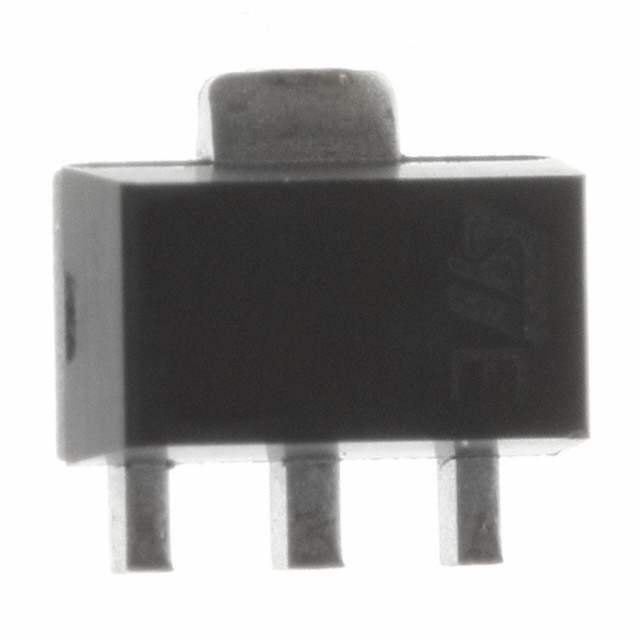
L78L33ABUTR vs MCP1700T-3302E/MAY: Linear Regulator Component Comparison
Quick verdict
For applications requiring up to 100mA output current from a wide input voltage range (up to 30V), the L78L33ABUTR is the better choice due to its higher input voltage tolerance and robust protection features. For battery-powered or low quiescent current designs needing up to 250mA output current with a low dropout voltage and small footprint, the MCP1700T-3302E/MAY is a superior fit.
Spec comparison table
| Spec | L78L33ABUTR | MCP1700T-3302E/MAY | Notes |
|---|---|---|---|
| Control features | — | — | Both have basic linear regulator control; no special features listed |
| Quiescent current (Iq) | 5.5 mA | 4 µA | MCP1700T’s 4µA quiescent current is orders of magnitude lower, critical for battery life |
| Max supply current | 6 mA | Not specified | L78L33A’s supply current likely tied to quiescent current; MCP1700’s not stated |
| Max input voltage | 30 V | 6 V | L78L33A supports 5x higher input voltage, allowing use with higher voltage rails |
| Mounting type | Surface mount (SOT-89-3) | Surface mount (6-DFN 2x2 mm) | MCP1700T’s smaller DFN package offers better PCB space efficiency |
| Number of regulators | 1 | 1 | Both single output |
| Operating temp range | -40°C to 125°C | -40°C to 125°C | Equivalent industrial temperature range |
| Output configuration | Positive | Positive | Both fixed positive output regulators |
| Max output current | 100 mA | 250 mA | MCP1700T supports 2.5x higher load current |
| Output type | Fixed 3.3 V | Fixed 3.3 V | Both fixed 3.3 V output |
| Package case | TO-243AA (SOT-89-3) | 6-DFN (2x2 mm, exposed pad) | MCP1700T’s package is smaller and thermally efficient |
| Protection features | Overcurrent, overtemperature, short circuit | Overcurrent, overtemperature, short circuit | Both provide standard protection mechanisms |
| PSRR | 49 dB @ 120 Hz | 44 dB @ 100 Hz | L78L33A offers slightly better PSRR at line frequency |
| Voltage dropout max | Not specified | 0.35 V @ 250 mA | MCP1700T’s dropout voltage specified and low, suitable for low headroom operation |
Design trade-offs
The L78L33ABUTR’s standout feature is its wide input voltage range up to 30V, making it appropriate for systems powered from unregulated or high-voltage sources (e.g., 12 V automotive or industrial rails). However, this comes with a relatively high quiescent current of 5.5 mA, which can significantly impact battery life in low-power or always-on applications. Its maximum output current is limited to 100 mA, adequate for small loads but insufficient for moderate current demands.
In contrast, the MCP1700T-3302E/MAY targets low power, battery-operated designs. The 4 µA quiescent current drastically reduces no-load power consumption, making it ideal for always-on or standby circuits. It can deliver up to 250 mA output current, more than double the L78L33A’s capability, supporting more demanding loads. However, its maximum input voltage is limited to 6 V, restricting its use to low-voltage power domains such as single-cell Li-ion batteries or regulated 5 V rails.
Thermally, the MCP1700T’s 6-DFN package with an exposed pad allows better heat dissipation on the PCB compared to the L78L33A’s SOT-89-3, which is compact but less thermally efficient. The dropout voltage of 0.35 V at full load for MCP1700T enables operation with input voltages only slightly above 3.3 V, improving efficiency compared to the unspecified (but typically higher) dropout of the L78L33A. This difference can reduce power dissipation and thermal stress.
From a layout perspective, the MCP1700T’s small 2x2 mm DFN package requires careful PCB design and thermal vias to maximize heat spreading, whereas the larger SOT-89 package of the L78L33A is easier to hand solder and mount but occupies more board space. The MCP1700T’s low dropout and low quiescent current favor compact, battery-powered devices; the L78L33A favors simple designs with wide voltage input margins and moderate current needs.
Cost at volume tends to favor the L78L33A for high-voltage linear regulator applications due to its simplicity and legacy manufacturing; the MCP1700T may carry a slight premium due to the advanced low quiescent current design and smaller package, but this is justified by power savings in battery-powered systems.
Use-case fit
Choose L78L33ABUTR when…
- Your input supply voltage can exceed 6 V, up to 30 V, such as 12 V automotive or industrial supplies.
- The load current is moderate but does not exceed 100 mA.
- Quiescent current is not critical, e.g., devices powered continuously or with large power budgets.
- You need a regulator with proven thermal and short-circuit protection for rugged environments.
- The design can accommodate a slightly larger SOT-89 package and does not require ultra-compact PCB real estate.
Choose MCP1700T-3302E/MAY when…
- Operating from a 1-cell Li-ion battery or regulated 5 V rail with a maximum input voltage of 6 V.
- Load current requirements up to 250 mA, such as powering small microcontrollers or sensors.
- Minimizing quiescent current to extend battery life is a priority (4 µA vs. 5.5 mA).
- Board space is constrained and a 2x2 mm DFN package is preferred.
- Low dropout voltage operation (0.35 V at 250 mA) is needed to maximize efficiency and reduce thermal dissipation.
Drop-in compatibility
These two parts are not pin- or footprint-compatible. The L78L33ABUTR comes in a SOT-89-3 (TO-243AA) package, while the MCP1700T-3302E/MAY uses a 6-lead 2x2 mm DFN package with an exposed pad. Pins are arranged differently, and the package sizes differ significantly.
Substituting one for the other requires PCB redesign, including footprint changes and possibly different input/output capacitor placement due to package and layout recommendations. Electrical characteristics such as maximum input voltage and dropout voltage must be verified to prevent damage or performance degradation.
Alternatives to consider
- LM1117-3.3 (Texas Instruments): A common 800 mA linear regulator with moderate dropout voltage and wide availability, suitable for higher current applications.
- TLV70233 (Texas Instruments): Offers low quiescent current (~40 µA) and low dropout voltage in a small SOT-23 package, fitting low-power designs with moderate current.
- MIC5205-3.3 (Microchip): Low dropout regulator with up to 150 mA output current and low quiescent current (~90 µA), a middle ground between L78L33A and MCP1700T.