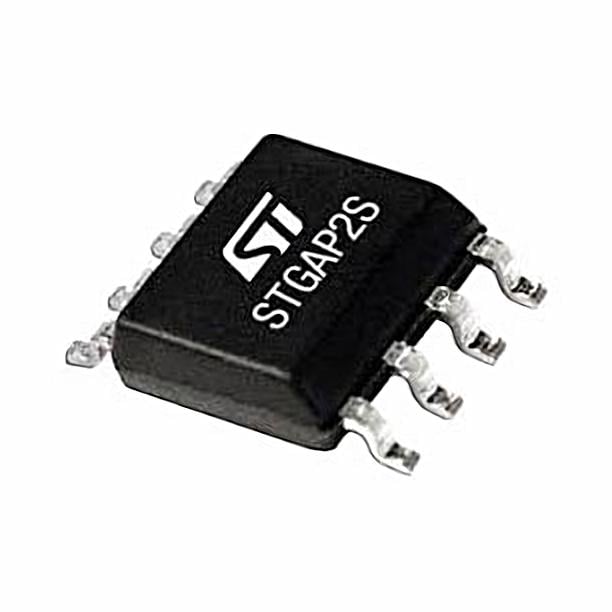
Key Specs
| Spec | Value | Condition | Source |
|---|---|---|---|
| Mode | Discontinuous (Transition) | Digi-Key | |
| Switching Frequency (Typ) | 1MHz | Digi-Key | |
| Current Startup | 40 µA | Digi-Key | |
| Voltage Supply | 10.3V ~ 22V | Digi-Key | |
| Operating Temperature Range | -25°C ~ 125°C | Digi-Key | |
| Mounting Type | Surface Mount | Digi-Key | |
| Package Case | 8-SOIC (0.154”, 3.90mm Width) | Digi-Key | |
| Supplier Device Package | 8-SOIC | Digi-Key |
When To Use
Use the L6562DTR in applications requiring high-frequency discontinuous transition mode power factor correction, such as switch-mode power supplies operating at a typical switching frequency of 1 MHz. Its operating voltage supply range of 10.3 V to 22 V and junction temperature range from -40 °C to 150 °C make it suitable for industrial and consumer power electronics requiring compact surface mount solutions in 8-SOIC packages.
Do not use the L6562DTR in applications demanding continuous conduction mode or where the supply voltage exceeds 22 V, as the device is self-limited and optimized for discontinuous mode operation. For higher voltage or continuous conduction mode requirements, consider dedicated PFC controllers designed for those modes.
When Not To Use
-
>10 A output current DC-DC converter: The maximum sink current capability of 2.5 mA and the limited power dissipation (0.65 W in SO8) disqualify this device for high-current applications; use a multi-phase buck controller instead.
-
Battery-powered sensor node with μA sleep current: The typical quiescent current of 3.75 mA is too high for ultra-low power applications where battery life depends on μA currents; switch to a low-IQ PFM buck to avoid premature battery drain.
-
Noise-sensitive linear post-regulator for analog supply: The switching nature and input voltage range (minimum 10.3 V supply) make it unsuitable for low-noise, low-dropout regulation; use an LDO regulator instead for stable and quiet output voltage.
Application Notes
The MOSFET drain node is the primary switching node and must have the smallest possible loop area to minimize EMI and switching losses. The zero current detector input is noise-sensitive; ensure proper filtering and layout to avoid false triggering.
Due to the maximum power dissipation of 0.65 W in the SO8 package, a suitable PCB thermal design or heatsink is recommended when operating near the upper junction temperature limit of 150 °C, especially at high switching frequencies (typical 1 MHz) and elevated ambient temperatures.
The device’s supply voltage should be maintained within 10.3 V to 22 V, with turn-on threshold around 12 V and turn-off threshold near 9.5 V, to ensure reliable startup and operation. Proper selection of startup resistor and input capacitors is critical to maintain stable power-up and minimize inrush currents.
Ensure the current sense clamp and offset voltages are correctly set according to the typical 1.7 V clamp and 5 mV offset to achieve accurate current sensing and protect against overcurrent conditions.
Proper layout and component selection following these guidelines will maximize the performance and reliability of the L6562DTR in discontinuous mode PFC applications.
Gotchas
-
[UVLO hysteresis interaction]: Assuming the UVLO turn-on threshold is a fixed voltage without considering the typ. 2.8 V hysteresis leads to oscillatory startup if the supply voltage ramps slowly between 8.7 V and 11 V. The symptom is repeated on/off cycling visible on the supply rail and output waveform. Fix by ensuring the supply voltage ramp rate is fast enough to cross the hysteresis band cleanly or add a hold-up capacitor to stabilize Vcc during startup.
-
[Zero current detector overcurrent]: Designers may connect low-value shunt resistors or external circuitry drawing more than 10 mA sink current from the zero current detector pin, thinking it can source/sink any current. This causes permanent device damage or erratic switching behavior. Fix by verifying the sink current on the zero current detector pin stays below 10 mA under all load and transient conditions.
-
[Switching frequency vs. gain-bandwidth]: The device’s gain-bandwidth product is 1 MHz, matching the typical switching frequency, which may cause control loop instability if the compensation network does not account for this limit. The symptom is output voltage ripple or subharmonic oscillation. Fix by carefully designing the error amplifier compensation to maintain phase margin at 1 MHz switching.
-
[Incorrect use of multiplier input voltage range]: Assuming the multiplier input can exceed 8 V or go negative leads to input stage saturation or damage, because the analog inputs/outputs are limited to −0.3 to 8 V. The symptom is distorted control signals and failure to regulate output voltage. Fix by scaling the input voltage signals with appropriate resistor dividers and ensuring no voltage spikes exceed the input range.