Key Specs
| Spec | Value | Condition | Source |
|---|---|---|---|
| 3db Bandwidth | 1.1 MHz | Digi-Key | |
| Amplifier Type | Current Sense | Digi-Key | |
| Current Input Bias | 35 µA | Digi-Key | |
| Mounting Type | Surface Mount | Digi-Key | |
| Number Of Circuits | 1 | Digi-Key | |
| Operating Temperature Range | -40°C ~ 125°C (TA) | Digi-Key | |
| Output Type | - | Digi-Key | |
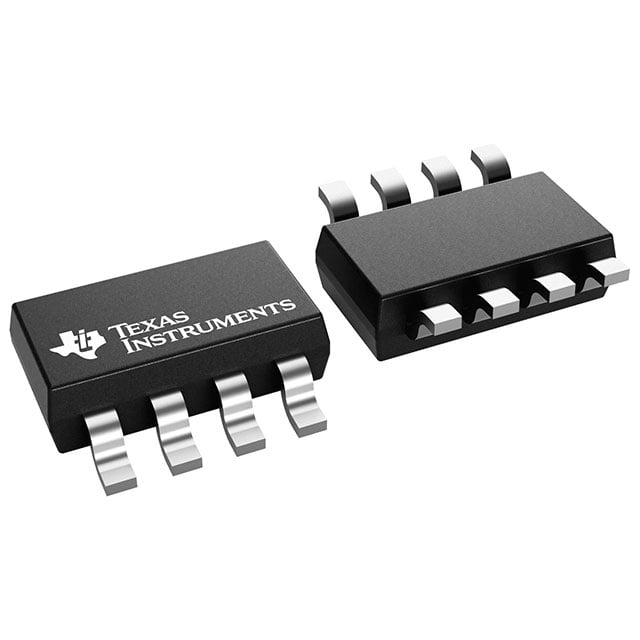
| Package Case | SOT-23-8 Thin, TSOT-23-8 | Digi-Key | |
| Quiescent Current (Typ) | 2.5mA | Digi-Key | |
| Slew Rate | 8V/µs | Digi-Key | |
| Supplier Device Package | TSOT-23-8 | Digi-Key | |
| Voltage Input Offset | 25 µV | Digi-Key | |
| Voltage Supply Span (Max) | 20 V | Digi-Key | |
| Voltage Supply Span (Min) | 2.7 V | Digi-Key |
When To Use
-
DC motor current sensing @ 10A peak: The 1.1 MHz bandwidth and 8 V/µs slew rate enable accurate transient current capture in dynamic motor drives. The 25 µV input offset voltage minimizes measurement error at low currents, preventing false torque or speed feedback; a lower-bandwidth amplifier would distort fast current edges, causing control instability.
-
Battery management system (BMS) current monitoring, 2.7–20 V rail: The wide supply range down to 2.7 V supports low-voltage battery packs, while the 2.5 mA quiescent current limits battery drain. Using a part without this low-voltage operation risks the sensor dropping out at battery voltage extremes, causing intermittent current loss and potential state-of-charge miscalculations.
-
Current sense in compact power modules with limited PCB area: The TSOT-23-8 package minimizes PCB footprint, enabling dense layouts in space-constrained designs. However, the small thermal pad area requires careful PCB thermal design; larger packages may simplify heat dissipation but consume more board space, risking overheating or layout congestion in tight modules.
When Not To Use
-
Current measurement requiring >1.1 MHz bandwidth: The 1.1 MHz bandwidth limit disqualifies this device for high-frequency switching node sensing or pulsed current events above this range. Use a higher-bandwidth current-sense amplifier instead to avoid signal aliasing and distorted transient capture.
-
Applications needing galvanic isolation from high-voltage rails: The INA296B1IDDFR does not provide isolation and relies on direct shunt connection. When isolation is required to prevent ground loops or high-voltage damage, select an isolated current-sense amplifier to avoid latch-up or damage from differential voltage stress.
-
High-current measurement above 50 A where shunt dissipation is prohibitive: The inherent need for a shunt resistor causes excessive power loss and thermal stress at these currents. A Hall-effect current sensor is better suited to eliminate shunt power dissipation and prevent thermal runaway in such high-current environments.
Application Notes
-
Pins 2 and the IN+ and IN− pin must be routed with matched impedance and Kelvin sensing to the shunt resistor terminals to minimize offset errors and noise pickup; avoid long traces or vias in these lines.
-
The TSOT-23-8 package has limited copper area for heat sinking; use large thermal vias and a dedicated copper pour connected to the exposed pad (if PCB design allows) to improve thermal dissipation and maintain stable offset voltage during continuous high-current operation.
-
Avoid placing high-frequency switching nodes close to pins 2 and 3 to prevent capacitive coupling and input bias current distortion; maintain guard traces connected to analog ground around sensitive input pins.
-
The output pin (pin 6) should be loaded with a high-impedance measurement device; heavy loading or capacitive output filtering can cause output instability or oscillation due to the amplifier’s internal compensation.
-
Place the power supply decoupling capacitor as close as possible to the V+ pin and the GND pin to ensure stable operation over the full supply range (2.7 V to 20 V), minimizing supply ripple-induced output noise.
Pin numbers are package-specific. Verify against the datasheet pinout diagram before routing.
Related Calculators
- Current Sense / Shunt Resistor Calculator — Size your shunt resistor for this amplifier
Gotchas
-
[Ignoring temperature derating of input bias current]: The 35 µA input bias current increases with temperature beyond the typical 25°C value, causing elevated offset voltage at high ambient temperatures. Symptom: unexpected output drift and increased measurement error under thermal stress. Fix: verify input bias current vs. temperature in datasheet graphs and include margin when designing offset compensation.
-
[Layout placing shunt resistor far from device inputs]: Long traces between the shunt resistor and pins 2/3 introduce parasitic inductance and noise pickup, which distort the sensed current waveform, causing output ringing or unstable readings. Fix: place the shunt resistor immediately adjacent to INA296B1IDDFR inputs with Kelvin routing to minimize trace length and parasitics.
-
[Assuming TSOT-23-8 package thermal path is sufficient without PCB thermal design]: The small package and limited copper area result in poor heat dissipation, causing device junction temperature to rise above maximum rating during continuous high-current sensing. Symptom: output offset drift, device reliability degradation. Fix: implement thermal vias and maximize PCB copper area beneath and around the package.
-
[Startup sequence with supply below 2.7 V]: Applying supply voltage below 2.7 V may cause the device to operate unpredictably or output a false zero current reading, leading to incorrect system behavior. Fix: ensure power supply ramps above the 2.7 V minimum before enabling measurement and verify power sequencing in system bring-up.