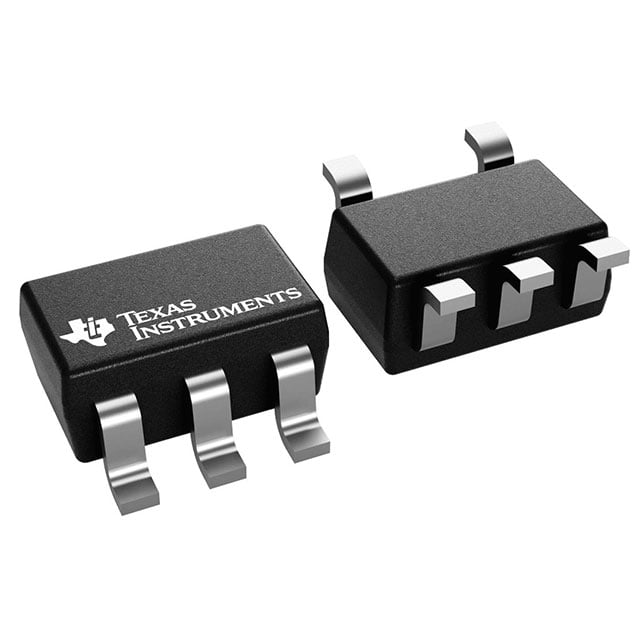
Key Specs
| Spec | Value | Condition | Source |
|---|---|---|---|
| Amplifier Type | Current Sense | Digi-Key | |
| Current Input Bias | 20 µA | Digi-Key | |
| Gain Bandwidth Product | 1.1 MHz | Digi-Key | |
| Mounting Type | Surface Mount | Digi-Key | |
| Number Of Circuits | 1 | Digi-Key | |
| Operating Temperature Range | -40°C ~ 125°C (TA) | Digi-Key | |
| Output Type | - | Digi-Key | |
| Package Case | 5-TSSOP, SC-70-5, SOT-353 | Digi-Key | |
| Quiescent Current (Typ) | 370µA | Digi-Key | |
| Slew Rate | 2V/µs | Digi-Key | |
| Supplier Device Package | SC-70-5 | Digi-Key | |
| Voltage Input Offset | 15 µV | Digi-Key | |
| Voltage Supply Span (Max) | 20 V | Digi-Key | |
| Voltage Supply Span (Min) | 2.7 V | Digi-Key |
When To Use
-
Precision current monitoring in low-voltage battery systems (3.3 V rail @ mA load): The INA280A3QDCKRQ1’s low input offset voltage of 15 µV and wide supply span down to 2.7 V make it ideal for accurately sensing small currents at low voltages without introducing significant error. Using a higher offset or higher minimum supply device would cause measurement drift and inaccurate current reporting, leading to erroneous power calculations or protection trips.
-
Thermally constrained space with limited airflow (-40°C to 125°C ambient): The quiescent current of only 370 µA combined with a maximum supply voltage of 20 V allows operation with minimal self-heating in compact surface-mount packages like SC-70-5. A device with higher quiescent current would risk thermal runaway or premature thermal shutdown in tight enclosures.
-
Current sense in moderately noisy industrial environments (up to 1.1 MHz bandwidth): The 1.1 MHz gain-bandwidth product and 2 V/µs slew rate ensure the INA280A3QDCKRQ1 can track fast current transients without significant phase lag or distortion. A slower amplifier would miss rapid current spikes, potentially causing protection circuits to react too late or fail to trigger.
When Not To Use
-
High current (>10 A) motor drive current sensing: The maximum input bias current of 20 µA and limited package power dissipation restrict practical current ranges. Use a high-current synchronous buck with external FETs controller that can handle large currents and ensure efficiency with external MOSFETs.
-
Battery-powered sensor nodes requiring ultra-low standby current: The 370 µA quiescent current is too high to preserve battery life in μA sleep-mode loads. Use a low-IQ PFM buck controller instead to minimize bias current in standby.
-
Switching frequency control above 500 kHz for size-constrained inductors: The 1.1 MHz gain-bandwidth product and slew rate limit response speed for high-frequency operation. Use a high-frequency buck controller designed specifically for switching frequencies above 500 kHz.
Application Notes
-
The INA280A3QDCKRQ1’s input bias current of 20 µA requires low-leakage PCB materials and clean soldering to avoid offset errors; guard rings around input traces reduce leakage currents.
-
Pins 2 and the current sense input terminals pin are noise-sensitive; route these traces away from high di/dt nodes and switching signals to minimize coupling-induced errors.
-
The SC-70-5 package thermal dissipation is limited; maintain copper pours under and around the device with multiple vias to the ground plane to improve thermal conduction.
-
Avoid placing high-frequency switching nodes (e.g., SW in adjacent converters) near the device to prevent injection of switching noise into the sense inputs.
-
The output stage is rail-to-rail but requires a stable supply between 2.7 V and 20 V; supply sequencing should ensure the device powers up within this range to prevent latch-up or output saturation.
Gotchas
-
[Input bias current interaction with high-value shunt resistors]: Designers often assume input bias current is negligible and choose large shunt resistors (e.g., >10 kΩ) to reduce power loss. The 20 µA bias current flowing through these resistors creates an offset voltage that skews the sensed current, causing persistent measurement error. Fix: Keep shunt resistor values low (<1 Ω) and verify offset voltage under actual bias current conditions.
-
[Incorrect layout causing input offset drift]: Routing the sense inputs (pins 2 and 3) near high-current switching nodes or digital lines induces capacitive and inductive coupling, resulting in erratic output fluctuations and noisy current readings. Fix: Use symmetrical differential routing, keep sense lines short, and shield or guard the traces with grounded copper.
-
[Power supply sequencing causing output saturation]: If the supply voltage ramps up slowly or undershoots below 2.7 V during power-on, the output stage may latch in a saturated state, appearing as a fixed high or low output voltage regardless of input. Fix: Ensure stable power supply startup above 2.7 V before enabling measurement or system operation.
-
[Output load capacitance destabilizing amplifier]: Large capacitive loads on the output pin can cause peaking or oscillations due to the 2 V/µs slew rate and internal compensation, leading to unstable or noisy current readings. Fix: Add a small series resistor (10–100 Ω) between output and capacitor or limit output capacitance to recommended values in the datasheet.