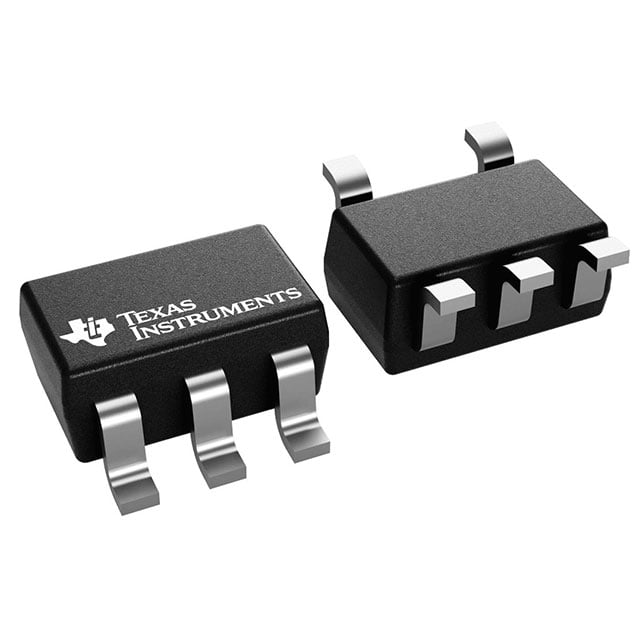
Key Specs
| Spec | Value | Condition | Source |
|---|---|---|---|
| Amplifier Type | Current Sense | Digi-Key | |
| Current Input Bias | 20 µA | Digi-Key | |
| Gain Bandwidth Product | 900 kHz | Digi-Key | |
| Mounting Type | Surface Mount | Digi-Key | |
| Number Of Circuits | 1 | Digi-Key | |
| Operating Temperature Range | -40°C ~ 125°C (TA) | Digi-Key | |
| Output Type | - | Digi-Key | |
| Package Case | 5-TSSOP, SC-70-5, SOT-353 | Digi-Key | |
| Quiescent Current (Typ) | 370µA | Digi-Key | |
| Slew Rate | 2V/µs | Digi-Key | |
| Supplier Device Package | SC-70-5 | Digi-Key | |
| Voltage Input Offset | 15 µV | Digi-Key | |
| Voltage Supply Span (Max) | 20 V | Digi-Key | |
| Voltage Supply Span (Min) | 2.7 V | Digi-Key |
When To Use
-
High-frequency switching converter current sensing → 12V @ 5A, 200kHz switching frequency: The 900 kHz gain bandwidth product is 20× higher than a 45kHz-class CSA, enabling meaningful current sensing at switching frequencies where the lower-bandwidth alternative has already rolled off past its −3dB point. A 45kHz-GBW CSA at a 200kHz switching frequency cannot resolve individual switching cycles — the sensed signal appears as a DC average, making cycle-by-cycle over-current protection impossible. The 2V/µs slew rate handles fast di/dt transients without output clipping.
-
Industrial 12–20V motor drive or power module in commercial-grade (non-automotive) designs: The 20V maximum supply covers 12V and 15V motor drive rails with transient headroom. For industrial designs where AEC-Q100 automotive qualification is not required, this commercial-grade IDCKR variant is the cost-appropriate choice over the automotive-qualified (AEC-Q100) version of this part. Both have identical electrical specifications — select QDCKRQ1 only when the assembly requires a qualified automotive part number on the BOM.
-
Wide supply range (2.7V to 20V) current limiting in multi-rail power systems: The 20 µA input bias current and 15 µV offset enable accurate low-side shunt sensing from 2.7V digital rails through 20V motor rails within a single design. The SC-70-5 package allows placement close to the shunt with minimal parasitic inductance. Avoid this part where the common-mode input voltage exceeds 20V — use an isolated or high-voltage CSA instead.
When Not To Use
-
High-side current sensing above 20 V supply: The maximum voltage supply span of 20 V limits operation in high-voltage rails beyond this range. Choose an isolated current-sense amplifier to handle higher voltages with galvanic isolation and prevent latch-up or damage.
-
Measuring pulsed currents with fast di/dt > 2V/µs slew rate: The 2 V/µs slew rate limits response to rapid transient currents, causing output distortion and delayed feedback. Use a higher-bandwidth current-sense amplifier designed for fast transient response to avoid undershoot or ringing.
-
Current measurement requiring sub-15 µV offset for µA-level sensing: The 15 µV input offset voltage may exceed the signal level in ultra-low current shunt applications, causing significant measurement error. Use a lower-offset current-sense amplifier to maintain accuracy in microampere current ranges.
Application Notes
-
At 900 kHz GBW, the input stage reacts to switching-frequency noise; decouple the supply pin with a 100nF ceramic capacitor placed within 2mm of the device, and add a 10Ω series resistor on the output if the downstream ADC input presents more than 100pF.
-
The 20 µA input bias current flows through the shunt resistor and creates a fixed offset of 20µA × R_shunt — at 1mΩ shunt this equals 20µV, comparable to the 15µV input offset spec. Total measurement error at zero current is up to 35µV differential. Size the shunt accordingly.
-
With 20V maximum supply, the SC-70-5 input pins may see up to 18V common-mode voltage. Ensure PCB trace clearance on input lines meets your design’s dielectric requirements at 20V to avoid creepage or leakage current paths.
-
The 370µA quiescent current at 20V equals 7.4mW continuous dissipation. Verify junction temperature in high-ambient (>85°C) applications using θJA ≈ 350°C/W typical for SC-70-5; at 7.4mW self-heating is ≈2.6°C above ambient — acceptable in most cases.
-
Input pins (differential pair) must connect symmetrically and as short as possible to the shunt resistor. At 900kHz GBW, a 10mm asymmetry in trace length between IN+ and IN− creates ≈6nH of differential inductance, causing peaking in the sense bandwidth that appears as output ringing on fast current transients.
Related Calculators
- Current Sense / Shunt Resistor Calculator — Size your shunt resistor for this amplifier
Gotchas
-
[Ignoring input bias current impact at low shunt resistance]: Designers often assume 20 µA input bias current is negligible, but when using very low-value shunt resistors (<1 mΩ), this current causes measurable voltage drop, shifting the sensed current. The output appears offset or drifts with temperature. Fix by selecting a shunt resistor value that balances power loss and input bias-induced error or calibrate offset in software.
-
[Layout placing input traces far apart]: Long or asymmetrical PCB traces to the shunt resistor cause imbalance and increased parasitic inductance, resulting in output ripple and measurement noise. This manifests as unstable or jittery output on the scope under load transients. Fix by routing input traces as short, symmetrical pairs with matched length and tight coupling.
-
[Assuming SC-70-5 package thermal dissipation equals larger packages]: The small SC-70-5 package restricts heat flow through the leads and PCB; under continuous high-current sensing conditions, device temperature may rise unnoticed causing gain drift or offset shift. The symptom is a slow drift in output voltage despite constant current. Fix by expanding PCB copper area under and around the device and verifying junction temperature with thermal measurements.
-
[Startup with no load current]: When the sensed current is zero or near zero at power-up, the output can settle at an undefined level due to input offset and bias currents, causing false triggering in downstream comparators or controllers. Fix by adding a minimum load or offset calibration step during system initialization.