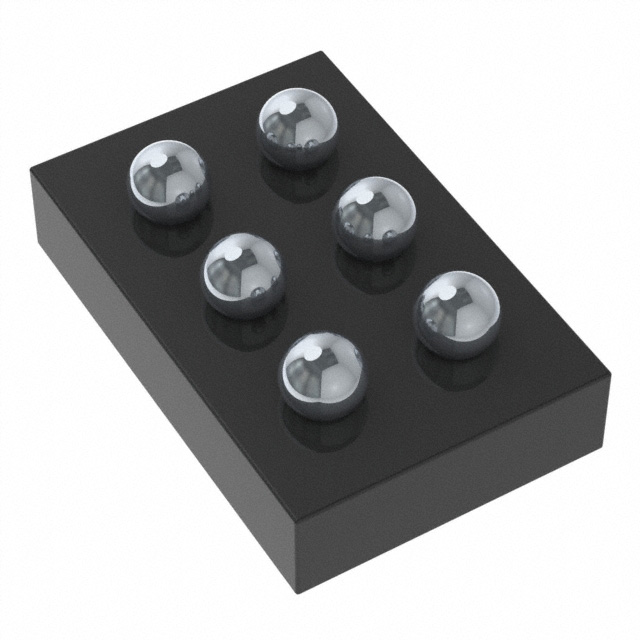
Key Specs
| Spec | Value | Condition | Source |
|---|---|---|---|
| Amplifier Type | Current Sense | Digi-Key | |
| Current Input Bias | 100 pA | Digi-Key | |
| Gain Bandwidth Product | 37 kHz | Digi-Key | |
| Mounting Type | Surface Mount | Digi-Key | |
| Number Of Circuits | 1 | Digi-Key | |
| Operating Temperature Range | -40°C ~ 125°C (TA) | Digi-Key | |
| Output Type | Rail-to-Rail | Digi-Key | |
| Package Case | 6-XFBGA, DSBGA | Digi-Key | |
| Quiescent Current (Typ) | 43µA | Digi-Key | |
| Slew Rate | 0.3V/µs | Digi-Key | |
| Supplier Device Package | 6-DSBGA (1.17x0.77) | Digi-Key | |
| Voltage Input Offset | 2.5 µV | Digi-Key | |
| Voltage Supply Span (Max) | 5.5 V | Digi-Key | |
| Voltage Supply Span (Min) | 1.7 V | Digi-Key |
When To Use
Use the INA191A2IYFDR in current sensing applications where low input bias current (100 pA) and rail-to-rail output are critical, such as battery management systems or motor control circuits. Its gain bandwidth product of 37 kHz suits low-frequency current monitoring, and the low quiescent current of 43 µA makes it ideal for low-power, surface-mount designs requiring a compact 6-DSBGA package. The device’s operating temperature range of -40°C to 125°C enables reliable use in industrial and automotive environments.
When Not To Use
Do not use the INA191A2IYFDR in high-frequency or high-speed current sensing applications that require gain bandwidth products significantly higher than 37 kHz, such as RF power amplifiers or fast switching power converters. In these cases, select a current sense amplifier with a higher gain bandwidth product and faster slew rate. Also avoid using this device in applications requiring supply voltages above 5.5 V or below 1.7 V, or where input bias currents greater than 100 pA are acceptable and cost is a primary concern.
Application Notes
The current sense input node must have the smallest possible loop area to minimize noise pickup and ensure measurement accuracy. The output pin is noise-sensitive and should be routed away from high-frequency switching nodes. Given the low quiescent current of 43 µA and the modest slew rate of 0.3 V/µs, the INA191A2IYFDR does not require a heatsink under typical operating conditions within the specified temperature range. Careful PCB layout and proper decoupling are recommended to maintain signal integrity.
Related Calculators
- Current Sense / Shunt Resistor Calculator — Size your shunt resistor for this amplifier
Gotchas
-
[Offset voltage drift with temperature spikes]: The nominal offset voltage is 2.5 µV, but transient temperature gradients across the package during board reflow or hot spots can cause temporary offset shifts beyond datasheet static values. This manifests as transient output errors during warm-up or under pulsed load conditions. Fix: Use uniform thermal mass around the device and avoid rapid temperature cycling during operation.
-
[Input bias current increase from PCB contamination]: The 100 pA input bias current relies on extremely clean PCB surfaces near the inputs. Residual flux or moisture leads to leakage paths that increase input bias current, causing offset errors and drift. Fix: Apply thorough cleaning and conformal coating with low ionic content around input pins.
-
[Output instability with excessive capacitive loading]: The device’s low gain bandwidth and slew rate make it prone to oscillations if large output capacitors or long output cables are used without series damping. This causes noisy or ringing output waveforms that can be misinterpreted as sensor faults. Fix: Add a small series resistor or reduce output capacitance per layout guidelines.
-
[Misinterpretation of “rail-to-rail” output]: Although the output swings rail-to-rail, it cannot source or sink large transient currents at the output pin due to internal stage limitations. This can cause output voltage droop or slow settling when driving low-impedance loads or cable capacitances. Fix: Buffer the output or ensure the load is high impedance to maintain linearity and response.