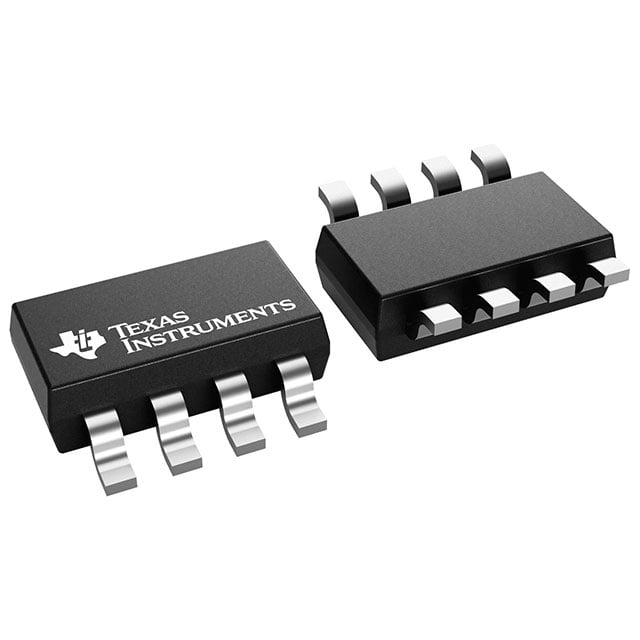
Key Specs
| Spec | Value | Condition | Source |
|---|---|---|---|
| Amplifier Type | Current Sense | Digi-Key | |
| Current Input Bias | 500 pA | Digi-Key | |
| Gain Bandwidth Product | 35 kHz | Digi-Key | |
| Mounting Type | Surface Mount | Digi-Key | |
| Number Of Circuits | 1 | Digi-Key | |
| Operating Temperature Range | -40°C ~ 125°C (TA) | Digi-Key | |
| Output Type | Rail-to-Rail | Digi-Key | |
| Package Case | SOT-23-8 Thin, TSOT-23-8 | Digi-Key | |
| Quiescent Current (Typ) | 48µA | Digi-Key | |
| Slew Rate | 0.3V/µs | Digi-Key | |
| Supplier Device Package | TSOT-23-8 | Digi-Key | |
| Voltage Input Offset | 3 µV | Digi-Key | |
| Voltage Supply Span (Max) | 5.5 V | Digi-Key | |
| Voltage Supply Span (Min) | 1.7 V | Digi-Key |
When To Use
-
Low-voltage battery current sensing, 3.3V @ 500mA: The very low input offset voltage of 3 µV and ultra-low input bias current of 500 pA enable precise current measurement at low voltages without offset drift. Using a general-purpose current sense amplifier with higher input bias would cause significant measurement error, especially at microamp-level loads, leading to inaccurate fuel gauge or protection thresholds.
-
Industrial motor current feedback, 5.5V supply max: The wide supply range from 1.7V to 5.5V and rail-to-rail output support direct interface with 3.3V or 5V microcontrollers in noisy industrial environments. A less robust amplifier with higher quiescent current or reduced supply range risks thermal runaway or latch-up from supply transients and elevated junction temperatures near the motor.
-
Precision overcurrent protection in compact SOT-23-8 space: With a quiescent current of only 48 µA and a small TSOT-23-8 package, this part fits tightly constrained PCB layouts while maintaining low power dissipation. Using a larger package or higher current amplifier would increase thermal stress or force board redesign due to space and power budget overruns, potentially causing early device failure.
When Not To Use
-
High-current (>5A) power stage current sensing: The limited gain bandwidth product of 35 kHz and low slew rate (0.3 V/µs) cannot handle fast transient currents or large dynamic ranges. Use a high-current synchronous buck with external FETs for accurate, high-speed current measurement and efficiency.
-
Switching frequency > 500 kHz in power conversion: The 35 kHz gain bandwidth product is insufficient for stable operation at high switching frequencies, causing output distortion or oscillation. Use a high-frequency buck controller designed for >500 kHz switching to avoid instability.
-
Battery-powered sensor with μA sleep-mode requirements: The typical quiescent current of 48 µA is too high to preserve battery life in ultra-low power designs. Use a low-IQ PFM buck regulator that can reduce quiescent current to single-digit microamps or less.
Application Notes
The INA190A3IDDFR is optimized for current sensing applications where the sense resistor node switches rapidly with load current changes; thus, the sense resistor and associated traces should have the smallest possible loop area to minimize parasitic inductance and noise pickup. The input pins are noise-sensitive and require careful PCB layout practices, including short, direct routing and proper grounding to maintain the specified input bias current of 500 pA and voltage offset of 3 µV. Due to the low quiescent current of 48 µA and low power dissipation, a heatsink is generally not required even at the maximum operating temperature of 125°C ambient. However, thermal considerations should be made based on resistor power dissipation and PCB thermal management.
Gotchas
-
[Bias current drift with temperature under low-level input]: Engineers may assume the 500 pA input bias current is constant across the full -40°C to 125°C range. In reality, input bias increases with temperature and can cause offset errors at low currents, resulting in unexpected output voltage drift.
Fix: Verify bias current vs. temperature from detailed curves in the datasheet and design margin accordingly; use shielded measurement methods to detect drift at operating temperature extremes. -
[Incorrect output loading causing slew-rate induced distortion]: Assuming the 0.3 V/µs slew rate is sufficient for fast transient currents leads to output slew rate limiting and distorted current indication during rapid load steps. This manifests as slow or clipped output waveform on the oscilloscope during current spikes.
Fix: Limit the output load capacitance and avoid heavy capacitive loads on the output; verify transient response with a scope during realistic load switching. -
[Ground reference noise coupling into input pins]: Routing the input pins on different ground potentials or sharing ground traces with high-current return paths causes common-mode noise injection, leading to jitter and erroneous output readings.
Fix: Use a dedicated low-noise ground plane segment for the amplifier inputs and star-ground return to minimize noise coupling. -
[Startup dead zone due to supply sequencing]: Powering the INA190A3IDDFR before its reference or supply rails stabilize can cause the amplifier to latch in an invalid output state, appearing as no output or stuck output voltage during bring-up.
Fix: Sequence supplies so the amplifier input common-mode and supply voltages are valid before enabling load current; add soft-start or power-good signals to control sequencing.
Related Calculators
- Current Sense / Shunt Resistor Calculator — Size your shunt resistor for this amplifier’s gain and V_ref