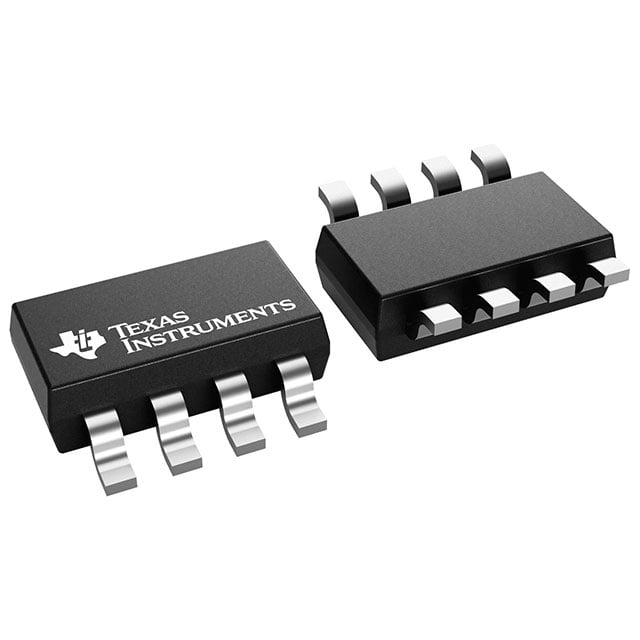
Key Specs
| Spec | Value | Condition | Source |
|---|---|---|---|
| Amplifier Type | Current Sense | Digi-Key | |
| Current Input Bias | 500 pA | Digi-Key | |
| Gain Bandwidth Product | 37 kHz | Digi-Key | |
| Mounting Type | Surface Mount | Digi-Key | |
| Number Of Circuits | 1 | Digi-Key | |
| Operating Temperature Range | -40°C ~ 125°C (TA) | Digi-Key | |
| Output Type | Rail-to-Rail | Digi-Key | |
| Package Case | SOT-23-8 Thin, TSOT-23-8 | Digi-Key | |
| Quiescent Current (Typ) | 48µA | Digi-Key | |
| Slew Rate | 0.3V/µs | Digi-Key | |
| Supplier Device Package | TSOT-23-8 | Digi-Key | |
| Voltage Input Offset | 3 µV | Digi-Key | |
| Voltage Supply Span (Max) | 5.5 V | Digi-Key | |
| Voltage Supply Span (Min) | 1.7 V | Digi-Key |
When To Use
Use the INA190A2IDDFR in applications requiring accurate current sensing with low input bias current (500 pA) and low quiescent current (48 µA), such as battery management systems, power supply monitoring, and motor control. Its rail-to-rail output and wide operating supply voltage range (1.7 V to 5.5 V) make it suitable for low-voltage, low-power systems where space-saving surface mount packages like TSOT-23-8 are preferred. The moderate gain bandwidth product of 37 kHz fits well in systems with relatively low-frequency current sensing requirements.
When Not To Use
Do not use the INA190A2IDDFR in high-frequency current sensing applications exceeding 37 kHz bandwidth, such as switching power supplies operating in the MHz range; instead, select a current sense amplifier with a higher gain bandwidth product. Avoid this device in environments requiring operation beyond the –40°C to 125°C temperature range or where input bias currents higher than 500 pA are acceptable and lower cost components suffice. For applications needing integrated shunt resistors or multi-circuit configurations, choose an alternative device with those features.
Application Notes
The current sense resistor node is the switching node and must have the smallest possible loop area to minimize inductive noise and improve measurement accuracy. The amplifier’s input pins are noise-sensitive and should be routed away from high-frequency or high-current switching signals. The device’s quiescent current of 48 µA typically eliminates the need for a heatsink under normal operating conditions within the –40°C to 125°C temperature range. Careful placement of a 0.1 µF ceramic decoupling capacitor near the power supply pin is recommended to ensure stable operation and low noise performance.
Related Calculators
- Current Sense / Shunt Resistor Calculator — Size your shunt resistor for this amplifier
Gotchas
-
Incorrect PCB layout causing noise coupling:
If the engineer routes the input current sensing traces with large loop areas or places noisy switching nodes near the input pins, the amplifier may pick up interference, causing inaccurate current measurements.
Fix: Keep the current sense resistor and amplifier input traces as short and close together as possible, minimizing loop area. Shield sensitive input pins from noisy signals. -
Operating outside the specified supply voltage range:
Applying supply voltages below 1.7 V or above 5.5 V can cause the amplifier to malfunction or permanently damage the device.
Fix: Ensure the supply voltage stays within the 1.7 V to 5.5 V range during all operating conditions, including transient events. -
Ignoring input bias current impact in high-impedance sensing:
Using very high-value shunt resistors without considering the 500 pA input bias current can introduce offset errors in current measurements.
Fix: Select shunt resistor values that balance voltage drop and input bias current error, or compensate for offset in system calibration.