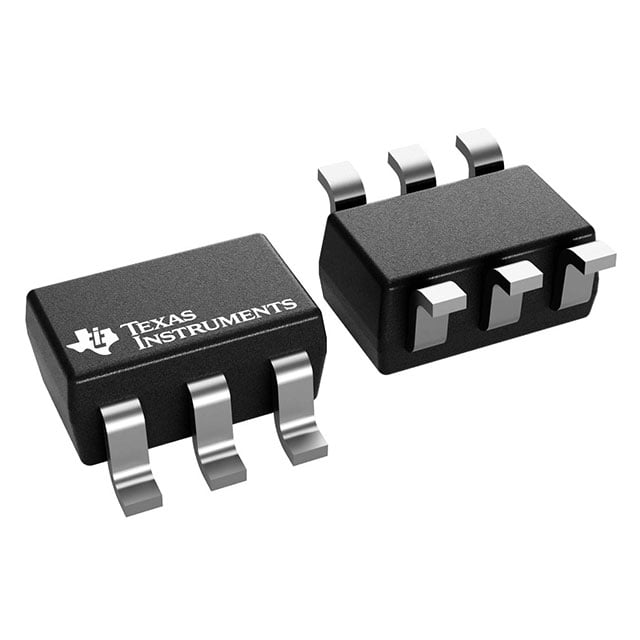
Key Specs
| Spec | Value | Condition | Source |
|---|---|---|---|
| Amplifier Type | Current Sense | Digi-Key | |
| Current Input Bias | 500 pA | Digi-Key | |
| Gain Bandwidth Product | 37 kHz | Digi-Key | |
| Mounting Type | Surface Mount | Digi-Key | |
| Number Of Circuits | 1 | Digi-Key | |
| Operating Temperature Range | -40°C ~ 125°C (TA) | Digi-Key | |
| Output Type | Rail-to-Rail | Digi-Key | |
| Package Case | 6-TSSOP, SC-88, SOT-363 | Digi-Key | |
| Quiescent Current (Typ) | 48µA | Digi-Key | |
| Slew Rate | 0.3V/µs | Digi-Key | |
| Supplier Device Package | SC-70-6 | Digi-Key | |
| Voltage Input Offset | 3 µV | Digi-Key | |
| Voltage Supply Span (Max) | 5.5 V | Digi-Key | |
| Voltage Supply Span (Min) | 1.7 V | Digi-Key |
When To Use
-
Battery-powered current sensing in 1.7 V to 5.5 V rails: The low quiescent current of 48µA combined with a wide supply voltage range down to 1.7 V make this part ideal for monitoring current in low-voltage battery-powered systems. Higher bias current amplifiers would drain the battery prematurely, causing early system failure.
-
Precision current measurement with minimal offset drift: The extremely low input offset voltage of 3 µV and ultra-low input bias current of 500 pA enable accurate sensing of small currents without significant error. Using a general-purpose current sense amplifier with higher offset would result in inaccurate current readings and potential false fault triggers.
-
Thermally constrained surface-mount applications: The SC-70-6 package with a maximum operating temperature of 125°C supports dense PCB layouts where thermal dissipation is limited. Using a package with higher quiescent current or less favorable thermal characteristics could lead to thermal runaway in tight enclosures.
When Not To Use
-
High-frequency switching power supplies above 500 kHz: The 37 kHz gain-bandwidth product and 0.3 V/µs slew rate limit the INA190A2IDCKR’s ability to track rapid current changes accurately. Use a high-frequency buck controller instead for switching frequencies exceeding 500 kHz.
-
Applications requiring galvanic isolation for safety or noise immunity: This device has no isolation barrier and cannot handle common-mode voltages beyond supply range. Use an isolated flyback solution where galvanic isolation is mandatory.
-
Systems with extremely low quiescent current budgets (sub-µA sleep modes): The 48µA quiescent current is too high for ultra-low power applications where battery life depends on µA or nA standby currents. Use a low-IQ PFM buck or dedicated ultra-low-power current sense solution instead.
Application Notes
-
Keep the input current sense resistor and connections as close to the amplifier’s input pins as possible to minimize parasitic inductance and noise pickup, especially since the input bias current is only 500 pA.
-
The output is rail-to-rail, but ensure the supply voltage remains within 1.7 V to 5.5 V to avoid output clipping or distortion under load transients.
-
Pin numbering matters: input pins (typically pins 2 and 3) are noise sensitive. Use ground planes and guard traces around these pins to reduce interference, especially in high-current switching environments.
-
Avoid routing switching nodes (SW) traces near the INA190A2IDCKR’s input pins to prevent capacitive coupling that could cause output instability or offset errors.
-
Because of the modest 37 kHz gain-bandwidth product, use appropriate low-pass filtering on the output if measuring rapidly changing currents to avoid aliasing or signal distortion.
Gotchas
-
[Offset drift under temperature extremes]: Engineers may assume the 3 µV input offset voltage is constant across temperature, but offset can vary significantly near the -40°C and 125°C limits. This causes apparent current measurement drift in cold or hot environments, leading to false alarms or missed faults.
Fix: Characterize offset drift across temperature during validation and implement offset compensation or calibration in firmware. -
[Layout-induced input bias current increase]: Routing high-impedance nodes without guarding can cause leakage currents far exceeding the specified 500 pA input bias, distorting low-current measurements. This manifests as a static offset offset on the output that does not track input current.
Fix: Use guard rings tied to low-impedance nodes around input traces and maintain clean PCB cleanliness to minimize leakage. -
[Startup under minimum supply voltage]: Applying supply below the 1.7 V minimum or slow ramp-up can cause the amplifier’s output to saturate or behave erratically during power-on, leading to incorrect initial current readings or latch-up conditions.
Fix: Ensure supply voltage ramps above 1.7 V before enabling sensing circuitry, and verify with scope that output settles correctly on startup. -
[Output instability from high ESR capacitors]: Using output filtering capacitors with high Equivalent Series Resistance (ESR) can introduce phase shifts and oscillations due to the low gain-bandwidth product and slew rate, causing noisy or oscillatory output signals.
Fix: Choose low-ESR ceramic capacitors for output filtering and validate stability with transient response tests.
Related Calculators
- Current Sense / Shunt Resistor Calculator — Size your shunt resistor for this amplifier’s gain and V_ref